A lead list building tool turns an ideal customer profile into a list of contacts with verified emails, ready to export or send. If you build lists in code, through an agent or at volume, the tool you pick sets your bill and your pace.
Most roundups rank the interface. This one ranks the filters, the counting step and the meter behind them. We put the same job to each tool on paper: size a list of VP-level sales leaders in Canada, export it, then price 1M records in a month. We then checked the API, the MCP server and the rate limit. This is a desk test of list prices and vendor docs, not a live lookup race, and it says so wherever a number is not public.
Some tools below have a LeadOcean head-to-head: Apollo, ZoomInfo, Clay, Cognism, UpLead and Crustdata. New to the term? Start with what a lead list is. Prices are list prices, checked in September 2026.
TL;DR
LeadOcean wins when you build lists through an API or an agent, or at volume. Apollo wins when reps build and work lists in one app. Clay wins on workflows that mix many providers. ZoomInfo and Cognism win on signals and mobile numbers, at a quote.
| Tool | Best for | Starting price | Cost at 1M records a month |
|---|---|---|---|
| LeadOcean | APIs, agents and volume | Free ($0, 1,000 records for life), then $97 a month | $497 a month (Agency), fair-use pace, no credits |
| Apollo | Reps who build and work lists in one app | $65 per seat a month, billed monthly ($49 billed yearly) | $24,750 a month (250 Professional seats); $19,600 billed yearly (400 Basic seats) |
| ZoomInfo | Enterprise teams that want intent and signals | GTM AI data credits from $20, $0.45 each at the base tier | No public 1M price |
| Clay | Table workflows over many providers | $185 a month, billed monthly ($167 billed yearly) | No public 1M price |
| Cognism | Phone-verified mobiles, especially in Europe | No public price. Quote only | No public 1M price |
| UpLead | One rep who wants verified emails and a Chrome extension | $99 a month, billed monthly ($74 billed yearly) | No public 1M price |
| Crustdata | Live web data and change watchers | No public plan price | No public 1M price |
What we evaluated
Every tool got the same five questions, in this order.
- Filters and a free count. How many filters can you stack, and can you see the size of a list before you spend a record on it?
- Cost at 1M records a month. One record is one contact on your list. We use the vendor's list price and say "No public 1M price" when none exists. We never multiply a rate out to 1M.
- Export and list size. How many rows leave in one request, and is bulk CSV on the entry plan?
- API and MCP. Is there a documented REST API on the entry plan, and does the vendor run its own hosted MCP server that an agent can call?
- Rate limit. How many requests can one key send, and does the number come from the vendor's own docs?
1. LeadOcean: best for API, agent and volume buyers
LeadOcean is a people and company data API with a hosted MCP server and no credits. It holds 693M people (366M with an email, 166M with a phone number) and 67M companies in one database (LeadOcean pricing, October 2026).
You build a list in three steps. Count the audience for free: leadocean_count_leads over MCP, or a search with count=true and limit=1 over REST. Search it with POST /v1/people/search (50 people filters) or POST /v1/companies/search (34 company filters). Then pull it with POST /v1/exports. On 30 September 2026, the count for VP-level sales leaders in Canada was 5,066 mailable contacts (verified, catch_all_valid and catch_all, count_leads). A company-side count is free too, with GET /v1/companies/count.
The MCP server at https://api.leadocean.io/mcp has 13 tools and signs in with OAuth 2.1, so an agent can size, search and export without a pasted key. The app at app.leadocean.io has an Exports page with a filter builder, a column picker and a price preview before you start. One search pages to 10,000 rows, so you narrow the filters instead of walking the index.
Pros
- Counts are free, so you size a list before you spend a record.
- Flat monthly price. Agency is $497 a month with a fair-use pace, no credits and no overage invoice.
- 13-tool hosted MCP server on every plan, including Free.
- Bulk CSV export is included on paid plans. Agency exports 50,000 rows a file.
- Email status on every record, with 13 values from
verifiedtospam_trap.
Cons
- It is a data layer only. There is no sequencer, dialer, CRM, Chrome extension or rep workspace.
- Bulk CSV export is not on the Free plan.
- One dataset, not a waterfall. A mobile number we lack is not fetched from a second source.
- No intent data. Funding and technology filters are the nearest signals.
Best for: engineers, RevOps teams and agents that build lists in volume and want a fixed bill.
Pricing: Free $0 (1,000 records for life), Solo $97 a month, Agency $497 a month, Platform $1,997 a month. LeadOcean pricing, October 2026.
2. Apollo: best for reps who build and work lists in one app
Apollo is the default list builder for sales teams. The list, the sequence and the inbox live in one app. It reports 240 million contacts and 30 million companies (Apollo pricing, September 2026).
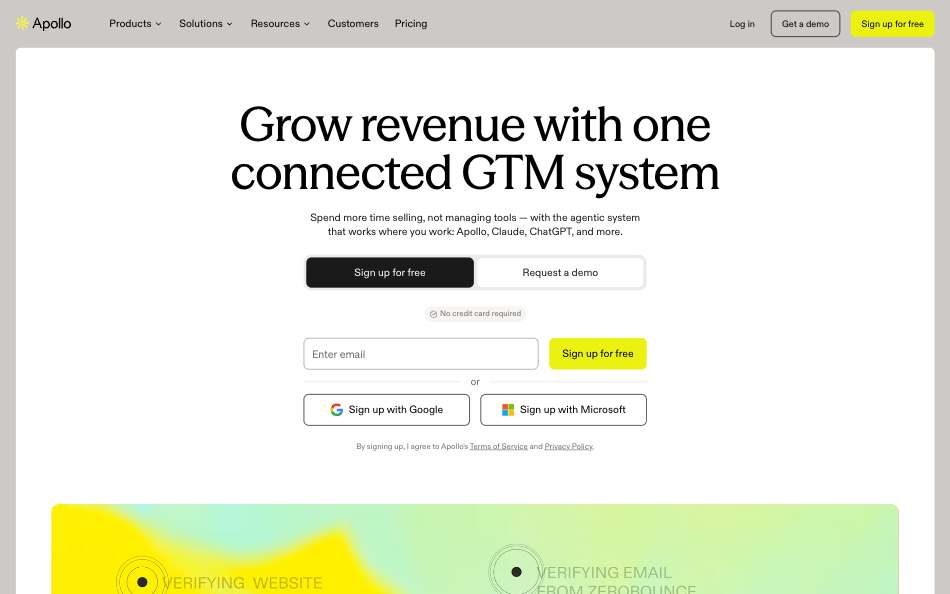
Credits are the meter. An email costs 1 credit and a phone number costs 8. Credits are pooled across the team, expire at the end of each billing cycle and do not roll over (Apollo API pricing, September 2026). The record selection limit per action is 25 on Free, 1,000 on Basic, 2,500 on Professional and 10,000 on Organization. A big list is pulled in batches (Apollo pricing, September 2026).
Every plan includes API access, and Apollo runs an official MCP server at https://mcp.apollo.io/mcp on any plan, Free included (Apollo developer docs, September 2026). Enrichment endpoints reach 1,000 requests a minute on paid plans, and people search reaches 200 a minute and 50,000 a day (Apollo rate limits, September 2026).
Pros
- One app for list, sequence, dialer and inbox.
- Free plan with API and MCP access.
- Official hosted MCP server, also a built-in connector in Claude and ChatGPT.
- Pooled credits across a team.
Cons
- Per-seat pricing. A 1M-credit month is 250 Professional seats at list price.
- Credits expire each cycle, and the price of extra credits is not public.
- A phone number costs 8 credits, so a phone list costs far more than an email list.
- Selection limits mean large lists are pulled in batches.
Best for: sales teams that prospect and send from the same tool.
Pricing: Free $0 with 75 credits a month. Basic $65, Professional $99 and Organization $149 per seat a month, billed monthly. Billed yearly: $49, $79 and $119. Apollo pricing, September 2026. See the Apollo alternative page.
3. ZoomInfo: best for enterprise teams that want intent and signals
ZoomInfo is the enterprise suite, and its platform plans are annual contracts quoted by sales. Its newer GTM AI product sells data as pay-as-you-go credits and is the one you can price in public (GTM AI pricing, September 2026).
On GTM AI, search, lookup and find-similar are free. One data credit enriches or exports one company, contact or intent record, and a record is charged once per 12 months (GTM AI docs, September 2026). The list price falls from $0.45 a credit at 100 credits to $0.25 at 100,000 credits ($25,000). The slider stops there. Anything larger goes to Enterprise.
The free tier gives 1,000 data credits and 1,000 AI credits, with API, MCP and CLI access and 5 requests a second. Audiences on the free tier hold 5 x 500 rows. Batch enrichment takes 25 records per call and search pages stop at 100 (GTM AI docs, September 2026). ZoomInfo's platform prices sit behind a human check, so this page uses GTM AI's public prices only.
Pros
- Free search and lookup on GTM AI. You pay only to enrich or export.
- Intent and buying signals are part of the product.
- Official MCP server for Claude, ChatGPT and Cursor.
- Credits do not expire while the account is active.
Cons
- No public price at 1M. Past 100,000 credits it is a quote.
- Platform plans are quoted by sales, with no public price.
- 25 records per batch call makes a large list a long loop.
- 5 requests a second on the free tier. Higher limits are by request.
Best for: enterprise sales teams that want intent data and signals on top of the list.
Pricing: GTM AI credits from $20, $0.45 each at the base tier down to $0.25 at 100,000 credits. GTM AI pricing, September 2026. See the ZoomInfo alternative page.
4. Clay: best for table workflows over many providers
Clay is a spreadsheet that builds lists from many data providers and runs enrichment as columns. It has no dataset of its own and sources from 150+ data partners (Clay pricing, September 2026).
Two meters apply. Actions run each step and Data Credits pay for the data. Launch starts at $185 a month billed monthly with 15,000 Actions and 2,500 Data Credits. Growth starts at $495 a month. Clay's own doc says a fully enriched record typically costs 6 to 20 Data Credits (Clay docs, September 2026). Tables cap at 50,000 rows on Launch and Growth, and 200 rows on Free (Clay docs, September 2026).
The Public API and CLI are on every plan, Free included. The HTTP API column, which calls an outside API from a table, starts on Growth (Clay docs, September 2026). Clay also runs an MCP server (Clay MCP guide, September 2026). The Public API has a per-workspace rate limit with no published number (Clay developer docs, September 2026).
Pros
- Combines many providers in one table, with waterfalls.
- No-code. Ops people can edit columns and watch each row run.
- Public API and CLI on every plan, including Free.
- A failed enrichment is charged nothing.
Cons
- Two meters (Actions and Data Credits) make cost hard to predict.
- Tables cap at 50,000 rows on Launch and Growth.
- No public price at 1M. The largest self-serve tier tops out at 200,000 Actions a month.
- Published rate limit: none.
Best for: RevOps and growth teams that build multi-step list workflows without code.
Pricing: Free $0, Launch from $185 a month ($167 billed yearly), Growth from $495 a month ($446 billed yearly), Enterprise by quote. Clay pricing, September 2026. See the Clay alternative page.
5. Cognism: best for phone-verified mobiles, especially in Europe
Cognism is a sales intelligence platform built around phone-verified mobiles and European data. It publishes no dollar price and describes its database as "hundreds of millions" of profiles (Cognism FAQ, September 2026).
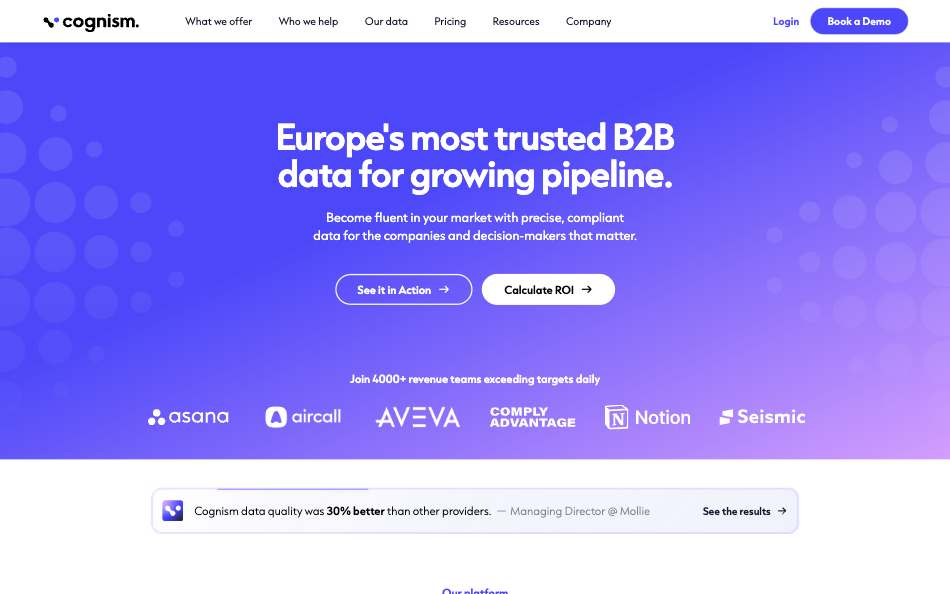
One credit reveals one contact, and each seat carries an allocation. Viewing a contact you already revealed is free (Cognism pricing, September 2026). Plans are Standard and Pro, five seats each, and Pro adds intent data and on-demand mobile verification.
The API takes 13 person filter fields and 21 company filter fields. Search pages run 1 to 100 records, with cursor pagination up to 100,000 records per journey (Cognism API reference, September 2026). The limit is 500 requests a minute per account, per operation (Cognism rate limits, September 2026). The MCP server has 15 tools and OAuth 2.0 sign-in (Cognism docs, September 2026).
Pros
- Phone-verified mobiles and Do Not Call checks in 15 territories.
- Intent data on Pro.
- Hosted MCP server with search and count tools.
- Cursor pagination to 100,000 records per journey.
Cons
- No public price. You cannot size a 1M-record job before a sales call.
- Seat-based credits suit a rep team, not a pipeline.
- API and MCP need a package that includes them.
- Its own docs disagree on whether a count call costs a search token (Cognism credits docs, September 2026).
Best for: sales teams that dial mobiles and sell into Europe.
Pricing: Quote only. Standard and Pro are listed without prices. Cognism pricing, September 2026. See the Cognism alternative page.
6. UpLead: best for one rep who wants verified emails and a Chrome extension
UpLead is a verified-contact database sold in credits, with real-time email checks. It states over 200 million contacts with email addresses and over 19 million company profiles (UpLead data page, September 2026).
Essentials is $99 a month for 170 credits. Plus is $199 for 400. Extra credits cost $0.60 and $0.50. Purchases are capped at $2,000 a day, about 124,000 extra credits in a 31-day month (UpLead help center, September 2026). A credit is spent on an email only when its status is Valid or Accept All.
API access is on Professional only, a custom annual quote. The API allows 500 requests a minute (UpLead API docs, September 2026). UpLead's docs mention no MCP server.
Pros
- You pay for an email only if it is Valid or Accept All.
- Unmatched enrichment rows are refunded.
- Over 50 search filters, a Chrome extension and CRM integrations on paid plans.
- Public prices for the two entry plans.
Cons
- The API is on Professional only.
- No MCP server in its docs.
- One user on Essentials and Plus.
- A $2,000 a day cap on extra credits makes a 1M pull impossible through public purchase.
Best for: a single rep or small team that prospects in the app and sends a few hundred contacts a month.
Pricing: Essentials $99 a month ($74 billed yearly), Plus $199 ($149 billed yearly), Professional by quote. UpLead pricing, September 2026. See the UpLead alternative page.
7. Crustdata: best for live web data and change watchers
Crustdata is a data API with its own index of people, companies, jobs and posts, sold on credits. It lists no plan names and no dollar price per credit (Crustdata pricing, September 2026).
Search costs 0.03 credits per result. Person enrich is 1 to 7 credits, and a work-email lookup is 2 credits on a self-serve key (Crustdata docs, September 2026). Watchers re-check people and companies for changes, at 5 credits per changed record on a 30-day cycle. Purchased credits expire 12 months after purchase.
The hosted MCP server is at https://install.crustdata.com/mcp with OAuth sign-in (Crustdata docs, September 2026). Default limits are 15 requests a minute on enrich and 30 on search. Batch person enrich takes up to 10,000 identifiers a job (Crustdata rate limits, September 2026).
Pros
- Live data and watchers for job changes and new records.
- Hosted MCP server with OAuth.
- Cheap search at 0.03 credits a result.
- Batch jobs of up to 10,000 identifiers.
Cons
- No public dollar price, so cost at 1M is a quote.
- 15 requests a minute on enrich is slow for a big list.
- The contact endpoint with a 1-credit email lookup needs an enterprise plan.
- Company count claims differ on its own homepage.
Best for: teams that build lists from web signals and need to know when a record changes.
Pricing: Credit-based, quote only. Crustdata pricing, September 2026. See the Crustdata alternative page.
Comparison table
| Tool | Best for | Starting price | Cost at 1M records a month | API | MCP | Rate limit |
|---|---|---|---|---|---|---|
| LeadOcean | APIs, agents and volume | Free, then $97 a month | $497 a month (Agency) | Every plan | Yes, 13 tools | 5, 50, 200 or 10,000 a second by plan |
| Apollo | Reps in one app | $65 per seat a month | $24,750 a month; $19,600 billed yearly | Every plan | Yes, official | 1,000 a minute enrich; 200 search |
| ZoomInfo | Intent and signals | Credits from $20 | No public 1M price | GTM AI, all tiers | Yes | 5 a second (free tier) |
| Clay | Multi-provider workflows | $185 a month | No public 1M price | Every plan; HTTP column from Growth | Yes | Not published |
| Cognism | Mobiles in Europe | Quote only | No public 1M price | By package | Yes, 15 tools | 500 a minute |
| UpLead | One rep, verified emails | $99 a month | No public 1M price | Professional only | None in docs | 500 a minute |
| Crustdata | Live web data | Quote only | No public 1M price | Yes | Yes | 15 a minute enrich; 30 a minute search |
How to choose
- You build lists in code or with an agent: LeadOcean. Free counts, a 13-tool MCP server and a flat bill.
- You want one app for list, sequence and calls: Apollo. Budget for seats and credits.
- You need intent data and have an enterprise budget: ZoomInfo, through GTM AI if you want a public price.
- You chain providers in a table: Clay. Plan for two meters.
- You dial mobiles in Europe: Cognism. Ask for a quote at your volume.
- You are one rep with a few hundred contacts a month: UpLead.
- You need to know when records change: Crustdata, with LeadOcean as the first-pass list.
Verdict
For API, agent and volume buyers, LeadOcean is the pick: you size the list for free, export 50,000 rows a request and pay $497 a month on Agency's fair-use pace. Apollo wins for sales teams that work lists in the app. Clay wins for table workflows, ZoomInfo for intent, Cognism for mobiles and UpLead for a single rep. Crustdata wins when freshness matters more than price. Start with LeadOcean's free counts, then compare the list you get against your current tool.
FAQ
What is a lead list building tool?
It is software that takes your ideal customer profile and returns a list of matching contacts with emails and, sometimes, phone numbers. Good ones show the size of the list before you pay for it.
Which tool is cheapest at 1M records a month?
LeadOcean Agency is $497 a month on a fair-use pace. Apollo's list price for 1M credits is $24,750 a month on monthly billing. The other five publish no price at that volume, so we do not give one.
Can an AI agent build a lead list?
Yes, through a hosted MCP server. LeadOcean, Apollo, ZoomInfo, Clay, Cognism and Crustdata each run one. UpLead's docs mention none. An agent should count first, then search, then export.
Do I need a free count before buying a list?
Yes. A free count tells you whether the filters are too wide or too narrow before you spend a record. LeadOcean's counts are free. ZoomInfo's GTM AI search is free. Credits on other tools may apply to searches.
Is a bigger database always better?
No. Filter depth and email status matter more. Read the status on each record and set your own risk line before you send.
Can I build a list for free?
LeadOcean Free gives 1,000 records for life with every feature and no card. Apollo Free gives 75 credits a month. ZoomInfo's GTM AI gives 1,000 data credits at signup. See list building with LeadOcean or the lead list builder skill.
Build your first lead list with a free count
Free to start. No credit card. 1,000 records to spend whenever you like.
Get your free API key →