People leave Apollo.io for its data, not its app. Seats cost $49 (Basic), $79 (Professional) or $119 (Organization) a month, billed annually, and the credits on them expire each billing cycle (Apollo pricing, September 2026). Record selection is capped at 25 on Free and 2,500 on Professional. The plans are for internal business use only.
The API adds a second squeeze. General endpoints allow 200 requests a minute and 2,000 a day on Basic and Professional (Apollo API docs, September 2026). A pipeline, an agent or a product built on the data hits that ceiling first.
This list ranks seven alternatives by fit for API and volume buyers, with the cost of 1M records a month for each. For a two-way comparison, read LeadOcean vs Apollo. For API-only options, see Apollo API alternatives.
TL;DR
| Tool | Best for | Starting price | Cost at 1M records a month |
|---|---|---|---|
| LeadOcean | Code, agents and volume pulls | Free (1,000 records, one-off). Pro $499 a month. | $499 flat. |
| BlitzAPI | Flat-rate email data for outbound teams | $399 a month (Blitz) | $499 (Plus, emails) or $599 (Full, US phones). |
| People Data Labs | Dataset licences and the widest record count | Pro from $98 a month (PDL) | No public 1M price. Above about 100,000 profiles a year it is quote only. |
| Crustdata | Live signals and agent workflows | From $95 a month, reported by a Crustdata blog post, not shown on the pricing page (Crustdata blog) | No public price. 1M work-email lookups is 2,000,000 credits on /person/enrich, or 1,000,000 on the enterprise-only contact endpoint (Crustdata pricing docs, September 2026). |
| Coresignal | Company, jobs and employee datasets | Mini $49 a month (Coresignal) | No public 1M price for work-email lookups (20M credits). About $10,000 derived at the Elite rate, not published. 1M Base records is $5,000 (Elite, 10M credits). |
| FullEnrich | Waterfall email and phone on your own list | Pro from $29 a month (FullEnrich) | Contact sales. About $35,000 at the top listed rate. |
| Clay | GTM engineers building workflows | Launch from $185 a month (Clay) | No public 1M price. Enterprise quote. $50,000 at $0.05 a credit, at list rate, if sold at that volume. |
For scale, Apollo at 1M emails a month is $24,750 a month on monthly billing (250 Professional seats at $99, 4,000 credits each) or $19,600 a month billed yearly (400 Basic seats at $49, 2,500 credits each). That is 1 credit per email (Apollo pricing, September 2026). Every figure in the last column is list-price arithmetic at one credit per record, not a quote.
What we evaluated
- Access in code. A documented REST API on the plan you would buy, and whether an MCP server returns records or only docs.
- Rate limits. Requests per second or per minute on the default plan, because a 1M pull is a rate-limit problem first.
- Price model. Seats, credits or a flat fee, and what 1M records a month costs at list price.
- Coverage. Published counts of people, companies, emails and phone numbers, from the vendor's own pages.
- Terms. Fair use, credit expiry and whether you can build a product on the data.
1. LeadOcean: best for engineers, agents and volume pulls
LeadOcean is our product. It is first here for one reader only: the one who pulls data in code or through an agent. It is the data layer and nothing else. You search 693M people and 63M companies, enrich one record at a time and export up to 50,000 rows per request with POST /v1/exports.
The price is flat. Free gives you 1,000 records, one-off, with no card. Pro is $499 a month, with no credits, no per-record price and no overage invoice. Rate limit is 100 requests per second per key on every plan, including Free. A very large month is paced down to one request a minute until the reset, and one email to support raises the headroom.
The MCP server has 12 tools, signs in with OAuth 2.1 and works on Free. Counts are free, so you size a pull before you spend a record.
curl "https://api.leadocean.io/v1/people/search?jobLevel=VP&country=CA&limit=1&count=true" \
  -H "x-api-key: $LEADOCEAN_API_KEY"
Pros
- Flat $499 a month at any volume, with the same API and MCP server on the free plan.
- 100 requests per second per key, which is 6,000 a minute.
- 366M people with an email and 166M with a phone number, with an email status on every record.
- A miss on
POST /v1/people/enrichis a 404 and costs nothing. - 12 MCP tools, including free
count_leadsandlist_filters.
Cons
- No rep workspace, sequences, dialer or Chrome extension. Export to your own sequencer.
- No intent data or job-change signals of its own.
- Past the fair-usage line a very large month is paced down rather than cut off.
Best for: Engineers, RevOps and agent builders who want a fixed bill and an API that does not throttle a bulk job.
Pricing: Free, then Pro at $499 a month. See LeadOcean pricing.
2. BlitzAPI: best for outbound teams that want flat-rate email data
BlitzAPI sells unlimited use of a B2B data API for a flat monthly fee. There are three plans. Core is $399 without emails or phones, Plus is $499 with verified work emails, and Full is $599 with US phone numbers (Blitz pricing, September 2026). Blitz says every endpoint is unlimited once you subscribe, with no per-request fee (Blitz docs, September 2026).
The speed is the catch to read closely. Accounts opened by September 30, 2026 get 50 requests per second, and standard accounts run at 5 (BlitzAPI pricing, September 2026). The Terms say later plans carry the limits stated on the website or order form at subscription (BlitzAPI Terms, September 2026). Limits for accounts opened later are not published, so confirm what a new account gets today.
Blitz lists 550M+ profiles, 65M+ companies, 65M+ verified emails and 45M+ US phone numbers. Blitz's MCP server connects an assistant to its documentation, not to data (Blitz MCP docs, September 2026).
Pros
- Three flat prices and no per-request fee, so 1M emails a month costs the plan price.
- Company search, people search, job postings, reverse lookups and TAM endpoints on every plan.
- 1,000 free credits with no card to test.
- Client work is included without a separate agreement.
Cons
- Phone numbers are US only and only on the $599 plan.
- The MCP server exposes docs, not records, so an agent still needs REST.
- Building a product on the data needs Blitz Embedded, from $2,000 a month on an annual agreement.
Best for: Agencies and cold email teams feeding a sequencer with verified US and global work emails.
Pricing: $399, $499 or $599 a month, flat (Blitz pricing, September 2026).
3. People Data Labs: best for dataset licences and the widest record count
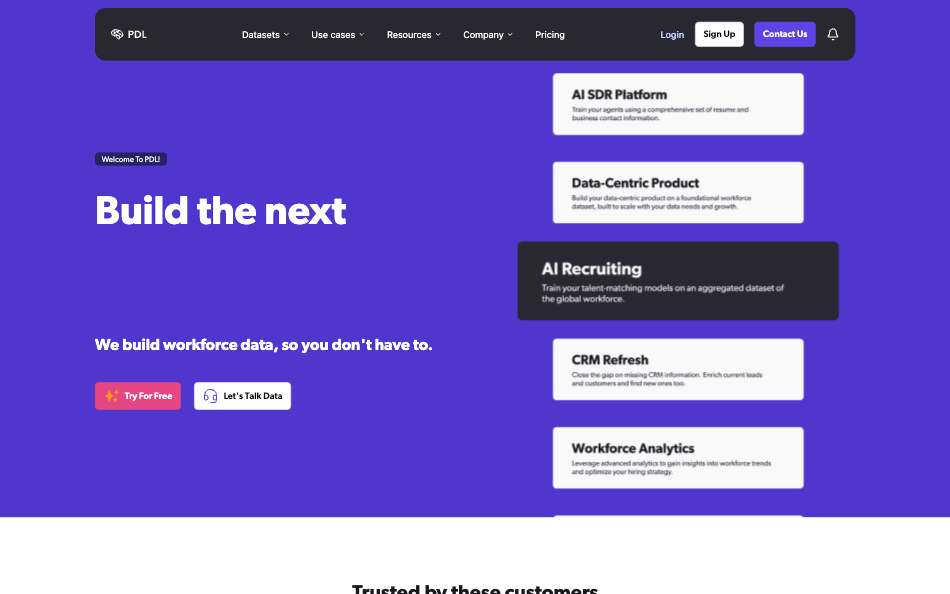
People Data Labs (PDL) is the largest database on this list by record count. Its All dataset holds 2.47 billion person profiles, and 592M of them have an email (PDL datasets, September 2026). If you want files in your own warehouse, PDL sells annual data licences as well as the API.
The API is per record. Pro starts at $98 a month for 350 credits, and PDL puts Pro profiles at about $0.20 to $0.28 each. Enrichment costs one credit per successful match, search costs one credit per profile returned, and requests that match nothing are not billed (PDL docs, September 2026). PDL says volume above 100,000 records needs a sales conversation.
Rate limits are the pinch. Person Search defaults to 10 requests a minute (PDL search docs, September 2026). Enrichment allows 1,000 a minute on paid accounts (PDL enrichment docs, September 2026).
Pros
- 2.47 billion person profiles, more than any other tool here.
- Annual data licences delivered as files.
- A failed lookup costs nothing.
- Mature docs, SDKs and ISO and SOC 2 Type 2 compliance on the pricing page.
Cons
- Per-record pricing climbs fast, and there is no public 1M price. Above about 100,000 profiles a year it is quote only.
- Contact data is obfuscated on the free plan and unlocks on Pro.
- Person Search defaults to 10 requests a minute.
- No first-party MCP server that we could find. none listed in PDL's docs index (PDL docs, September 2026).
Best for: Teams that license data in bulk, or need the biggest profile count and accept per-record prices.
Pricing: Free up to 100 records a month, Pro from $98 a month for 350 credits, Enterprise on request (PDL pricing, September 2026).
4. Crustdata: best for live signals and agent workflows
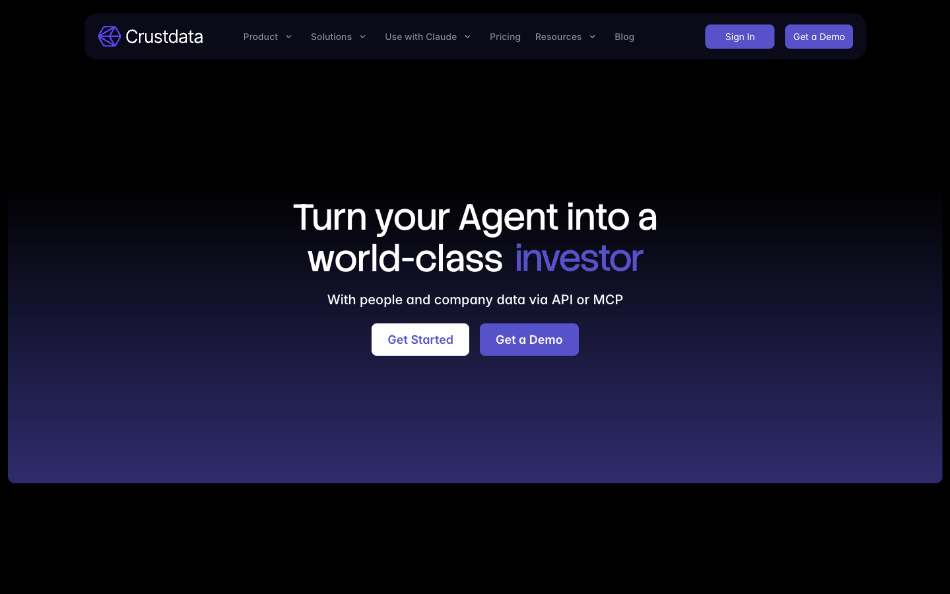
Crustdata is a data API with live signals on people, companies, jobs and posts. Its homepage claims 1B people (Crustdata, September 2026). The pitch is fresh data and change alerts, where Apollo sells a static database.
Pricing is credits, and the dollar value of a credit is not public. Search costs 0.03 credits per result. Person enrich costs 1 to 7 credits, and a work-email lookup is 2 (1 base plus 1 business email). Company enrich costs 2 to 4, and a person watcher costs 5 credits per changed profile (Crustdata pricing docs, September 2026). Crustdata's own blog reports the lowest tier at $95 a month, and the pricing page does not show it (Crustdata blog, September 2026).
The hosted MCP server is at https://install.crustdata.com/mcp (Crustdata MCP docs, September 2026). Default rate limits are per endpoint: 15 requests a minute for person enrich and 30 for search (Crustdata rate limits, September 2026).
Pros
- Cheap discovery at 0.03 credits per search result, and
/company/identifyis free. - Change watchers for people, companies, jobs and posts.
- Hosted MCP server that works with Claude and Cursor.
- Purchased credits last 12 months.
Cons
- No public dollar price per credit, so you cannot forecast a month without asking.
- Low default limits: 15 a minute on person enrich.
- Contact enrichment for emails and phones is on Enterprise plans.
Best for: AI SDR builders and teams that need change alerts on accounts and champions.
Pricing: Credit-based, from $95 a month as reported by Crustdata's blog (Crustdata, September 2026). No public dollar price per credit (Crustdata pricing docs, September 2026).
5. Coresignal: best for company, jobs and employee datasets
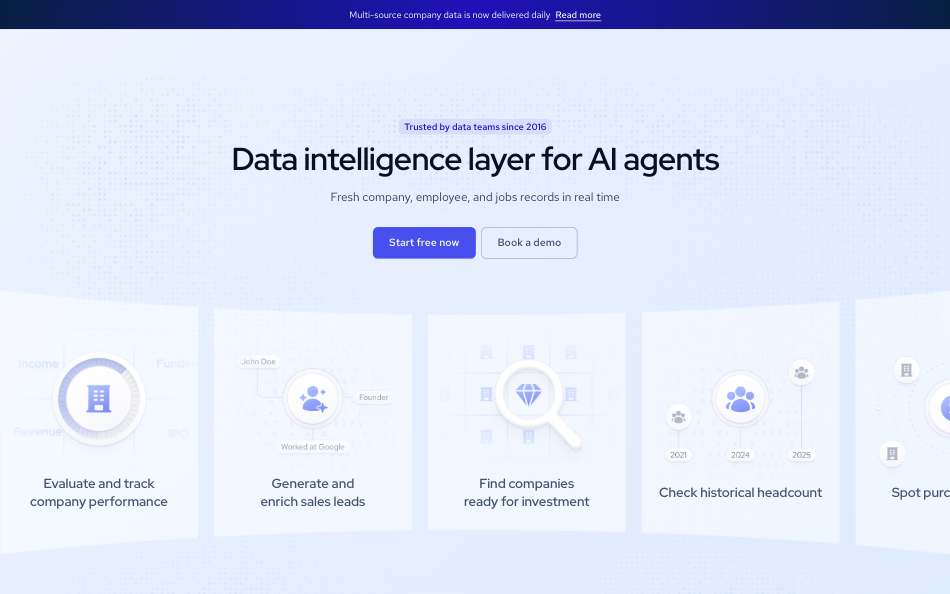
Coresignal sells employee, company and job-posting data as a credit plan, and claims 4.5B+ records (Coresignal, September 2026). It is built for research, investment and recruiting use cases more than for outbound contact data. Emails come from a separate Contact Enrichment API at 20 credits each.
The plans run from Mini at $49 a month for 2,500 credits to Elite at $5,000 for 10M. A base employee or company record costs 10 credits and a multi-source record 20. So 1M base records is 10M credits, which is one Elite month at $5,000. 1M work-email lookups is 20M credits, which no public plan covers. Two Elite months would be about $10,000 at list rate, a derived figure and not a published price.
The rate limit rises with the plan: 5 requests per second on Mini and Starter, 50 on Premium and 100 or more on Elite (Coresignal rate limits, September 2026). Its MCP server at https://mcp.coresignal.com/mcp/v2 signs in with OAuth 2.1 and asks you to confirm before a costly pull (Coresignal MCP docs, September 2026).
Pros
- Fresh company, employee and jobs data with Elasticsearch DSL and webhooks.
- Published rate limits on every plan, up to 100 or more requests per second.
- The MCP server shows credit cost and pauses before large pulls.
- A 3-month credit rollover on Premium and above.
Cons
- Contact details cost extra. Emails run through a separate endpoint at 20 credits.
- Mini and Starter run at 5 requests per second.
- Credits scale with record type, so a multi-source pull at 1M records exceeds the Elite plan.
Best for: Analysts and product teams that need firmographic, hiring and employee datasets at scale, not contact data for outreach.
Pricing: Mini $49 to Elite $5,000 a month (Coresignal pricing, September 2026).
6. FullEnrich: best for waterfall email and phone on a list you already have
FullEnrich is an enrichment layer, not a single database. It queries 25+ providers in turn and charges only for data it finds and verifies (FullEnrich pricing, September 2026). A work email is 1 credit, a personal email 3 and a mobile phone 10. A lookup that finds nothing is free.
Pro starts at $29 a month for 500 credits. The price per credit falls from $0.058 to $0.035 at 100,000 credits a month, and anything above that is a sales conversation (FullEnrich pricing, September 2026). Users are unlimited on every plan.
The API allows 60 calls a minute, with up to 100 contacts in each bulk request, so 6,000 contacts a minute (FullEnrich rate limits, September 2026). An MCP server is included in Pro (FullEnrich MCP, September 2026).
Pros
- Pay only for found and verified emails and phones.
- Phone numbers come from a waterfall, not a single source.
- MCP server and API on every paid plan, with unlimited users.
- Credits roll over for 3 months on monthly plans.
Cons
- Credits scale with records. 1M work emails a month is above the published 100,000-credit tier.
- A mobile number costs 10 credits, so phone-heavy pulls get expensive.
- 60 calls a minute, so a large job depends on bulk batches of 100.
Best for: Teams that already have a list and want the best match rate on emails and mobiles, paid per find.
Pricing: Free trial with 50 credits, Pro from $29 a month, Enterprise custom (FullEnrich pricing, September 2026).
7. Clay: best for GTM engineers building multi-provider workflows
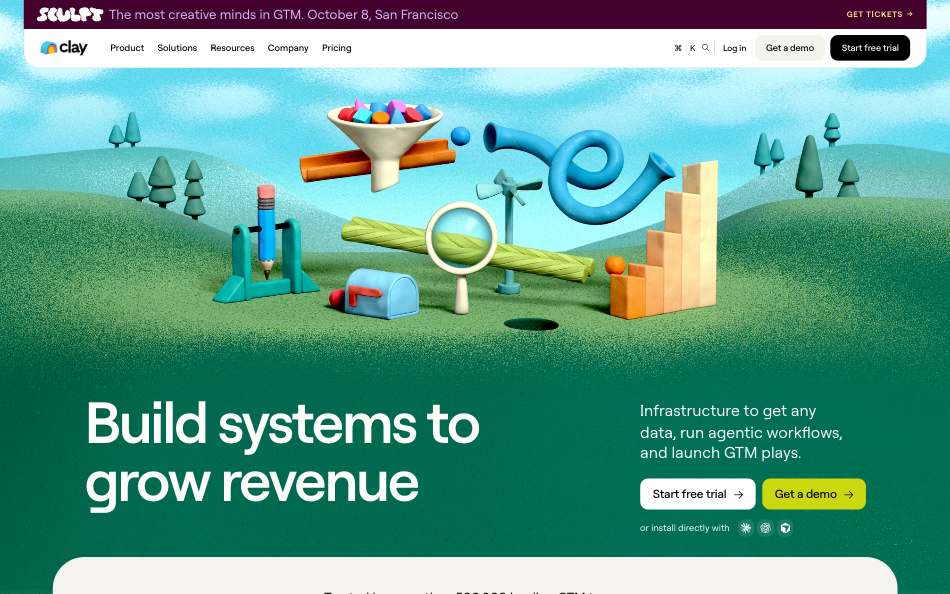
Clay is a workflow platform that buys data from 150+ providers on your behalf. That is a different job from a data API. You build tables, waterfalls and agents, and Clay spends credits at each step (Clay pricing, September 2026). It ranks last here because it is not built for bulk API pulls.
There are two meters. Data Credits buy the data and start at $0.05 each. Actions meter the platform work. Launch starts at $185 a month and Growth at $495. Enterprise is custom priced on an annual commitment. The Public API and CLI are on every plan, including Free. The HTTP API column, which calls out of Clay, starts on Growth, and table queries are Enterprise (Clay API docs, September 2026).
Clay MCP exposes its providers and your workflows inside Claude, ChatGPT and Codex (Clay MCP guide, September 2026). Clay publishes no rate limit for its API.
Pros
- 150+ data providers and waterfalls in one workspace.
- Clay MCP for reps who work in Claude or ChatGPT.
- A free plan with 100 Data Credits and 500 Actions a month.
- Bring your own provider keys to skip Data Credits.
Cons
- Two meters, Data Credits and Actions, make cost hard to forecast.
- The HTTP API column, which calls out of Clay, starts on Growth. Table queries through the API are Enterprise.
- No published API rate limit.
Best for: GTM engineers who want to orchestrate many providers and AI research in one place.
Pricing: Free, Launch from $185, Growth from $495, Enterprise custom (Clay pricing, September 2026).
Comparison table
| Tool | Best for | Starting price | Cost at 1M records a month | API | MCP | Rate limit |
|---|---|---|---|---|---|---|
| LeadOcean | Code, agents and volume pulls | Free. Pro $499 a month. | $499 flat. | REST on every plan, including Free | Yes. 12 tools, OAuth 2.1, returns records. | 100 requests per second per key |
| BlitzAPI | Flat-rate email data | $399 a month | $499 to $599 | REST on every plan | Docs only (Blitz) | 50 per second for accounts opened by September 30, 2026, 5 on standard (Blitz pricing) |
| People Data Labs | Dataset licences, record count | Pro from $98 a month | No public 1M price. Quote only above about 100,000 profiles a year | REST on Free and Pro | none listed in PDL's docs index (PDL docs, September 2026) | Enrichment 1,000 a minute, Person Search 10 a minute |
| Crustdata | Live signals | From $95 a month (reported by Crustdata's blog) | No public price. 2,000,000 credits for 1M work-email lookups | REST, credits | Yes (Crustdata) | 15 a minute person enrich, 30 search |
| Coresignal | Company and jobs datasets | Mini $49 a month | No public 1M price. About $10,000 derived for emails; $5,000 for 1M Base records | REST, credits | Yes, OAuth 2.1 | 5 to 100+ per second by plan |
| FullEnrich | Waterfall enrichment | Pro from $29 a month | Contact sales | REST, credits | Yes, on Pro | 60 calls a minute, 100 contacts per bulk call |
| Clay | Workflows | Launch from $185 a month | No public 1M price. Enterprise quote. | All plans (Public API and CLI). HTTP API column from Growth | Yes | Clay enforces a per-workspace limit on the Public API and publishes no number, returning 429 with a Retry-After header when you exceed it (Clay developer docs, September 2026). |
Every non-LeadOcean cell comes from the vendor pages linked in its section, checked in September 2026. Prices change, so confirm before you buy.
How to choose
- You pull data in code, at volume, on a fixed bill: LeadOcean, or BlitzAPI if you only need emails and US phones. Both are flat.
- You run a cold email agency: BlitzAPI Plus at $499, or LeadOcean if you also want an MCP server that returns records.
- You need the biggest profile count or files in your warehouse: People Data Labs. Budget for per-record prices.
- You build agents that react to changes: Crustdata. Ask for the dollar price per credit first.
- You study companies, jobs or employees, not contact data: Coresignal.
- You have a list and want the best email and mobile match rate: FullEnrich.
- You build multi-provider workflows with a GTM engineer: Clay.
- Your reps live in Apollo all day: keep Apollo for the workspace and sequences, and move bulk pulls elsewhere. See LeadOcean vs Apollo.
Verdict
LeadOcean wins for API, agent and volume buyers because it is the only option here with a flat price, 100 requests per second and an MCP server that returns records, all on the free plan. BlitzAPI is the closest flat-rate rival if your use is email-led outbound. People Data Labs wins on record count and dataset files. Crustdata wins on live signals, Coresignal on firmographic and jobs data, FullEnrich on match rate per find and Clay on workflow building. None of them replaces Apollo's rep workspace, so teams with reps should keep Apollo and change only where the data comes from. See also the Apollo API alternatives comparison.
FAQ
What is the best Apollo.io alternative for API access?
For a flat price and high rate limits, LeadOcean and BlitzAPI. LeadOcean allows 100 requests per second per key on every plan. Apollo's API is on every plan, including Free, and its general endpoints allow 200 requests a minute on Basic and Professional (Apollo API docs, September 2026).
Is there a free Apollo.io alternative with an API?
Yes, several have a free way in. LeadOcean Free gives 1,000 records, one-off, with no card and the same API and MCP server as Pro. Blitz offers 1,000 credits, PDL up to 100 records a month and FullEnrich 50 credits. Clay's Free plan includes the Public API and CLI, capped at 50 search results per request and 100 a month. It has no HTTP API column (Clay API docs, September 2026).
Why is Apollo expensive at volume?
Credits are sold on seats. Basic is $49 a seat a month with 30,000 credits a year, or 2,500 a month, so one email costs about $0.02 (Apollo pricing, September 2026). A phone number costs 8 credits, about $0.16.
Can I keep Apollo and add another data source?
Yes, and it is the cheapest change. Pull bulk lists from an API source, then import the CSV into Apollo for sequencing and calling. Reps keep their workspace and the volume work leaves the credit meter.
Which Apollo alternatives have an MCP server?
LeadOcean, Crustdata, Coresignal, FullEnrich and Clay all publish one that returns data. Blitz's MCP server covers its documentation only. For PDL, see the open check in the comparison table.
Can I build a product on these data sources?
Check each vendor's terms first. Apollo's standard plans are for internal business use, and products on its data need a separate agreement (Apollo pricing, September 2026). Blitz sells a separate Embedded plan from $2,000 a month for that case (Blitz pricing, September 2026).
Related: LeadOcean vs Apollo, Apollo API alternatives, LeadOcean pricing. Back to all alternatives.
Replace Apollo's credit meter with one flat API. Start free.
Free to start. No credit card. 1,000 records to spend whenever you like.
Get your free API key →