Company data enrichment takes a domain or a company name and returns the firmographics behind it: industry, headcount, location, funding and technology. Developers, RevOps teams and agencies need it when a CRM, a scoring model or an agent has to act on accounts it knows nothing about.
Most buyers leave their current tool for one of three reasons. The price per lookup is unpublished, credits expire, or the plan stops short of the volume they need. Crustdata publishes credits, not dollars. People Data Labs sends company buyers above about 400,000 profiles a year to sales. Clay caps self-serve at 200,000 Actions a month. If you are replacing one of them, see our pages on Crustdata, People Data Labs, Coresignal, Apollo, ZoomInfo and Clay. Below: seven tools, one real test, and what a million lookups costs on each.
TL;DR
| Tool | Best for | Starting price | Cost at 1M records a month |
|---|---|---|---|
| LeadOcean | API, agent and volume buyers | Free ($0, 1,000 records for life), then $97 a month | $497 a month (Agency, fair-use pace) |
| Crustdata | Signals and live company data | Credits only, no public dollar price | No public 1M price |
| People Data Labs | Raw company records by API | Company Pro from $100 a month ($80 billed yearly) | No public 1M price |
| Coresignal | Company and job datasets | $49 a month (Mini) | No public 1M price |
| Apollo | Sales teams that want a UI | $0, then $65 a seat a month ($49 billed yearly) | $24,750 a month at list, monthly billing |
| ZoomInfo | Enterprise sales orgs | Data credits from $20 (GTM AI) | No public 1M price |
| Clay | No-code enrichment workflows | $0, Launch from $185 a month | No public 1M price |
What we evaluated
- Company coverage. How many company records the vendor states, and which filters reach them.
- Access. REST API, official MCP server, and the rate limit you get on a paid plan.
- Price model. Plan price, credits per company lookup, and whether credits expire.
- Cost at 1M records a month. The settled list price, or "No public 1M price". We never multiply a rate out.
- Fit. Whether a developer or an agent can use it without a sales call.
A real test: sizing a company list
Accurate insight starts with knowing how many accounts you can actually reach. On 21 October 2026 we ran the free LeadOcean company count (the leadocean_count_companies MCP tool, behind GET /v1/companies/count). The filters: industry Software Development, HQ country US, headcount 51-200 or 201-500.
- Companies matching: 11,577 (9,261 in 51-200 and 2,316 in 201-500).
- Of those, companies with at least one mailable contact (hasMailableContacts, meaning a verified, catch_all_valid or catch_all email): 7,793.
- The count cost 0 records. The total is exact, with breakdowns by state and NAICS code.
That is a sizing result, not a find-rate benchmark. We have not run the same filter on the other six tools, and we do not claim they would return less.
1. LeadOcean: best for API, agent and volume buyers
LeadOcean is a people and company data API with a hosted MCP server. The dataset holds 693M people and 67M companies, with 34 company filters including industry, headcount range, HQ country, technology category (about 7.8M crawled sites) and funding. POST /v1/companies/enrich takes a domain and returns the company record. /v1/companies/search filters a list, and GET /v1/companies/{domain}/people returns who works there.
The pricing is the point. One record is one person or one company you receive. A miss costs nothing, and so do counts, filter lookups and usage calls. Paid plans have a fair-use pace, not credits, so nothing expires. Agency at $497 a month allows 1M enrichments a day at 200 requests a second. One search pages to 10,000 rows, and bulk CSV export is on every paid plan.
It is not a rep workspace. There is no sequencer, dialer, CRM or Chrome extension. The app at app.leadocean.io has an Exports page with a filter builder, column picker and a price preview, and that is all. If your team lives in a sales UI, pick Apollo or ZoomInfo.
Pros
- Free company count with exact totals and breakdowns by industry, headcount, state and NAICS.
- Flat plan price, no credits to top up and no expiry.
- Official MCP server with 13 tools, OAuth 2.1, on every plan.
- 5, 50, 200 and 10,000 requests a second by plan.
- Same data and every feature on the Free plan: 1,000 records, no card.
Cons
- No sales UI, sequencer or CRM.
- Free is a one-off 1,000 records, not a monthly allowance, and bulk CSV export is not on Free.
- The free people count (
leadocean_count_leads) does not take revenue, HQ city or funding filters, so size those people lists at search time.
Best for: developers, agencies and agent builders who enrich accounts through an API at volume.
Pricing: Free $0; Solo $97 a month; Agency $497 a month; Platform $1,997 a month (LeadOcean pricing, checked 21 October 2026).
2. Crustdata: best for live company signals
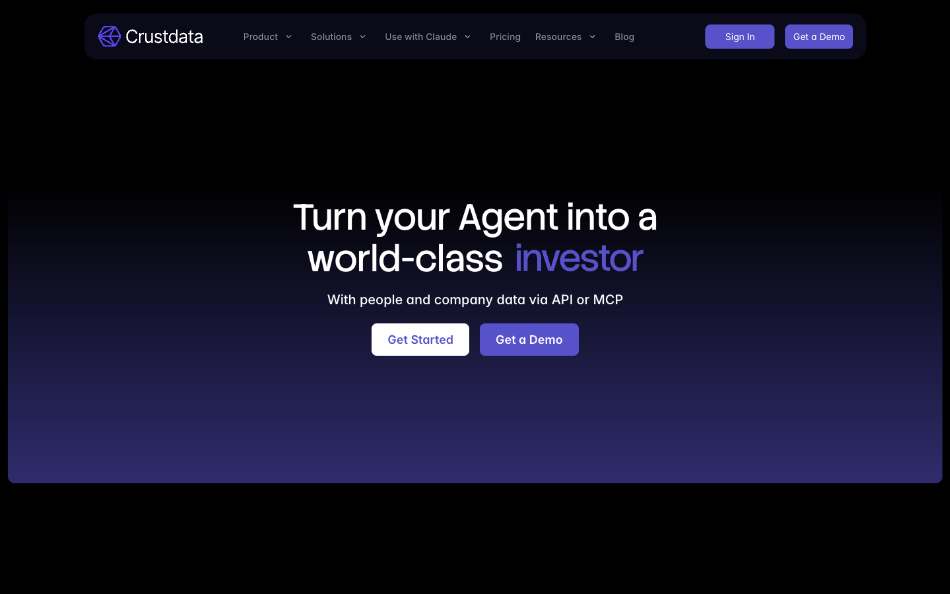
Crustdata sells company and people data with a focus on change signals. Company enrich costs 2 to 4 credits a call, company search is 0.03 credits per result, and company identify and autocomplete are free. Watchers alert you when a company record changes, at 5 credits per changed company on a 30-day SLA (Crustdata pricing docs, September 2026).
The catch is the price. The pricing page lists no plan names, dollar prices or price per credit, and says to confirm costs in the dashboard (Crustdata pricing, September 2026). A Crustdata blog post reports a lowest tier of $95 a month, but the pricing page does not list it. Credits expire 12 months after purchase per the docs, though a July 2026 blog post says 6 months. Confirm the term before you buy in bulk.
Default rate limits are low for volume: 15 requests a minute on company enrich (Crustdata rate limits, September 2026). A hosted MCP server exists at install.crustdata.com/mcp (Crustdata MCP docs, September 2026).
Pros
- Free company identify and autocomplete calls.
- Change watchers for company records.
- Official MCP server with OAuth.
Cons
- No public dollar price per credit.
- 15 requests a minute on company enrich by default.
- Credit expiry is stated two ways on Crustdata's own sites.
Best for: teams that need alerts when target companies change.
Pricing: credits only, no public dollar price (Crustdata pricing, September 2026).
3. People Data Labs: best for raw company records by API
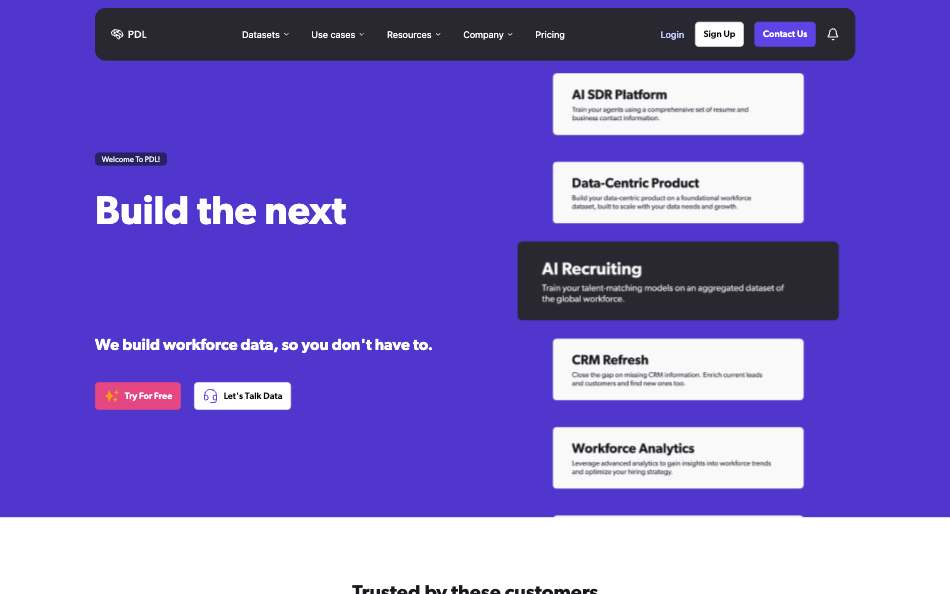
People Data Labs (PDL) states 76,606,079 company records (PDL company stats, September 2026). It is an API-first vendor: you send a name, domain or LinkedIn URL and get a record, or search with a query.
Company Pro starts at $100 a month for 1,000 records a month, or $960 a year billed yearly (PDL company pricing, September 2026). PDL advises Enterprise above 400,000 company profiles a year, so there is no public 1M price. Requests that return nothing are not billed. Paying plans get 1,000 company enrichment requests a minute (PDL usage limits, September 2026).
PDL has no official MCP server. Only community servers exist, which PDL does not publish (PDL llms.txt, September 2026).
Pros
- Large stated company dataset.
- Misses are not billed.
- 1,000 company enrichment requests a minute on paid plans.
Cons
- 1,000 records for $100 a month is a small entry allowance.
- No official MCP server.
- Search is 10 requests a minute by default.
Best for: engineers who want raw company JSON and can talk to sales at volume.
Pricing: Pro company data from $100 a month (PDL pricing, September 2026).
4. Coresignal: best for company and job datasets
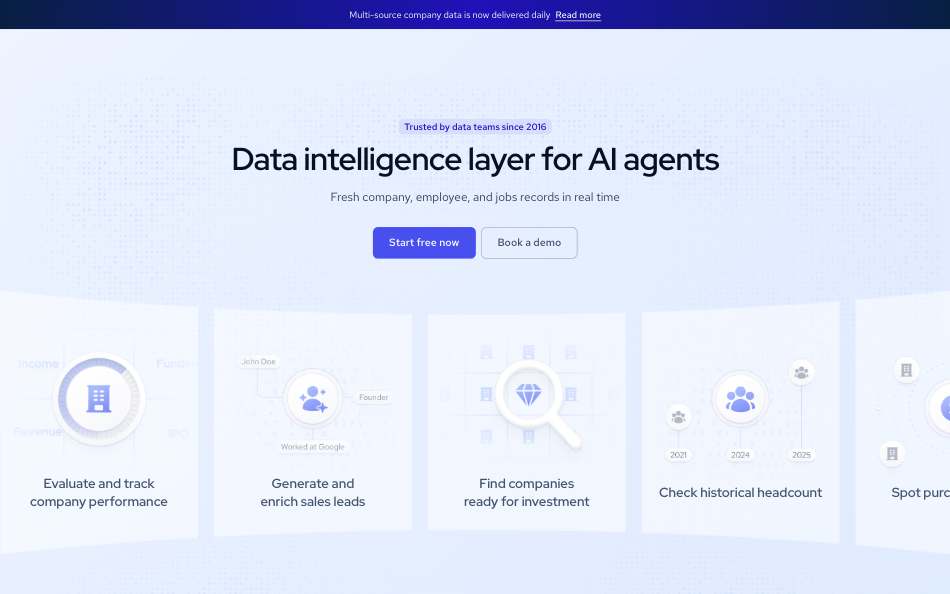
Coresignal claims 70M+ company records and 482M+ job postings on its homepage (Coresignal, September 2026). It is the pick when firmographics and hiring signals matter more than contact data.
Plans run from Mini at $49 a month (2,500 credits) to Elite at $5,000 a month (10,000,000 credits), billed yearly at 10% off (Coresignal pricing, September 2026). A Base or Clean company record costs 10 credits, a multi-source record 20. At 10 credits a record, the top public plan covers about 1M Base company records a month, but Coresignal publishes no 1M price, and we do not claim one.
Rate limits climb with the plan, from 5 requests a second on Mini to 100+ on Elite (Coresignal rate limits, September 2026). The MCP server has 5 tools and uses OAuth 2.1 (Coresignal MCP docs, September 2026).
Pros
- Company and job posting data in one place.
- Clear credit table per record type.
- Official MCP server.
Cons
- Credits per record are high at the entry tiers.
- Only Premium, Scale and Elite roll credits over for 3 months.
- No public 1M price.
Best for: analysts and data teams that build on company and hiring datasets.
Pricing: from $49 a month (Coresignal pricing, September 2026).
5. Apollo: best for sales teams that want a UI
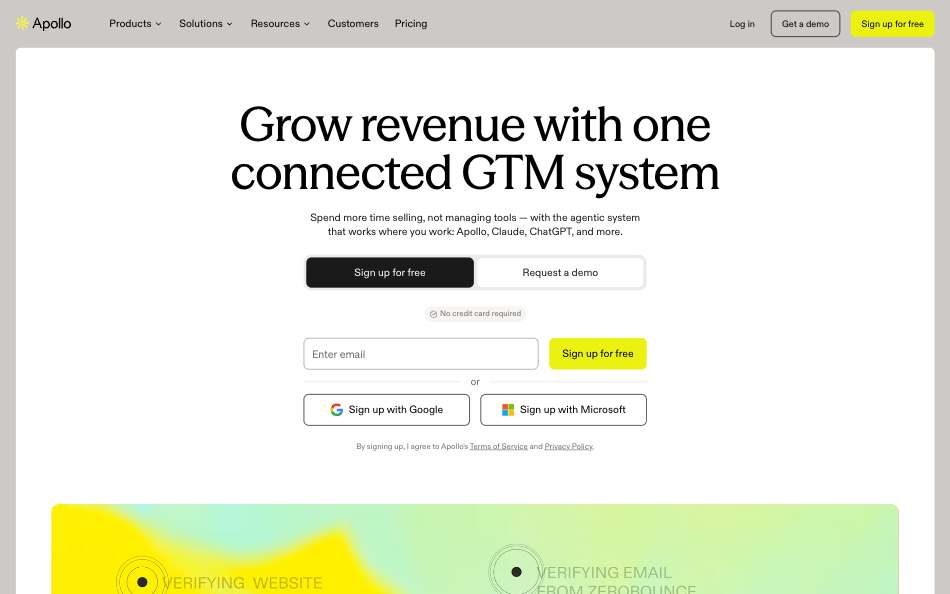
Apollo is a sales platform with a database behind it. Organization enrichment by API is 1 credit, and every plan includes API access (Apollo API pricing, September 2026).
Pricing is per seat. Basic is $65 a seat a month with 2,500 credits, Professional $99 with 4,000 and Organization $149 with 6,000. Billed yearly they drop to $49, $79 and $119 (Apollo pricing, September 2026). At 1 credit a lookup, 1M lookups need 250 Professional seats, which is $24,750 a month at list on monthly billing. Add-on credit prices are not public.
Enrichment endpoints allow 1,000 requests a minute on paid plans (Apollo rate limits, September 2026). The official MCP server works on any plan, Free included (Apollo MCP docs, September 2026).
Pros
- Full sales UI and sequencing in one product.
- 1 credit per organization enrichment.
- MCP on every plan.
Cons
- Credits are per seat, so volume means buying seats.
- Add-on credit price is not public.
- Seat minimum of 3 on Organization.
Best for: SDR teams that want data and outreach in one tool.
Pricing: Free, then $65 a seat a month, or $49 billed yearly (Apollo pricing, September 2026).
6. ZoomInfo: best for enterprise sales orgs
ZoomInfo is the enterprise incumbent and claims 100M+ companies and 500M+ contacts through its MCP server (ZoomInfo MCP docs, September 2026). Its platform plans are sales-led, and zoominfo.com/pricing blocked our fetch, so we do not state platform prices.
The self-serve route is GTM AI. Data credits are pay as you go from $20. The list price falls from $0.45 a credit on the smallest pack to $0.25 at 100,000 credits ($25,000), and larger volumes go to Enterprise (GTM AI pricing, September 2026). A record is charged once per 12 months. Search and lookup are free. The free tier gives 1,000 data credits and MCP, API and CLI access at 5 requests a second.
Package limits run from 5 to 35 requests a second (GTM AI rate limits, September 2026). Batch enrichment takes at most 25 records per call.
Pros
- Large stated company database (100M+ companies).
- Pay-as-you-go credits with no contract.
- Official MCP server.
Cons
- List price per credit runs from $0.45 down to $0.25 at 100,000 credits.
- Batch enrichment capped at 25 per call.
- Platform pricing is not public.
Best for: enterprise teams with a budget and a procurement process.
Pricing: data credits from $20 (GTM AI pricing, September 2026).
7. Clay: best for no-code enrichment workflows
Clay is a workflow spreadsheet that resells many data providers on credits. It is the right tool when a non-engineer builds the enrichment flow in a table and wants waterfalls and AI research columns.
Launch is $185 a month billed monthly ($167 billed yearly) with 15,000 Actions and 2,500 Data Credits. Growth starts at $495 a month ($446 yearly). Clay's own docs put a fully enriched record at 6 to 20 Data Credits plus one Action (Clay credits docs, September 2026). Self-serve stops at 200,000 Actions and 50,000 Data Credits a month, and Actions cannot be topped up, so 1M lookups a month is Enterprise only (Clay pricing, September 2026).
Clay has a public API on every plan and an MCP server (Clay MCP guide, September 2026). The API rate limit is per workspace and Clay publishes no number.
Pros
- No-code tables, waterfalls and Claygent.
- API on every plan.
- Failed enrichments are not charged.
Cons
- Two meters: Actions and Data Credits.
- Self-serve ceiling of 200,000 Actions a month.
- Published rate limit: none.
Best for: growth teams that build enrichment in a table.
Pricing: Free, Launch from $185 a month, Growth from $495 (Clay pricing, September 2026).
Comparison table
| Tool | Best for | Starting price | Cost at 1M records a month | API | MCP | Rate limit |
|---|---|---|---|---|---|---|
| LeadOcean | API and volume | Free, then $97 a month | $497 a month (Agency) | Yes | Yes, 13 tools | 5 to 10,000 a second by plan |
| Crustdata | Live signals | Credits, no dollar price | No public 1M price | Yes | Yes | 15 a minute on company enrich |
| People Data Labs | Raw records | $0, Pro from $100 a month (company) | No public 1M price | Yes | No official server | 1,000 a minute (paid, company enrich) |
| Coresignal | Datasets | $49 a month | No public 1M price | Yes | Yes, 5 tools | 5 to 100+ a second |
| Apollo | Sales teams | $0, then $65 a seat ($49 yearly) | $24,750 a month (monthly billing) | Yes | Yes | 1,000 a minute (enrichment) |
| ZoomInfo | Enterprise | Credits from $20 | No public 1M price | Yes | Yes | 5 to 35 a second |
| Clay | No-code flows | $0, Launch $185 a month | No public 1M price | Yes | Yes | Not published |
How to choose
- You call an API or run an agent at volume: LeadOcean. Flat price, free counts, 13 MCP tools.
- You need change alerts on accounts: Crustdata. Confirm the dollar price first.
- You want raw company JSON and have a sales contact: People Data Labs.
- You analyse companies and hiring together: Coresignal.
- Your reps need a UI and sequences: Apollo, or ZoomInfo at enterprise budgets.
- A non-engineer builds the flow: Clay, and keep volume under 200,000 Actions a month.
Verdict
For accurate company insight through an API or an agent, LeadOcean wins on cost at volume: $497 a month for 1M enrichments a day against vendors with no public 1M price. Apollo wins for sales teams that need the UI and ZoomInfo for enterprise procurement. Clay wins for no-code builders, Coresignal for company and job datasets, Crustdata for change signals and People Data Labs for raw company records. Run the free count on your own filter before you buy anything.
FAQ
What is a company data enrichment tool?
It takes a domain or company name and returns firmographics: industry, headcount, location, funding and technology. Most also offer search, so you can build a list by filter.
How accurate is company enrichment data?
It depends on how fresh the source is and which fields you need. LeadOcean refreshes its dataset monthly, and each record carries a fetched_at date. Read how accurate B2B data is before you trust any single vendor.
How much does enrichment cost at 1M records a month?
Only LeadOcean ($497 a month on Agency) and Apollo ($24,750 a month at list on monthly billing) have a settled public figure. The other five publish no 1M price, and we do not multiply their rates out.
Do these tools have an MCP server?
Six of the seven do: LeadOcean, Crustdata, Coresignal, Apollo, ZoomInfo and Clay. People Data Labs has only community servers. LeadOcean's has 13 tools and a free count_companies tool.
Can I size a company list for free?
Yes on LeadOcean. GET /v1/companies/count and the leadocean_count_companies MCP tool return an exact total with breakdowns at no record cost. See also what data enrichment is and our wider tool roundup.
Which plan should I start on?
Start on LeadOcean Free to test, then Solo at $97 a month for one person or Agency at $497 for teams. See pricing.
Enrich your company list through one API, at one flat price
Free to start. No credit card. 1,000 records to spend whenever you like.
Get your free API key →