A GTM agent platform is a product that gives an AI agent the people and company data it needs for go-to-market work, or runs that work for it. Teams outgrow the first one for three reasons: a credit meter, a rate limit or a seat count. All three are fine at 5,000 records and hurt at 1M.
This page ranks six platforms for teams that run agents through MCP or an API. We compared published prices, limits and MCP docs from September and October 2026. We did not run a find-rate benchmark, so there are no accuracy numbers here, only what each vendor publishes. For closer looks, read LeadOcean vs Apollo, Clay, ZoomInfo and Crustdata.
To build an agent yourself, start with how to build a GTM agent on Claude. For the data-side view, see best AI agent tools for GTM and sales teams.
TL;DR
| Tool | Best for | Starting price | Cost at 1M records a month |
|---|---|---|---|
| LeadOcean | Agents and code that pull data at volume | Free $0 (1,000 records for life); Solo $97 a month | $497 a month (Agency, fair-use pace) |
| Apollo | Reps who want data and outreach in one seat | Free; Basic $65 per seat a month ($49 billed yearly) | $24,750 a month at list, monthly billing ($19,600 billed yearly) |
| Clay | Table workflows with AI research per row | Free; Launch $185 a month ($167 billed yearly) | No public 1M price |
| Amplemarket | Outbound teams that want sequences, calling and data in one tool | Startup $600 a month, annual term | No public 1M price |
| ZoomInfo (GTM.AI) | Teams already on ZoomInfo data and intent | Pay as you go from $20; free tier with 1,000 data credits | No public 1M price |
| Crustdata | Agents that react to job changes and company events | No public dollar price | No public 1M price |
Cost at 1M means 1,000,000 work-email lookups in one month. Where a vendor publishes no price at that size, we say so and do not multiply a small-tier rate out to 1M.
What we evaluated
- MCP access. Is there an official hosted MCP server, how does it sign in, and which plans get it?
- API limits. Published rate limits per key, team or workspace, and what happens when you pass them.
- Price model. Seats, credits, actions or flat. What a lookup that finds nothing costs.
- Cost at 1M records a month. From the vendor's own price page or docs only. No public price means we say so.
- Fit for agents. Does the platform hand data to your model, or does it run the outreach itself?
1. LeadOcean: best for agents and code that pull data at volume
LeadOcean is a data layer, not a rep workspace. It holds 693M people and 67M companies, reachable over REST and over a hosted MCP server at https://api.leadocean.io/mcp with OAuth 2.1 sign-in. No key gets pasted into a chat. The server has 13 tools, and leadocean_count_leads, leadocean_count_companies, list_filters and list_enum_values are free.
That free sizing is the agent feature that matters. An agent can count a segment before it spends a record, then search with 50 people filters and 34 company filters. POST /v1/people/enrich returns a profile, and a person we hold nothing for is a 404 that costs nothing. POST /v1/exports writes up to 50,000 rows per request.
Here is the sizing call an agent runs first. It spends no records.
curl -X POST "https://api.leadocean.io/v1/people/search?count=true" \
  -H "x-api-key: $LEADOCEAN_API_KEY" \
  -H "Content-Type: application/json" \
  -d '{"jobLevel": ["VP"], "country": ["US"], "limit": 1}'
Pricing is flat. Free is 1,000 records for life with no card. Solo is $97 a month, Agency is $497 a month and Platform is $1,997 a month. Paid plans have a fair-use pace, not credits. Rate limits are 5, 50, 200 and 10,000 requests a second per account.
Pros
- Public flat price. Agency is $497 a month with no credit balance and no overage invoice.
- The Free plan includes REST and MCP, so you can test a real agent before paying.
- Counts, filter lookups and empty enrichments cost nothing.
- 200 requests a second per account on Agency, 10,000 on Platform.
- One search pages to 10,000 rows, and person enrich returns career history.
Cons
- No rep workspace: no sequencer, dialer, CRM or Chrome extension.
- No AI research columns. You bring your own model through MCP.
- Bulk CSV export is not on Free.
- Reaching the fair-use pace slows your key until the window resets.
Best for: engineers, RevOps teams and agencies who want people and company data in code or in Claude at a predictable price.
Pricing: Free $0, Solo $97, Agency $497, Platform $1,997 a month (LeadOcean pricing, October 2026). MCP details are in the LeadOcean MCP docs, October 2026.
2. Apollo: best for reps who want data and outreach in one seat
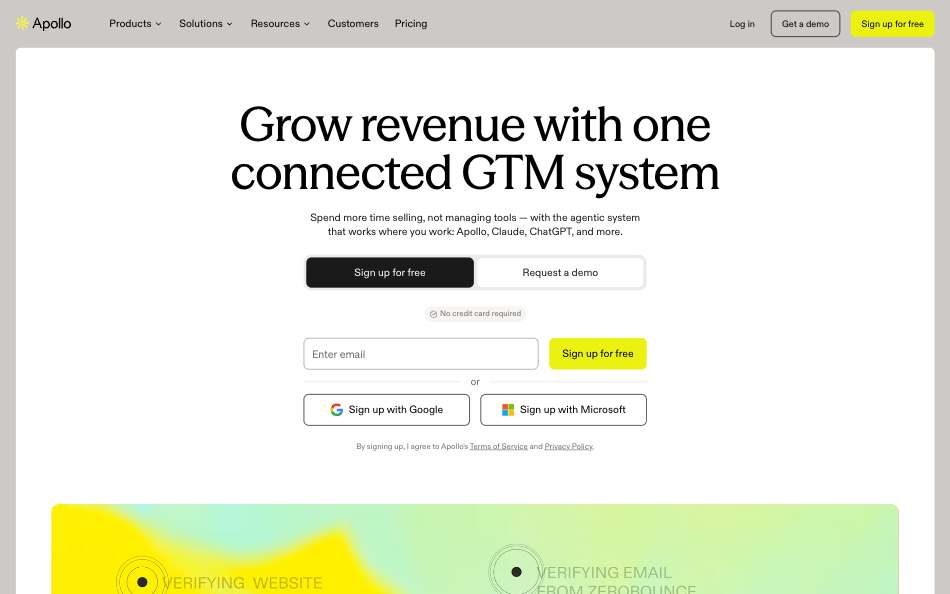
Apollo is an all-in-one sales platform: a contact database, sequences, a dialer and a rep workspace. It runs an official MCP server at https://mcp.apollo.io/mcp, with OAuth 2.0 or an API key. Any plan qualifies, Free included, and MCP enrichment spends the same credits as the app (Apollo developer docs, September 2026).
If your agent also has to enroll people in sequences, Apollo does both jobs. The cost is the model. Pricing is per seat with a monthly credit pool, and credits expire at the end of each billing cycle.
An email costs 1 credit and a phone number costs 8. API enrichment runs 1 to 9 credits per person (Apollo API pricing, September 2026).
Pros
- Data, sequences and a dialer in one product.
- Official MCP server on every plan, including Free.
- API on every plan, with enrichment at 1,000 requests a minute on paid plans.
- A low per-seat price for a small team.
Cons
- Credits are pooled per seat and do not roll over.
- General endpoints allow 200 requests a minute and 2,000 a day on Basic and Professional.
- The price of extra credits is not public.
- At volume you buy seats to get credits.
Best for: sales teams that want an agent and a rep workspace in the same tool.
Pricing: Free $0; Basic $65 per seat a month, or $49 billed yearly; Professional $99 or $79; Organization $149 or $119 with 3 seats minimum (Apollo pricing, September 2026). At 1M work emails the cheapest monthly path is 250 Professional seats, $24,750 a month at list. Billed yearly, 400 Basic seats come to $19,600 a month.
3. Clay: best for table workflows with AI research
Clay is a workflow spreadsheet. You build a table, add enrichment columns from many data providers and run Claygent, its AI research agent, per row. Claygent is on every plan, including Free (Clay pricing, September 2026).
For agents, Clay offers a Public API and CLI on every plan. The HTTP API column, which calls outside APIs from a table, starts on Growth. Clay also has an MCP server, and new accounts get 500 free credits on first connect (Clay MCP guide, September 2026).
Billing uses two meters: Data Credits and Actions. Clay's own docs say a fully enriched record typically costs 6 to 20 Data Credits, plus one Action per enrichment (Clay docs, September 2026).
Pros
- Claygent runs web research per row, on every plan.
- Waterfalls across many providers inside one table.
- Public API and CLI on every plan, Free included.
- An enrichment that returns nothing is not charged.
Cons
- Two meters. You track Actions and Data Credits.
- The largest self-serve tier is 200,000 Actions a month, and Actions cannot be bought as top-ups.
- Tables hold 50,000 rows on Launch and Growth.
- The Public API rate limit has no published number.
Best for: RevOps teams that want enrichment and AI research in a table, at list-building volume.
Pricing: Free $0; Launch from $185 a month, or $167 billed yearly; Growth from $495, or $446 billed yearly; Enterprise by quote (Clay pricing, September 2026). Clay publishes no price at 1M, and no self-serve tier reaches 1M Actions a month.
4. Amplemarket: best for outbound teams that want sequences, calling and data in one tool
Amplemarket is a sales engagement platform with a data source inside it. Seats pay for multichannel sequences, intent signals and an AI copilot as well as the records. It also has an MCP server that connects Claude, ChatGPT and Cursor to your account, signed in with OAuth and no API key (Amplemarket MCP guide, October 2026).
Through MCP an assistant can search prospects, enrich contacts, build lead lists and enroll leads into sequences.
The public price is one tier. Startup is $600 a month on an annual term with 2 users and 27,000 contacts. Growth lists 140,000 contacts and Elite 400,000, both on custom quotes (Amplemarket pricing, October 2026).
Pros
- Sequences, intent signals and an MCP server in one account.
- MCP sign-in is OAuth, so no key sits in a chat.
- The API default is 500 requests a minute across endpoints, raised on request.
- One public price to budget from.
Cons
- No monthly billing shown. Startup is $7,200 a year on an annual term.
- Growth and Elite are quotes, and the biggest listed allotment is 400,000 contacts.
- No free plan. Every plan includes a free trial.
- 500 requests a minute caps a bulk job well below code-first platforms.
Best for: founder-led and SDR teams that want outbound, calling and data from one vendor.
Pricing: Startup $600 a month, annual term; Growth and Elite custom (Amplemarket pricing, October 2026). Default API limit is 500 requests a minute (Amplemarket API docs, October 2026). No public 1M price.
5. ZoomInfo (GTM.AI): best for teams on ZoomInfo data and intent
ZoomInfo is an enterprise sales intelligence suite whose platform plans are negotiated contracts. For agents it now sells GTM.AI, an API, MCP server and CLI on pay-as-you-go data credits with a free tier.
The MCP server works with Claude, ChatGPT and Cursor. It needs a free GTM.AI account or an existing ZoomInfo subscription with data credits (GTM.AI MCP docs, September 2026). Search and lookup are free. One data credit enriches or exports one company, contact or intent record, and a record is charged once per 12 months (GTM.AI credit docs, September 2026).
Credits list from $0.45 each at 100 credits down to $0.25 at 100,000 credits for $25,000. The slider stops there (GTM.AI pricing, September 2026).
Pros
- Free tier with 1,000 data credits and 1,000 AI credits, no card.
- MCP, API and CLI included on the free tier.
- Intent records sit in the same credit model.
- Search is free, and a record is charged once per 12 months.
Cons
- The free tier is limited to 5 requests a second.
- Batch enrichment takes at most 25 records per call.
- No public price past 100,000 credits.
- Platform contracts are quote only.
Best for: teams already buying ZoomInfo data who want an agent on the same records.
Pricing: pay as you go from $20 on GTM.AI (GTM.AI pricing, September 2026). Rate limits are Builder 5 requests a second, Standard 25 and Scaling 35 (GTM.AI rate limits, September 2026). No public 1M price.
6. Crustdata: best for agents that react to job changes and company events
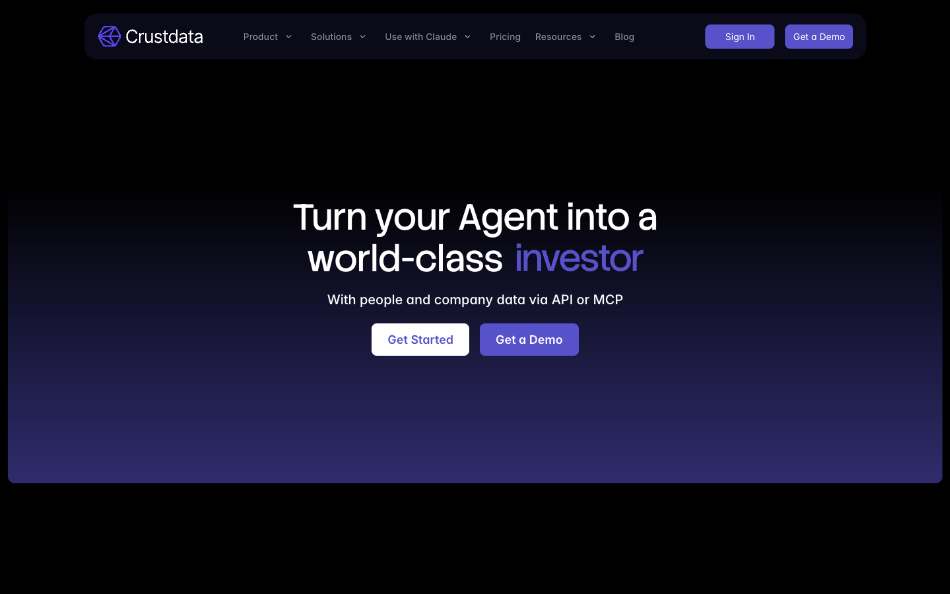
Crustdata is a data API with its own index of people, companies, jobs and posts, sold on credits. Its hosted MCP server is at https://install.crustdata.com/mcp, with OAuth for interactive clients and an API key for code (Crustdata MCP docs, September 2026).
What sets it apart is watchers. A person watcher bills 5 credits per changed person at the 30-day service level. That gives an agent job-change alerts without polling.
The pricing page lists no plan names and no dollar prices (Crustdata pricing, September 2026). The docs give credits per call: search is 0.03 credits per result, and person enrich is 1 to 7 credits.
Pros
- Official MCP server with OAuth or an API key.
- Watchers for people and company changes.
- Search at 0.03 credits per result.
- Batch person enrich takes up to 10,000 identifiers a job.
Cons
- Default rate limits are low: 15 requests a minute on person enrich and 30 on search.
- Contact enrich, the cheaper email path, needs an enterprise plan.
- No public dollar price, so you cannot size a bill before a sales call.
- Docs say credits expire 12 months after purchase.
Best for: teams building agents that react to job changes and company events.
Pricing: credits, no public dollar price (Crustdata docs, September 2026). A work-email lookup is 2 credits on self-serve keys. No public 1M price.
Comparison table
| Tool | Best for | Starting price | Cost at 1M records a month | API | MCP | Rate limit |
|---|---|---|---|---|---|---|
| LeadOcean | Agents and code at volume | Free $0; Solo $97 a month | $497 a month (Agency, fair-use pace) | Yes, every plan | Yes, OAuth 2.1, 13 tools, every plan | 5, 50, 200, 10,000 requests a second by plan |
| Apollo | Data and outreach in one seat | Basic $65 per seat a month ($49 billed yearly) | $24,750 a month monthly ($19,600 billed yearly) | Yes, every plan | Yes, every plan | Enrichment 1,000 a minute on paid plans |
| Clay | Table workflows with AI research | Launch $185 a month ($167 billed yearly) | No public 1M price | Yes, every plan | Yes | No published number |
| Amplemarket | Outbound with data inside | Startup $600 a month, annual term | No public 1M price | Yes | Yes, OAuth | 500 requests a minute by default |
| ZoomInfo (GTM.AI) | ZoomInfo data and intent | Pay as you go from $20 | No public 1M price | Yes, free tier included | Yes | 5, 25 or 35 requests a second by package |
| Crustdata | Job changes and company events | No public dollar price | No public 1M price | Yes | Yes, OAuth or API key | 15 a minute enrich, 30 a minute search |
All figures come from the vendor pages linked in each section, checked in September or October 2026.
How to choose
- You build agents in code or in Claude and pull data at volume: LeadOcean. A flat price and 200 requests a second per account on Agency mean no credit math.
- Your reps need sequences and a dialer next to the data: Apollo or Amplemarket. Apollo is cheaper per seat and has a free plan. Amplemarket bundles more outbound tooling.
- You want AI research on every row in a table: Clay. Keep it for the workflow and use a cheaper data source as its first hop.
- You already pay ZoomInfo: GTM.AI puts an agent on records you own, with a free tier to test.
- You need alerts when people change jobs: Crustdata. Ask for a quote before you size volume.
- You need 1M records a month at a public price: only LeadOcean and Apollo publish one. Apollo's is $24,750 a month at list.
Verdict
LeadOcean wins for builders who pull people and company data through an API or an agent at volume, because the price is flat and the sizing calls are free. Apollo wins for sales teams that want data and outreach in one seat. Clay wins for table-based research, Amplemarket for outbound teams that want one vendor, ZoomInfo for teams already on its data, and Crustdata for event-driven agents. No platform here does everything. Most teams pair a data layer with one workspace.
FAQ
What is a GTM agent platform?
It is a product that gives an AI agent people and company data, or runs go-to-market work for it, such as research, list building and outreach. Most expose an API and an MCP server so Claude, ChatGPT or your own code can call them.
Which GTM agent platform is cheapest at 1M records a month?
Only LeadOcean and Apollo publish a price at that size. LeadOcean Agency is $497 a month on a fair-use pace. Apollo is $24,750 a month at list on monthly billing (Apollo pricing, September 2026). The others publish no 1M price.
Do I need an MCP server for a GTM agent?
You need one if the agent runs in Claude, ChatGPT or Cursor. All six platforms here have a hosted MCP server. If you write the agent in code, the REST API is enough.
Can I test these platforms for free?
Four have a free path: LeadOcean (1,000 records for life, no card), Apollo (Free plan), Clay (Free plan) and GTM.AI (1,000 data credits). Amplemarket and Crustdata do not list a free plan.
Why is there no accuracy ranking?
We did not run a find-rate test for this page. Rankings here rest on published prices, limits and MCP docs from September and October 2026. Run your own list through each free tier before you commit.
Does LeadOcean replace Clay or Apollo?
Give your GTM agent 693M people on one flat price. Start free and size a real segment first.
Free to start. No credit card. 1,000 records to spend whenever you like.
Get your free API key →