Lead enrichment tools take a LinkedIn URL, email or domain and return a person's role, company, email and phone. Enterprise teams need them when millions of records a month flow through a CRM, a pipeline or an agent.
That changes what matters. Seats and polish count for less than the price at volume, the rate limit and whether the vendor will quote you a number at all. Most enterprise buyers leave their first tool for one of three reasons. The credit meter turns 1M records into a quote request. The seat count grows with every new rep. Or an annual contract was signed before the data was tested.
We ranked six tools on those limits. For single-tool comparisons, see our ZoomInfo, Cognism, Apollo, People Data Labs and Clay alternative pages. For the wider category, see our guide to lead enrichment tools.
TL;DR
| Tool | Best for | Starting price | Cost at 1M records a month |
|---|---|---|---|
| LeadOcean | Pipelines and agents at volume | Free, then Solo $97 a month | $497 a month (Agency, fair-use pace, no credits) |
| ZoomInfo | A full GTM suite with signals | GTM AI credits from $20; platform plans quoted | No public 1M price |
| Cognism | Phone-verified mobile data | No public price | No public 1M price |
| Apollo | Teams that also want a sales app | Basic $65 a seat ($49 billed yearly) | $24,750 a month ($19,600 billed yearly) |
| People Data Labs | Raw person and company datasets | Pro $98 a month ($78 billed yearly) | No public 1M price |
| Clay | Table workflows with waterfalls | Launch $185 a month ($167 billed yearly) | No public 1M price |
The cost at 1M is for 1,000,000 work-email lookups at list price, September 2026. Where a vendor publishes no price at that volume we say so and do not multiply a small-tier rate. Sources are in each section.
What we evaluated
- Volume and price model: what 1M records a month costs, and whether you pay per credit, per seat or a flat fee.
- Self-serve ceiling: the largest volume you can buy without a sales call, and what happens above it.
- API and rate limits: endpoints for enrich and search, and requests per second or per minute on the plan an enterprise team would buy.
- MCP support: a hosted server your agents can call, and what a call costs.
- Seats and contracts: whether cost grows per user, and whether you can leave after a month.
1. LeadOcean: best for pipelines and agents at volume
LeadOcean is a people and company data API with a hosted MCP server. The database holds 693M people and 67M companies. Search has 50 people filters and 34 company filters, and enrichment takes a LinkedIn URL, email, phone or person ID on POST /v1/people/enrich.
The price model is the reason it ranks first for volume. Paid plans have no credits: each has a fair-use pace instead. Agency is $497 a month for teams, with 200 requests a second, five keys and phones and exports included. Platform is $1,997 a month for products that embed or resell the data, with 10,000 requests a second. Every plan has the same data and every endpoint.
The MCP server has 13 tools at https://api.leadocean.io/mcp with OAuth sign-in. Counts are free, so an agent can size a company list with leadocean_count_companies before it spends a record. Person enrich also returns career history: past roles, education, certifications and awards.
Pros
- Flat monthly price. No credits to buy, no per-record invoice, nothing expires.
- Search, enrich, email, phone and CSV export on the same key, with the same data on every plan.
- 13 MCP tools with OAuth sign-in. Count and filter-discovery calls are free.
- Monthly billing with a public price at every tier, including the one that fits 1M records.
Cons
- No rep workspace. There is no sequencer, dialer, CRM or Chrome extension. It is data, not a sales app.
- Rate limit depends on the plan: 5 requests a second on Free, 50 on Solo, 200 on Agency.
- Bulk CSV export is not on the Free plan. Free is 1,000 records for life.
- Platform is sales-led, so a reseller or embed deal means a conversation.
Best for: enterprise data, RevOps and engineering teams that pull people and company data in code or through an agent, on a predictable bill.
Pricing: Free $0, Solo $97, Agency $497, Platform $1,997 a month. See LeadOcean pricing (checked October 2026).
2. ZoomInfo: best for a full GTM suite with signals
ZoomInfo is the default enterprise sales intelligence suite. Its platform plans are annual contracts quoted by sales. Vendr reports a median of $33,500 a year across 1,574 purchases, with contracts from $7,220 to $155,730 (Vendr, updated February 2026). ZoomInfo says most paid plans are billed annually upfront (ZoomInfo, July 2026).
The newer API product, GTM AI, sells data credits pay as you go from $20. List price per credit falls from $0.45 for 100 credits to $0.25 at 100,000 credits ($25,000), the largest size on the slider. Past that it is Enterprise by quote, so there is no public price at 1M (GTM AI pricing, September 2026).
Limits for the API are 5 requests a second on Builder, 25 on Standard and 35 on Scaling, with higher limits by request (ZoomInfo API docs, September 2026). ZoomInfo has an official MCP server that needs a GTM AI account or an existing subscription with data credits (GTM AI docs, September 2026).
Pros
- Intent signals, org charts and a rep-facing app in one suite.
- Search, lookup and find-similar are free on GTM AI. Credits apply to enrich and export.
- A record is charged once per 12 months, so re-enriching it inside that window costs nothing extra.
- Official MCP server, usable with Claude, ChatGPT and Cursor.
Cons
- Platform prices are not public, and zoominfo.com/pricing blocked our fetch in September 2026.
- Annual contracts, with terms of 1 to 3 years and renewal increases reported by Vendr.
- Batch enrichment takes at most 25 records per call, so large jobs mean many calls.
- No public price at 1M. The self-serve slider stops at 100,000 credits.
Best for: enterprise sales teams that want intent, org charts and CRM integrations in one contract and can accept a quote-led purchase.
Pricing: GTM AI credits from $0.45 down to $0.25 each, from $20. Platform plans quoted. See GTM AI pricing (September 2026).
3. Cognism: best for phone-verified mobile data
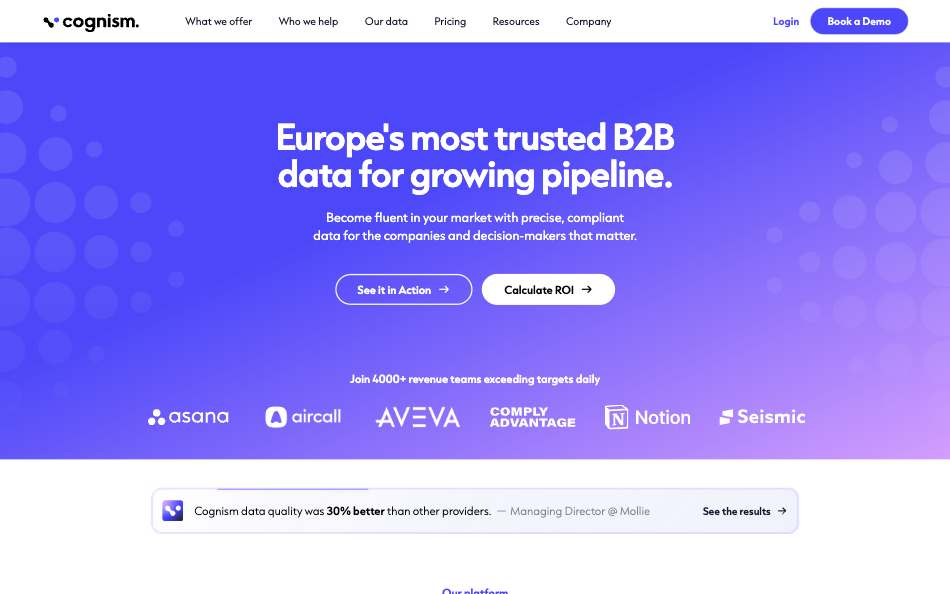
Cognism is a sales prospecting platform with a data API and an MCP server. It publishes no dollar price. The pricing page lists Standard and Pro plans with 5 seats each. CRM Enrichment is an add-on or standalone product. Pricing is tailored by product, team setup and usage (Cognism pricing, September 2026).
Credits work per revealed contact: 1 credit is 1 contact, and viewing a contact you already revealed is free. The same credits work across the platform, Enrich and the API. Cognism's Diamond Data page claims over 10m phone-verified contacts and on-demand verification in under 48 hours (Cognism, September 2026). That is a vendor claim, so test a sample.
The API allows 500 requests a minute per account, per operation, with higher limits set per package (Cognism docs, September 2026). The MCP server has 15 tools with OAuth 2.0 sign-in (Cognism docs, September 2026).
Pros
- Phone data is a core product, with a published verification claim.
- Hosted MCP server whose tools map one to one onto the API.
- Reveal-once credits: a contact you already revealed costs nothing to view again.
- Seats are bundled into plans, so a team can be sized up front.
Cons
- No public price for plans, seats or credits.
- The rate limit is per minute, 500 a minute per operation, not per second.
- API and MCP access need a package that includes them.
- No public price at 1M. Credit allowance per seat is not published.
Best for: enterprise sales teams that prioritise mobile numbers and want a managed contract with a vendor.
Pricing: quote only, Standard and Pro plans. See Cognism pricing (September 2026).
4. Apollo: best for teams that also want a sales app
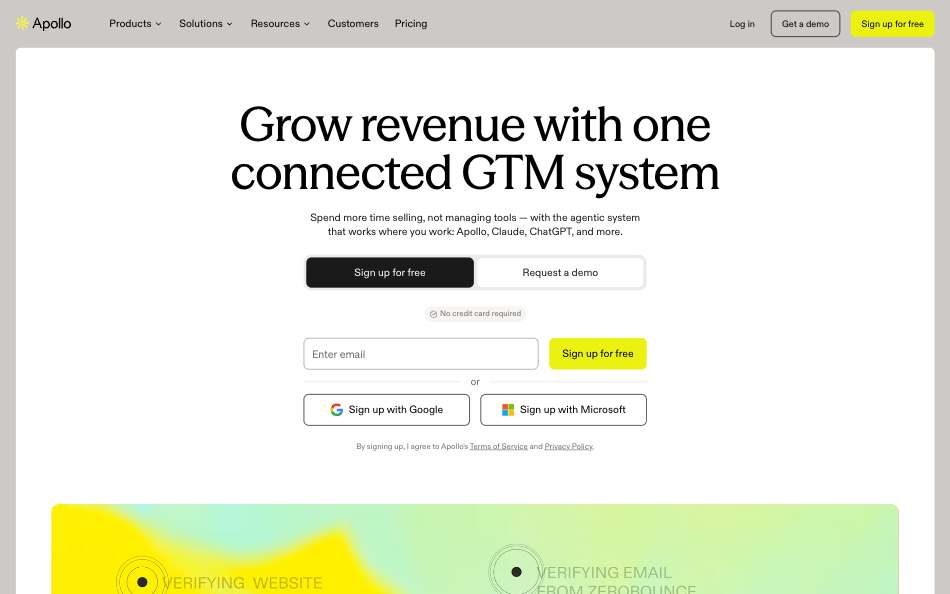
Apollo is a sales app with a large contact database and an API. It is the only tool here with a public per-seat price at every tier. Billed monthly, per seat: Basic $65, Professional $99 and Organization $149, which needs at least 3 seats. Billed yearly they are $49, $79 and $119 (Apollo pricing, September 2026).
Credits are the catch for volume. An email costs 1 credit and a phone number costs 8. Credits pool across the team but expire at the end of each billing cycle and do not roll over (Apollo API pricing, September 2026). A paid seat holds 4,000 credits a month on Professional, so 1M lookups would take about 250 seats.
Every plan includes API access, and paid enrichment endpoints allow 1,000 requests a minute (Apollo rate limits, September 2026). Apollo runs an official MCP server on any plan (Apollo MCP docs, September 2026).
Pros
- Public prices and a self-serve plan for every team size.
- API and MCP on every plan, including Free.
- Sales app, sequences and database in one login.
- Credits pool across the whole team.
Cons
- Credits expire each cycle, including purchased add-on credits.
- At 1M work-email lookups, list price is $24,750 a month, or $19,600 a month billed yearly.
- A phone number costs 8 credits, so mobile-heavy jobs cost far more.
- Apollo does not print a price per extra credit that we could read, so top-ups are unclear.
Best for: enterprise sales teams that want a rep workspace and enrichment under one login, at modest volume per seat.
Pricing: Free $0, Basic $65, Professional $99, Organization $149 a seat a month ($49, $79 and $119 billed yearly). See Apollo pricing (September 2026).
5. People Data Labs: best for raw person and company datasets
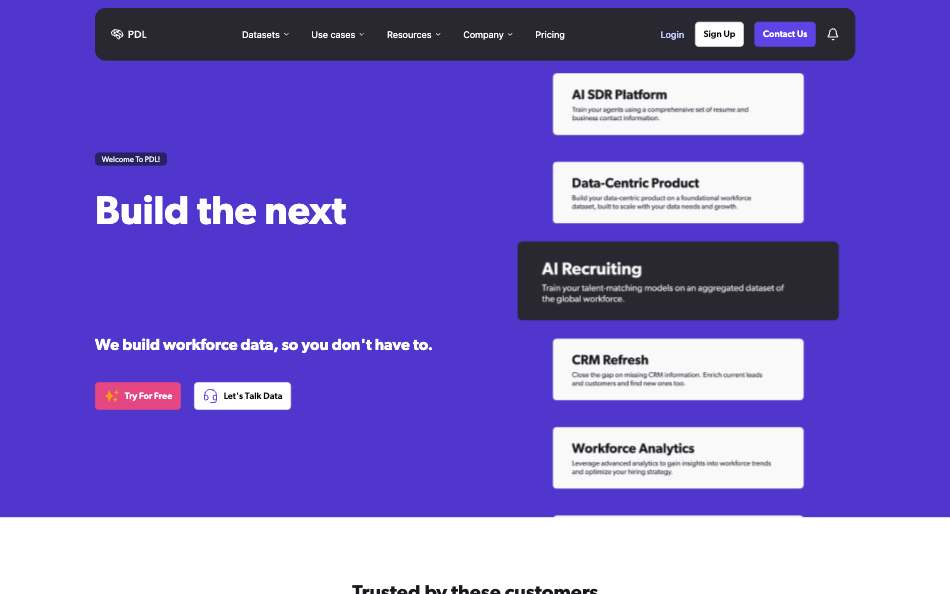
People Data Labs (PDL) sells person and company data as an API and as bulk datasets. Its person dataset holds about 2.47B profiles and its company dataset about 76.6M records, per its own dataset docs (September 2026). For an enterprise data team that builds its own product on top, the breadth is the draw.
The price model is per credit. Pro starts at $98 a month for 350 credits, which is $0.28 a credit. PDL says Pro profiles cost about $0.20 to $0.28 each depending on volume (PDL pricing, September 2026). Self-serve stops near 100,000 person profiles, and above that PDL sells Enterprise by quote.
Person Enrichment allows 1,000 requests a minute on paid plans, but Person Search is limited to 10 requests a minute by default (PDL docs, September 2026). PDL has no official MCP server in its docs or llms.txt (PDL llms.txt, September 2026).
Pros
- Very large person and company datasets, with bulk delivery for data teams.
- A request that returns nothing (404) is not billed.
- Bulk enrichment takes up to 100 persons per request.
- Mature documentation and long track record with data teams.
Cons
- Credit meter. The entry price of $0.28 a credit is not a 1M rate.
- Self-serve ceiling near 100,000 profiles, then Enterprise only.
- Person Search is 10 requests a minute by default.
- No official MCP server, so agents need a community wrapper.
Best for: enterprise data and engineering teams that want raw datasets and are ready to negotiate a contract.
Pricing: Free $0 (100 credits a month, contact data obscured), Pro from $98 a month ($78 billed yearly), Enterprise custom. See PDL pricing (September 2026).
6. Clay: best for table workflows with waterfalls
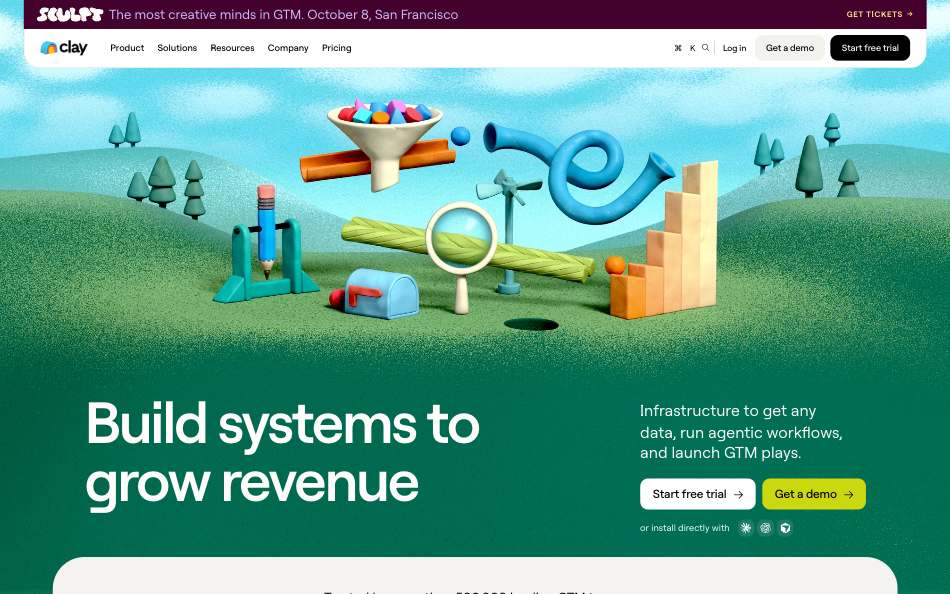
Clay is a spreadsheet that runs enrichment waterfalls across many data providers and pushes rows to your outreach tools. The Free plan has unlimited seats, so team size does not set the price (Clay pricing, September 2026). Enterprise adds SSO, role-based access, data warehouse sync and a dedicated strategist, priced by quote on an annual commitment.
The price is the issue at volume. Launch starts at $185 a month ($167 billed yearly) and Growth at $495 ($446 billed yearly). Clay's own doc says a fully enriched record typically costs 6 to 20 Data Credits, plus one Action (Clay docs, September 2026). The largest self-serve tier is 200,000 Actions and 50,000 Data Credits a month, so 1M lookups cannot be bought self-serve.
Clay's developer platform, with a public API and CLI, is on every plan (Clay API docs, September 2026). The API rate limit is per workspace and Clay publishes no number (Clay rate limits, September 2026). There is an official MCP server (Clay MCP guide, September 2026).
Pros
- Unlimited seats on Free, with waterfalls, Claygent and bring-your-own-key.
- Enterprise lists SSO, role-based access and warehouse sync, which governance teams ask about.
- A record that returns no result costs no Data Credits and no Actions.
- Public API, CLI and MCP server.
Cons
- Credits plus Actions make the monthly cost hard to forecast at volume.
- Self-serve tiers stop at 200,000 Actions a month, far below 1M lookups.
- No published API rate limit.
- Growth, at $495 a month, is the tier that adds the HTTP API column and webhooks.
Best for: enterprise RevOps teams whose operators live in tables and want a visible workflow over many providers.
Pricing: Free $0, Launch from $185 a month ($167 billed yearly), Growth from $495 ($446 billed yearly), Enterprise by quote. See Clay pricing (September 2026).
Comparison table
| Tool | Best for | Starting price | Cost at 1M records a month | API | MCP | Rate limit |
|---|---|---|---|---|---|---|
| LeadOcean | Pipelines and agents at volume | Free, Solo $97 a month | $497 a month (Agency, fair-use pace) | REST: search, enrich, email, phone, export | Yes, 13 tools, OAuth | 5, 50, 200, 10,000 a second by plan |
| ZoomInfo | Full GTM suite | GTM AI from $20; platform quoted | No public 1M price | REST via GTM AI; batch of 25 | Yes, official | 5, 25, 35 a second by package |
| Cognism | Phone-verified data | No public price | No public 1M price | REST, search and enrich | Yes, 15 tools, OAuth | 500 a minute per operation |
| Apollo | Sales app plus API | Basic $65 a seat | $24,750 a month | REST on all plans | Yes, any plan | Enrichment 1,000 a minute on paid |
| People Data Labs | Raw datasets | Pro $98 a month | No public 1M price | REST: enrich, search, bulk | No official server | Enrichment 1,000 a minute paid; search 10 a minute |
| Clay | Table workflows | Launch $185 a month | No public 1M price | Public API and CLI | Yes, official | Per workspace, no number published |
How to choose
- You pull data in code or through an agent, at volume: LeadOcean. Flat price, 13 MCP tools, free counts, and a public price at 1M.
- You want intent signals, org charts and one suite: ZoomInfo. Accept the annual contract and a quote.
- Your reps live on mobile numbers: Cognism. Test a sample of phone-verified contacts first.
- You want a rep workspace and a per-seat price you can read: Apollo. Watch the credit expiry.
- You build your own product on raw datasets: People Data Labs. Plan for an Enterprise contract.
- Your operators build workflows in tables: Clay. Budget for credits and Actions on top of the plan.
Verdict
LeadOcean wins for enterprise teams that enrich in code or through agents, because it is the only tool here with a flat public price at 1M records a month: $497 on Agency, with no credits. ZoomInfo wins for teams that want a full GTM suite and will sign a contract for it. Cognism wins on phone-led sales prospecting, Apollo on a visible per-seat price with a rep app, People Data Labs on raw dataset breadth and Clay on table workflows. If a vendor will not give you a price at your volume, you cannot forecast the bill, so ask for one in writing before you commit.
FAQ
What do enterprise teams need from a lead enrichment tool?
Volume, a price they can forecast, an API with a rate limit that fits the job, and seat rules that do not grow cost with headcount. Governance features such as SSO and role-based access matter for some teams, so check them per vendor. Our guide to enterprise enrichment platforms with governance covers that angle.
Which tool has a public price at 1M records a month?
Of the six, LeadOcean and Apollo. LeadOcean Agency is $497 a month with a fair-use pace. Apollo works out to $24,750 a month at list price on monthly billing, using 250 Professional seats. ZoomInfo, Cognism, PDL and Clay publish no price at 1M, as of September 2026.
Is a credit model or a flat model better at enterprise volume?
A flat model is easier to forecast. Credit models scale with every record, so a 10x month is a 10x bill unless a contract caps it. Flat models trade that for a fair-use pace, which slows the key instead of billing more.
Can an AI agent call these tools?
Yes. LeadOcean, ZoomInfo, Cognism, Apollo and Clay run official MCP servers. People Data Labs has none in its docs, only community wrappers. See our guide for AI agents.
How do I compare these tools for a RevOps team?
Run the same 1,000 contacts through each tool and compare find rate and email status. Then price the winner at your real monthly volume. Our RevOps ranking covers CRM sync and workflow needs.
Where can I see LeadOcean pricing?
On the pricing page. Free is $0 for 1,000 records for life, Solo is $97, Agency is $497 and Platform is $1,997 a month.
Enrich at enterprise volume from code or an agent
Free to start. No credit card. 1,000 records to spend whenever you like.
Get your free API key →