Lead enrichment adds missing fields, such as email, phone, title and company size, to a lead or account record. RevOps teams need it because they own the CRM and the pipeline that fills it, so they feel every limit on volume, price and seats.
Most teams leave their first tool when credits run out before the data does, or when seats multiply. We read each vendor's own pricing and docs in September 2026 and ranked seven for that buyer. Where a vendor publishes no price, we say so.
We wrote full alternatives pages for Apollo, ZoomInfo, Clay, FullEnrich, People Data Labs and Crustdata.
TL;DR
| Tool | Best for | Starting price | Cost at 1M records a month |
|---|---|---|---|
| LeadOcean | Enriching in code or with an agent | Free $0, then $97 a month | $497 a month (Agency) |
| Apollo | Reps who work in the app all day | $65 per seat monthly, $49 billed yearly | $24,750 a month on monthly billing, $19,600 a month billed yearly |
| ZoomInfo | Enterprise suites with intent data | GTM AI from $20 pay as you go | No public 1M price |
| Clay | Workflow tables that stitch many vendors | $185 a month, $167 billed yearly | No public 1M price |
| FullEnrich | Waterfall mobiles on a modest volume | $29 a month, $26 billed yearly | No public 1M price |
| People Data Labs | Record-priced API and dataset licences | Free $0, then $98 a month | No public 1M price |
| Crustdata | Live signals by API | No public dollar price | No public 1M price |
The 1M column assumes 1,000,000 work-email lookups in a month. Apollo's figure is list price at one credit per email.
What we evaluated
- Volume. Can you enrich 1M records without a sales call, and what stops you at that size?
- Price model. Seats, credits or a flat fee, and whether a list price exists you can read before you buy.
- API access. Which plans include it, which endpoints are gated, and the published rate limit.
- Seats. Whether you pay for people who never open the app, such as a pipeline or an agent.
- Agent access. Whether there is an official MCP server and what it costs to use.
1. LeadOcean: best for enriching in code or with an agent
LeadOcean is a data API and MCP server. It holds 693M people (366M with an email, 166M with a phone) and 67M companies. It has no seats and no credits. You call REST or MCP with a key, and the plan sets the pace.
RevOps teams buy Agency at $497 a month. That covers 5 keys, 200 requests a second, bulk CSV export and use for your own and your clients' work. Free is $0 for 1,000 records for life, with no card.
Enrich with POST /v1/people/enrich by LinkedIn URL, email, phone or person ID. Size a company list first: GET /v1/companies/count is free. Person enrich also returns career history.
LeadOcean is not a rep workspace. There is no sequencer, dialer, CRM or Chrome extension. The app at app.leadocean.io has an Exports page with a filter builder, a column picker and a price preview before you download.
Pros
- Flat price: $97 Solo, $497 Agency, $1,997 Platform. No per-record price and no overage invoice.
- Counts are free:
GET /v1/companies/countandleadocean_count_companiessize a list before you pull it. - 13 MCP tools with OAuth 2.1 sign-in, on every plan including Free.
- A miss on enrich is a 404 and costs nothing.
Cons
- No rep workspace, so reps need another tool for sequences and calls.
- Bulk CSV export is not on Free.
- The dataset is refreshed monthly, not live.
Best for: RevOps teams and GTM engineers who enrich in code, run agents, or need volume without counting credits.
Pricing: Free $0, Solo $97, Agency $497 and Platform $1,997 a month (LeadOcean pricing, October 2026). Agency covers 1M enrichments a day.
2. Apollo: best for reps who work in the app all day
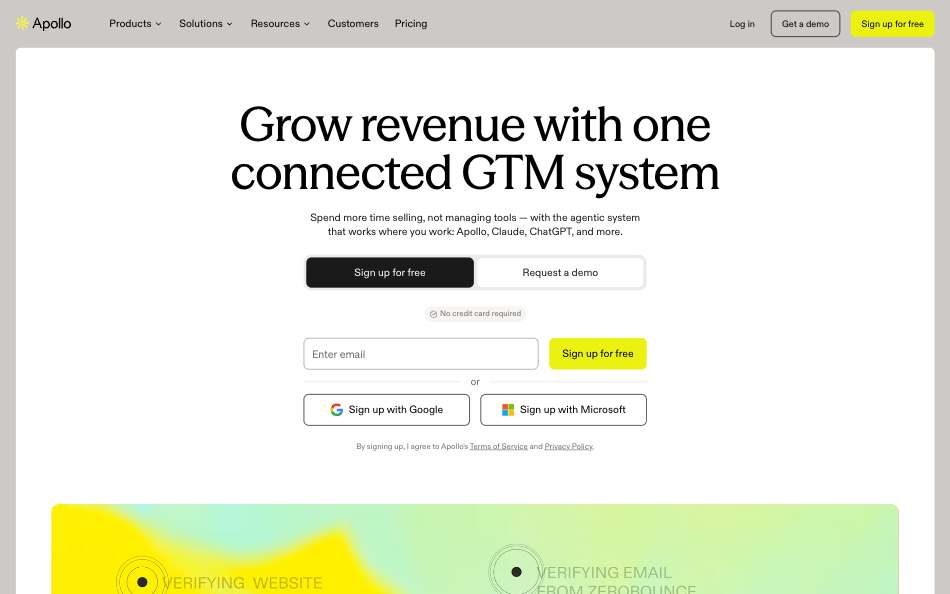
Apollo is an all-in-one platform: a contact database, sequences, a dialer and a rep workspace. It is the right call when sellers need the data and the workflow in one login.
The cost is the seat model. Basic is $65 per seat a month, Professional $99 and Organization $149 (minimum 3 seats). Billed yearly they drop to $49, $79 and $119 (Apollo pricing, September 2026). Credits are pooled and reset each cycle.
Every plan includes API access. An email costs 1 credit and a phone number costs 8 (Apollo API pricing, September 2026). Apollo prints no per-credit price for extra credits on the pages we read.
Pros
- Data, sequences and a dialer in one product.
- API and an official MCP server on every plan, including Free (Apollo MCP docs, September 2026).
- Enrichment endpoints allow 1,000 requests a minute on paid plans (Apollo rate limits, September 2026).
Cons
- Seats hold the credits, so a pipeline nobody opens still costs seats.
- Credits expire at the end of each cycle and do not roll over.
- Record selection per action is capped, from 25 on Free to 10,000 on Organization.
Best for: Sales teams that live in the app, and RevOps teams with a modest number of seats.
Pricing: $65 per seat monthly, $49 billed yearly, on Basic (Apollo pricing, September 2026).
3. ZoomInfo: best for enterprise suites with intent data
ZoomInfo is the enterprise sales intelligence suite. Its platform plans (Professional, Copilot Advanced and Copilot Enterprise) carry no list price: the pricing page asks you to request one (ZoomInfo pricing, October 2026).
For code and agents, ZoomInfo sells GTM AI. It is pay as you go from $20, with no contract and no seat fee. Data credits list at $0.45 each for 100 credits, falling to $0.25 at 100,000 credits (GTM AI pricing, September 2026). Search and lookup are free, and one credit enriches one record.
The slider stops at 100,000 credits for $25,000. Past that you talk to Enterprise sales, so there is no public price at 1M.
Pros
- A full suite, with buyer intent signals from Copilot Advanced up (ZoomInfo pricing, October 2026).
- Official MCP server that works with Claude, ChatGPT and Cursor (GTM AI MCP docs, September 2026).
- A free tier with 1,000 data credits, API, MCP and CLI included.
Cons
- Platform prices are quote only.
- GTM AI rate limits are modest: 5 requests a second on Builder, 25 on Standard (GTM AI docs, September 2026).
- Credit pricing stops at 100,000 credits.
Best for: Enterprise RevOps teams that want intent data and a full GTM suite, and have a procurement process.
Pricing: GTM AI from $20 pay as you go (GTM AI pricing, September 2026). Platform plans are quote only.
4. Clay: best for workflow tables that stitch many vendors
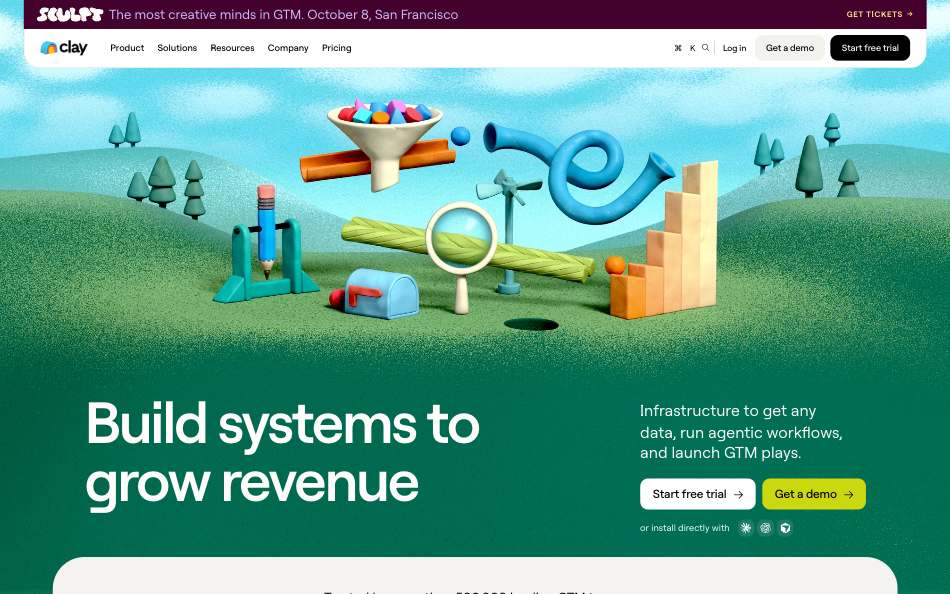
Clay is a workflow spreadsheet that waterfalls across data vendors. RevOps teams use it to build enrichment flows with little code. It is a layer on top of data, not a single dataset.
Launch is $185 a month billed monthly, or $167 billed yearly, with 15,000 Actions and 2,500 Data Credits. Growth is $495 a month, or $446 billed yearly (Clay pricing, September 2026). Free gives 100 Data Credits a month.
The largest self-serve tier is 200,000 Actions and 50,000 Data Credits a month. Actions cannot be topped up, so 1M lookups a month means Enterprise.
Pros
- Unlimited seats, even on Free.
- The Public API is on every plan (Clay docs, September 2026).
- An MCP server exists (Clay MCP guide, September 2026).
Cons
- A fully enriched record typically costs 6 to 20 Data Credits, so credit math drives the bill (Clay docs, September 2026).
- The HTTP API column starts on Growth.
- Clay publishes no number for its Public API rate limit (Clay docs, September 2026).
Best for: RevOps teams that want tables and waterfalls and accept paying for credits.
Pricing: Launch from $185 a month, $167 billed yearly (Clay pricing, September 2026).
5. FullEnrich: best for waterfall mobiles on a modest volume
FullEnrich is a waterfall enrichment tool. It asks 25+ data sources in turn for each email and phone, and bills credits for what it finds. It suits RevOps teams that need mobile numbers on a short list.
Pro starts at $29 a month for 500 credits, or $26 a month billed yearly. A work email costs 1 credit, a personal email 3 and a mobile 10 (FullEnrich pricing, September 2026). A miss costs 0 credits (FullEnrich docs, September 2026).
The top public tier is 100,000 credits for $3,500 a month. Above that, contact sales. The API allows 60 calls a minute by default, with up to 100 contacts per bulk request (FullEnrich docs, September 2026).
Pros
- Waterfall across 25+ data sources for each email and phone.
- API, MCP, search and bulk CSV are on every plan, with unlimited users (FullEnrich pricing, September 2026).
- Entry price is low, from $29 a month.
Cons
- Every field is a credit, so work email plus mobile costs 11.
- 60 API calls a minute is slow for a pipeline.
- No public price at 1M records.
Best for: Teams that need verified mobiles on a few thousand contacts a month.
Pricing: Pro from $29 a month for 500 credits (FullEnrich pricing, September 2026).
6. People Data Labs: best for record-priced API and dataset licences
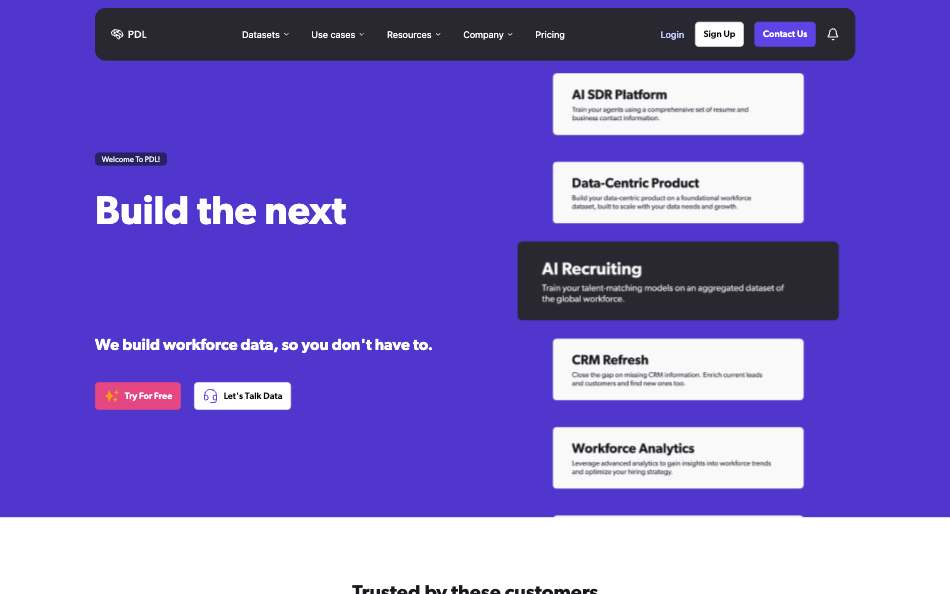
People Data Labs (PDL) is a well-documented data API sold per record, plus bulk dataset licences. Its person dataset holds 2.47B profiles by its own count. Engineers like it for clean docs and bulk enrichment of 100 persons a request.
Pro starts at $98 a month for 350 credits, or $78 a month billed yearly (PDL pricing, September 2026). That is $0.28 a credit at the entry rate. Self-serve is meant for volumes below roughly 100,000 profiles a year, and above that PDL sells Enterprise (PDL, September 2026).
PDL has no official MCP server in its docs, llms.txt or GitHub organization (PDL llms.txt, September 2026).
Pros
- Large datasets you can license into your own warehouse.
- Person enrichment allows 1,000 requests a minute on paid plans (PDL docs, September 2026).
- No bill for requests that return nothing.
Cons
- No public 1M price, and self-serve stops near 100,000 profiles a year.
- Person search is 10 requests a minute by default.
- No official MCP server.
Best for: Data teams that want licensed datasets or a record-priced API.
Pricing: Free $0, Pro from $98 a month (PDL pricing, September 2026).
7. Crustdata: best for live signals by API
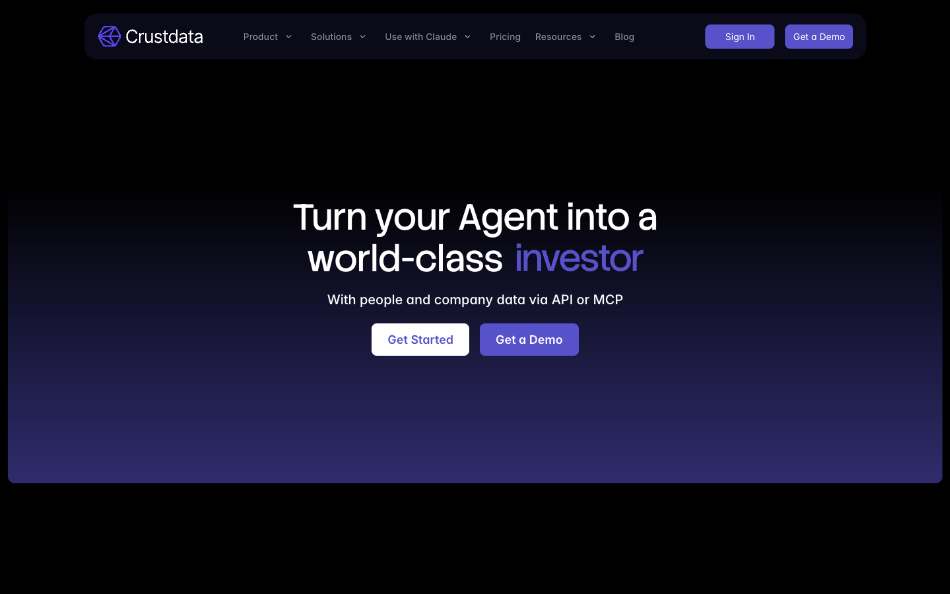
Crustdata is a data API with its own index of people, companies and jobs, sold on credits. It adds watchers that alert you when a person or company changes. RevOps teams use it to trigger workflows on job changes.
The pricing page lists no plan names and no dollar price per credit. The docs give credits per call: 0.03 per search result and 1 to 7 per person enrich (Crustdata pricing docs, September 2026). Confirm the dollar value in your dashboard.
Defaults are tight: 15 requests a minute on person enrich and 30 on search (Crustdata rate limits, September 2026). The contact endpoint needs an enterprise plan.
Pros
- Change watchers for people and companies.
- Hosted MCP server with OAuth (Crustdata MCP docs, September 2026).
- Batch person enrich takes up to 10,000 identifiers a job.
Cons
- No public dollar price, so no 1M forecast.
- Self-serve keys get a 403 on
/person/contact/enrich. - Credits expire 12 months after purchase.
Best for: Teams that build signal-driven workflows and accept a sales-led price.
Pricing: Credits, no public dollar price (Crustdata pricing docs, September 2026).
Comparison table
| Tool | Best for | Starting price | Cost at 1M records a month | API | MCP | Rate limit |
|---|---|---|---|---|---|---|
| LeadOcean | Code and agents | Free $0, Solo $97 a month | $497 a month (Agency) | Yes, every plan | Yes, 13 tools | 200 a second on Agency, 5 on Free |
| Apollo | Reps in the app | $65 per seat monthly, $49 billed yearly | $24,750 a month, $19,600 billed yearly | Yes, every plan | Yes, every plan | Enrichment 1,000 a minute on paid |
| ZoomInfo | Enterprise suites | GTM AI from $20 | No public 1M price | Yes, GTM AI | Yes | 5 a second Builder, 25 Standard |
| Clay | Workflow tables | $185 a month, $167 billed yearly | No public 1M price | Yes, every plan | Yes | No number published |
| FullEnrich | Waterfall mobiles | $29 a month, $26 billed yearly | No public 1M price | Yes, every plan | Yes | 60 calls a minute |
| People Data Labs | Datasets | Free $0, Pro $98 a month | No public 1M price | Yes | No official server | 1,000 a minute enrich on paid |
| Crustdata | Live signals | No public dollar price | No public 1M price | Yes | Yes | 15 a minute person enrich |
How to choose
- You enrich in code, run agents, or need 1M records a month: LeadOcean. A flat fee is the only price here you can read at that size.
- Reps need data and sequences in one login: Apollo. Watch the seat count as the team grows.
- You need intent data and have a budget: ZoomInfo.
- You build no-code enrichment tables: Clay, with LeadOcean as the first hop.
- You need mobiles on a short list: FullEnrich.
- You license datasets for a warehouse: People Data Labs.
- You trigger on job changes: Crustdata.
Verdict
For RevOps teams that own the pipeline, LeadOcean wins on volume and price model: $497 a month for 1M records, no seats and no credits. Apollo wins when reps work in the app, ZoomInfo when you need a full suite and a contract, and Clay for no-code tables. FullEnrich wins for mobiles on a short list, People Data Labs for dataset licences and Crustdata for change signals. Most teams end up with two: a rep tool and a data API.
FAQ
What do RevOps teams need from a lead enrichment tool?
Volume, a price you can forecast, an API and a seat model that fits. Check what 1M records cost and what stops you at that size.
Which tool is cheapest at 1M records a month?
LeadOcean Agency at $497 a month. Apollo is $24,750 a month at list price on monthly billing. The others publish no 1M price.
Do I need seats for an enrichment pipeline?
Not with LeadOcean. Apollo ties credits to seats, so a pipeline still pays for them. Clay and FullEnrich have unlimited users.
Which tools have an official MCP server?
LeadOcean, Apollo, ZoomInfo through GTM AI, Clay, FullEnrich and Crustdata. People Data Labs has no official one in its docs.
Can I try these before paying?
LeadOcean Free is 1,000 records for life with no card. Apollo, ZoomInfo GTM AI, Clay, FullEnrich and PDL also have free tiers or trials; see each pricing page.
Is LeadOcean a replacement for Apollo or ZoomInfo?
Only as the data layer. It has no sequencer, dialer or CRM. Read more on pricing. Related: enterprise lead enrichment tools, all lead enrichment tools and B2B data providers for RevOps.
Enrich your RevOps pipeline in code with a free LeadOcean key
Free to start. No credit card. 1,000 records to spend whenever you like.
Get your free API key →