An SDR prospecting tool finds the right people at the right companies and gives you a way to reach them. Most buyers are SDR managers, RevOps leads and founders building outbound. A growing group is engineers who feed an AI SDR from an API.
Teams leave their current tool for three reasons. Per-seat plans get expensive as the team grows (Apollo needs 250 Professional seats to cover 1M email credits). Credit meters make cost hard to predict (Lusha, Clay). Quote-only pricing hides the number until a sales call (ZoomInfo, Cognism, Seamless.AI).
We checked each vendor's public pricing and docs in September 2026. For LeadOcean we also ran a free count on 21 October 2026, shown in its section. For related reading see AI SDR prospecting with live signals and rep prospecting.
TL;DR
| Tool | Best for | Starting price | Cost at 1M records a month |
|---|---|---|---|
| LeadOcean | API, agents and volume | Free ($0, 1,000 records); Solo $97 a month | $497 a month (Agency plan, fair use) |
| Apollo | Reps who want one workspace | Free; Basic $65 per seat a month ($49 billed yearly) | $24,750 a month at list ($19,600 billed yearly) |
| ZoomInfo | Enterprise intent and org data | Pay as you go from $20 (GTM AI) | No public 1M price |
| Lusha | Individual reps and small teams | Free; Starter $49.90 a month ($37.45 billed yearly) | No public 1M price |
| Cognism | European phone-led calling | No public price | No public 1M price |
| Clay | Workflow builders | Free; Launch $185 a month ($167 billed yearly) | No public 1M price |
| Seamless.AI | Reps buying through a sales team | No public price | No public 1M price |
What we evaluated
- Data fit for SDRs: verified work emails, direct dials and filters on title, level and company size.
- API and MCP access: whether an engineer or an agent can pull records without a sales call.
- Rate limits: how many requests a second or minute you get on a normal plan.
- Price you can read: a public figure for the plan and for volume, billed monthly first and yearly after.
- Rep workflow: whether the tool includes sequences, a dialer or a Chrome extension, or is data only.
1. LeadOcean: best for API, agent and volume prospecting
LeadOcean is a people and company data API with a hosted MCP server. It holds 693M people and 67M companies; 366M of the people have an email and 166M a phone number. You search with 50 people filters and 34 company filters, then enrich by person_id.
We ran a free count on 21 October 2026: titles "Sales Development Representative", "SDR" or "Business Development Representative", country US. It found 23,619 people with a mailable email (verified, catch_all_valid or catch_all) across 8,359 companies. Without the email condition it was 80,768. The count spent no records; count=true on /v1/people/search does the same over REST.
It is data only. There is no sequencer, dialer, CRM or Chrome extension. The app at app.leadocean.io has an Exports page with a filter builder, a column picker, a price preview and a CSV download.
Pricing is flat. Agency is $497 a month with 200 requests a second and 5 keys. Paid plans have a fair-use pace, not credits. 13 MCP tools work in Claude and ChatGPT.
Pros
- Public flat price, and a free plan with the whole database.
- Free counts:
leadocean_count_leadsandGET /v1/companies/countsize a list for nothing. - 200 requests a second on Agency, 10,000 on Platform.
- Bulk CSV export from the Solo plan.
Cons
- No rep workspace, so you bring your own sequencer.
- Free is 1,000 records for life, not monthly.
- No bounce refunds. Read
email_statusbefore you send.
Best for: engineers, RevOps teams and agencies that pull data at volume or feed an agent. Pricing: Free $0, Solo $97, Agency $497, Platform $1,997 a month (LeadOcean pricing, October 2026).
2. Apollo: best for reps who want one workspace
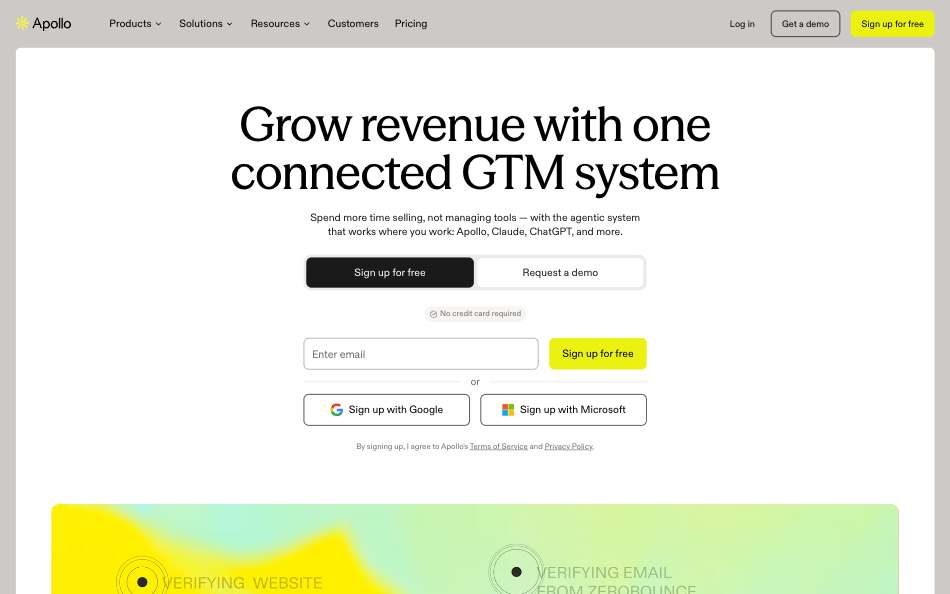
Apollo combines a contact database, sequences, a dialer and a Chrome extension. It is the easiest place for a rep to start. Credits are granted per seat each month and expire at the end of the cycle.
An email costs 1 credit and a phone number costs 8 (Apollo API pricing, September 2026). Every plan includes API access. Apollo also runs an official MCP server on any plan, including Free.
The cost climbs with volume. One million email lookups need 250 Professional seats at $99, which is $24,750 a month. Add-on credit prices are not public.
Pros
- Sequences, dialer and extension in one product.
- Free plan and low entry price.
- Official MCP server on every plan.
Cons
- Per-seat pricing at volume.
- Credits expire each cycle.
- Search endpoints allow 200 requests a minute on paid plans, against 1,000 for enrichment (Apollo rate limits, September 2026).
Best for: reps and small teams who want data and outreach in one app. Pricing: Basic $65 per seat a month, Professional $99, Organization $149 (minimum 3 seats). Billed yearly: $49, $79 and $119 (Apollo pricing, September 2026).
3. ZoomInfo: best for enterprise intent and org data
ZoomInfo is the enterprise suite for intent signals, org charts and large sales teams. Its platform plans are quoted by sales, and zoominfo.com/pricing blocked our read behind a human check, so we print no platform price.
The self-serve route is GTM AI. Data credits list from $0.45 down to $0.25 at 100,000 credits, and one credit covers one record (GTM AI pricing, September 2026). The free tier gives 1,000 data credits, API, MCP and 5 requests a second.
The public slider stops at 100,000 credits. There is no public 1M price, so we do not multiply the rate out.
Pros
- Deep intent and company data.
- Self-serve API and MCP through GTM AI.
- Records are charged once per 12 months.
Cons
- Platform prices are not public.
- Rate limits are low on the entry package (5 requests a second).
- Batch enrichment is capped at 25 records a call.
Best for: enterprise teams that need intent data and a full GTM suite. Pricing: pay as you go from $20 on GTM AI; platform plans by quote (GTM AI pricing, September 2026).
4. Lusha: best for individual reps and small teams
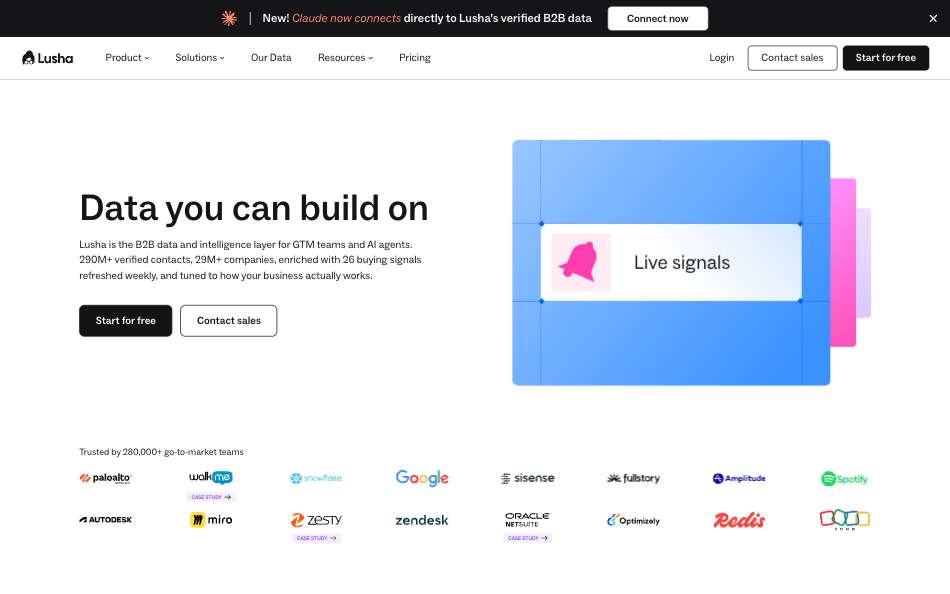
Lusha is a contact finder with a browser extension, a simple credit plan and an API on every plan. An email costs 1 credit and a phone number 5. A bulk API request adds 1 credit per 25 results.
The Lusha MCP server has 50 tools and shares the API credit pool. Premium bills $399.90 a month for 3,400 credits, or $299.95 billed yearly (Lusha pricing, September 2026).
The top public tier is 10,000 credits a month at $977.40. One million emails by bulk API need about 1,040,000 credits, which is 104 times that tier. Scale is custom.
Pros
- Clear starter prices and a free plan.
- API key on every plan.
- Data waterfall on all paid plans.
Cons
- Credits limit volume.
- Rate limits are low on lower plans (Starter 40 a minute).
- Docs disagree on whether a no-match call is charged.
Best for: single reps who need quick emails and phones. Pricing: Free (40 credits), Starter $49.90, Pro $69.90, Premium $399.90 a month; billed yearly $37.45, $52.45, $299.95 (Lusha pricing, September 2026).
5. Cognism: best for European phone-led calling
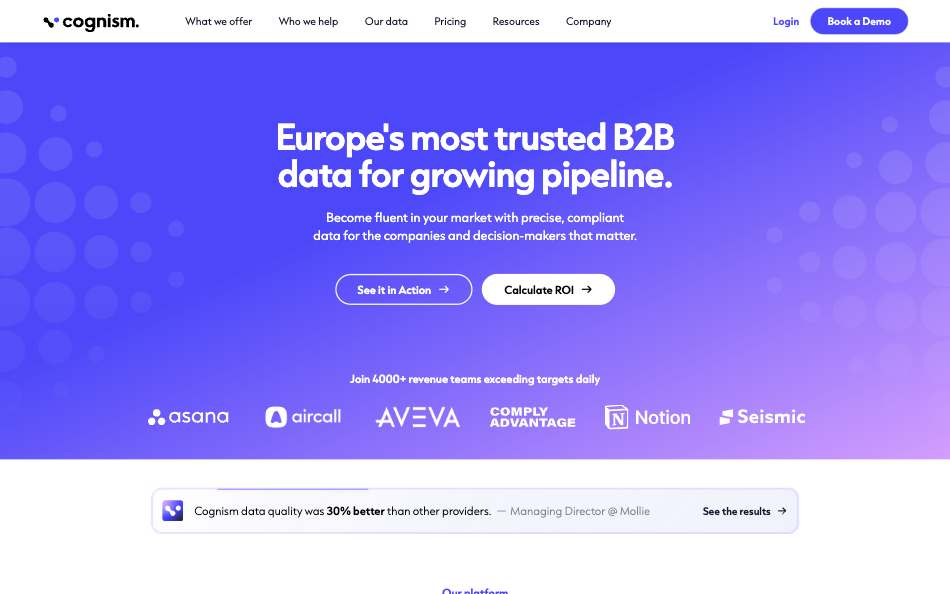
Cognism sells phone-verified mobile data and European coverage to calling teams. It claims over 10M phone-verified contacts and Do Not Call checks in 15 territories (Cognism Diamond Data, September 2026).
It publishes no dollar price. Plans are Standard and Pro with 5 seats each, tailored by quote. One credit reveals one contact.
The API allows 500 requests a minute per operation, and the MCP server has 15 tools. API and MCP need a package that includes them.
Pros
- Strong fit for phone-led European outbound.
- API and MCP with OAuth.
- Re-viewing a revealed contact is free.
Cons
- No public price at any volume.
- Credit allocations are not published.
- API access depends on the package.
Best for: calling teams selling into Europe. Pricing: quote only (Cognism pricing, September 2026).
6. Clay: best for workflow builders
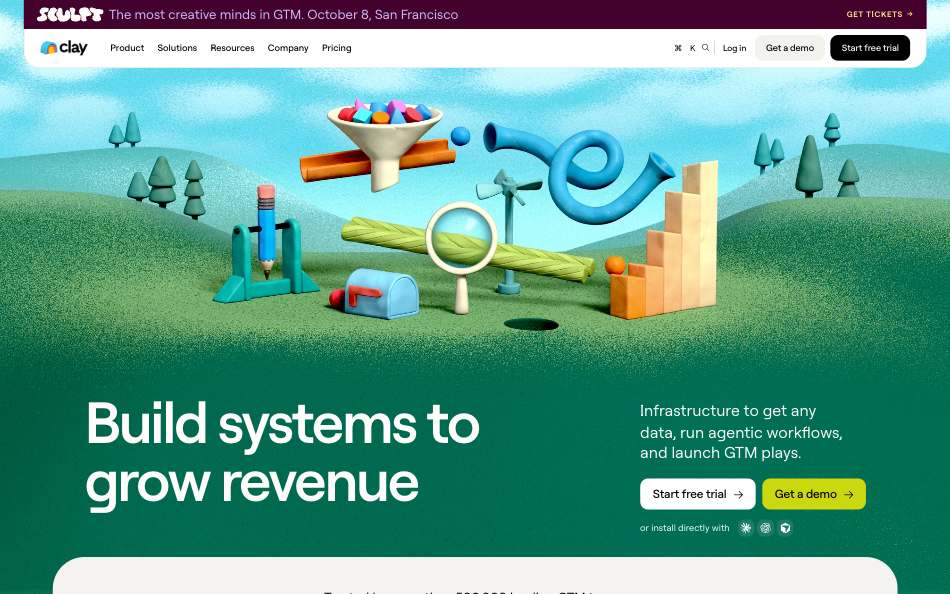
Clay is a table where you chain data providers, enrichment and AI research columns. It suits GTM engineers who want to build a custom flow. Its developer API is on every plan.
Plans use two meters: Data Credits and Actions. Launch starts at $185 a month ($167 billed yearly) and Growth at $495 ($446 billed yearly). Clay's own docs put a fully enriched record at 6 to 20 Data Credits (Clay pricing, September 2026).
The biggest self-serve tier is 200,000 Actions a month, and Actions cannot be topped up. One million lookups need an Enterprise quote.
Pros
- Many providers in one table.
- Free plan and a 14-day trial.
- No charge when an enrichment finds nothing.
Cons
- Two meters make cost hard to predict.
- Self-serve tops out below 1M lookups.
- No published API rate limit.
Best for: GTM engineers building multi-step enrichment flows. Pricing: Free, Launch from $185, Growth from $495 a month (Clay pricing, September 2026).
7. Seamless.AI: best for reps buying through a sales team
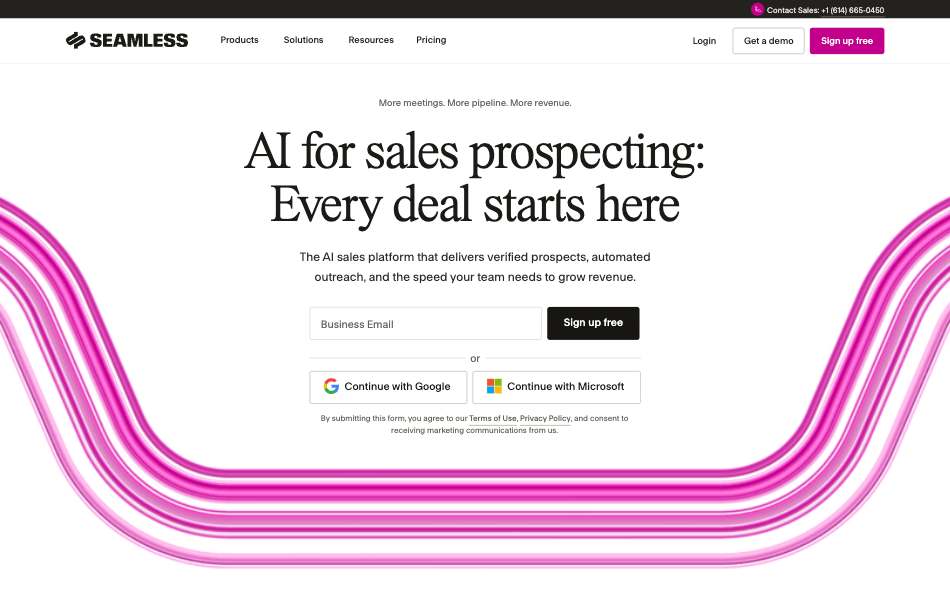
Seamless.AI sells contact research on license credits. Pricing is a form: seamless.ai/pricing asks you to book a demo, and API keys are bundled with plan tiers or sold as an add-on.
One credit covers a contact's email and phone together. Search costs 1 credit per 10 results. The default rate limit is 60 requests a minute per endpoint, shared across the organization (Seamless.AI docs, September 2026).
Contracts are annual, sales are final and renewal needs 60 days' notice. The hosted MCP server has 57 tools.
Pros
- One credit returns email and phone.
- Large coverage claims (2.2B+ contacts, the vendor's figure).
- Hosted MCP server.
Cons
- No public dollar price.
- Annual contract with a 60-day cancel window.
- Rate limit is shared by the whole org.
Best for: reps who buy through a sales-led process. Pricing: no public price (Seamless.AI pricing, September 2026).
Comparison table
| Tool | Best for | Starting price | Cost at 1M records a month | API | MCP | Rate limit |
|---|---|---|---|---|---|---|
| LeadOcean | API and agents | Free; Solo $97 | $497 (Agency) | Yes, every plan | Yes, 13 tools | 5 / 50 / 200 / 10,000 a second by plan |
| Apollo | Rep workspace | Free; $65 per seat | $24,750 list | Yes, every plan | Yes, every plan | Enrichment 1,000 a minute on paid |
| ZoomInfo | Enterprise intent | From $20 (GTM AI) | No public 1M price | Yes (GTM AI) | Yes | 5 to 35 a second by package |
| Lusha | Individual reps | Free; $49.90 | No public 1M price | Yes, every plan | Yes, 50 tools | 40 a minute (Starter) to 300 (Premium) |
| Cognism | European calling | No public price | No public 1M price | Package-dependent | Yes, 15 tools | 500 a minute per operation |
| Clay | Workflow builders | Free; $185 | No public 1M price | Yes, every plan | Yes | Not published |
| Seamless.AI | Sales-led buyers | No public price | No public 1M price | Bundled or add-on | Yes, 57 tools | 60 a minute per endpoint |
How to choose
- You feed an agent or code: LeadOcean. Public price, 200 requests a second, free counts.
- You want one rep workspace: Apollo. Sequences, dialer and extension in the same app.
- You need intent data at enterprise scale: ZoomInfo.
- You are one rep who needs quick contacts: Lusha.
- You call Europe: Cognism, once you have a quote.
- You build multi-provider flows: Clay, and call LeadOcean from an HTTP column.
- Your company already buys through sales: Seamless.AI, with the contract terms read first.
Verdict
For prospecting at volume through an API or an agent, LeadOcean wins on price and rate limit: $497 a month against $24,750 for 1M emails on Apollo list pricing. Apollo wins for reps who need a workspace, ZoomInfo for intent, Lusha for a single user, Cognism for European calls and Clay for custom flows. Most teams pair a data layer with an outreach tool. Start with the free plan and a free count on your own ICP.
FAQ
What is the best SDR tool for prospecting?
It depends on how you work. Reps who live in an app should pick Apollo. Teams that pull data through an API or an agent should pick LeadOcean.
Which SDR tool has the lowest cost at 1M records a month?
Only Apollo and LeadOcean publish enough to price 1M records. LeadOcean is $497 a month on Agency. Apollo is $24,750 a month at list price. The others have no public 1M price.
Do I need a separate sequencer?
With LeadOcean, yes. It is data only. Export a CSV or call the API and send from your sequencer. Apollo includes sequences.
Can an AI SDR use these tools?
Yes, through MCP. LeadOcean, Apollo, ZoomInfo, Lusha, Cognism, Clay and Seamless.AI all run MCP servers. See what is an AI SDR.
How do I size an SDR list before buying?
Use a free count. LeadOcean's count on 21 October 2026 found 23,619 mailable US SDR and BDR titles. Counts spend no records.
Is there a free option?
LeadOcean Free gives 1,000 records for life with no card. Apollo, Lusha, Clay and ZoomInfo GTM AI also have free tiers. See pricing.
Build your SDR prospect list with a free API key
Free to start. No credit card. 1,000 records to spend whenever you like.
Get your free API key →