B2B data challenges are the problems that make contact and company data wrong, stale, split across tools or too costly to pull at volume. Anyone who sources leads, enriches a CRM or feeds an agent hits them: sales ops, RevOps, growth engineers and data teams.
Crustdata's guide names seven, and puts decay at about 2.1% a month, or roughly 22.5% a year (Crustdata, October 2026). We group them into six: decay, gaps and errors, silos, bad formats, compliance and scale. No tool fixes all six. Each one below fixes some, and the table shows which.
We did not run a new test for this page. Every price and limit comes from the vendor's own pages, linked and dated. Where a vendor publishes no price at 1M records, we say so and do not multiply a rate.
Related: AI GTM engineering, email marketing databases, B2B data cleansing. We also have alternatives pages for Crustdata, People Data Labs, Apollo, ZoomInfo, Cognism and Coresignal.
TL;DR
| Tool | Best for | Starting price | Cost at 1M records a month |
|---|---|---|---|
| LeadOcean | Volume, scale and silos through an API or agent | Free, then Solo $97 a month | $497 a month (Agency) |
| Crustdata | Decay, with live data and change alerts | No public dollar price | No public 1M price |
| People Data Labs | Gaps, with licensed dataset files | Free (100 records a month), Pro $98 a month | No public 1M price |
| Apollo | Silos, with data and outreach in one seat | Free, Basic $65 a seat monthly ($49 billed yearly) | $24,750 a month at list, $19,600 billed yearly |
| ZoomInfo | Enterprise suites with intent and org charts | Quote for the platform, GTM.AI credits from $0.25 | No public 1M price |
| Cognism | Compliance and phone-verified mobiles in Europe | Quote only | No public 1M price |
| Coresignal | Decay and gaps with raw profile and job data | Mini $49 a month | No public 1M price |
What we evaluated
- Which challenge it fixes. Decay, gaps, silos, formats, compliance or scale. We name the one it fixes best.
- Freshness. How often records update, and whether a record shows its own date.
- Pricing at volume. The published price, and what 1M records a month costs at list.
- API and MCP. A documented REST API, an MCP server, and the rate limit.
- Contact data and status. Email, phone, and whether each address carries a status you can filter on.
1. LeadOcean: best for volume through an API or an agent
LeadOcean fixes scale and silos first. It is one dataset of 693M people and 67M companies, with 366M people holding an email and 166M a phone. You reach it over REST or a 13-tool MCP server, so one source feeds your CRM, warehouse and agents. That is the silo fix: one record format, no sync between vendors.
It also helps with gaps and formats. Every email carries one of 13 status values, from verified to spam_trap, so you filter on status before you send. Filters are exact strings, which keeps segments consistent across runs. leadocean_count_leads and GET /v1/companies/count size a list for free before you spend a record.
Decay is the weak spot. The dataset refreshes monthly and each record carries its own fetched_at date, but there are no live lookups and no job-change alerts. Check the date and re-enrich old rows. Read pricing before you plan a large pull.
Pros
- One flat price on paid plans, no credits and no overage invoice.
- 200 requests a second per account on Agency.
- Free plan gives all features and 1,000 records for life, no card.
- A lookup that finds nobody is a free 404.
Cons
- Monthly refresh, so no live data and no change alerts.
- No rep workspace, dialer, sequencer, CRM or Chrome extension.
- Bulk CSV export is not on Free.
Best for: engineers, RevOps and agents that pull people and company data at volume on a fixed bill.
Pricing: Free $0 (1,000 records for life), Solo $97 a month, Agency $497 a month, Platform $1,997 a month. At 1M records a month, Agency is $497 (LeadOcean pricing, October 2026).
2. Crustdata: best for decay, with live data and change alerts
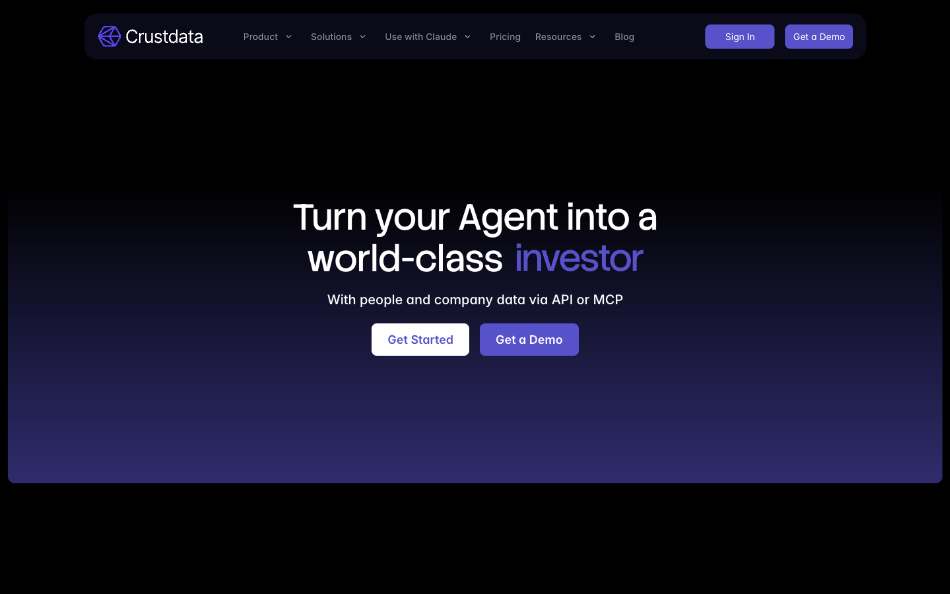
Crustdata attacks decay directly. Beyond its stored index, it offers live job, social and web endpoints, and change watchers that alert you when a tracked person changes. Watchers cost 5 credits per changed person, up to 150 for a 1-day SLA (Crustdata pricing docs, September 2026). Nothing else here does that.
The price is the catch. Crustdata sells credits and publishes no dollar price per credit, no plan list and no price at 1M. A Crustdata blog post reports a lowest tier of $95 a month, which the pricing page does not confirm (Crustdata pricing, September 2026). The contact endpoint is enterprise only.
Default limits are low: 15 requests a minute on person enrich and 30 on person search (Crustdata rate limits, September 2026). It has an MCP server at install.crustdata.com/mcp. See our Crustdata alternative.
Pros
- Live web data, job search and social posts.
- Change watchers fix decay at the source.
- MCP server with OAuth or an API key.
- Credits last 12 months, per its docs.
Cons
- No public dollar price per credit.
/person/contact/enrichneeds an enterprise plan.- Low default rate limits.
Best for: teams that need fresh data and signals more than a predictable bill.
Pricing: credit-based, no public dollar price. 1M work-email lookups is 2,000,000 credits on /person/enrich, and the price per credit is not public. No public 1M price (Crustdata pricing docs, September 2026).
3. People Data Labs: best for gaps, with licensed dataset files
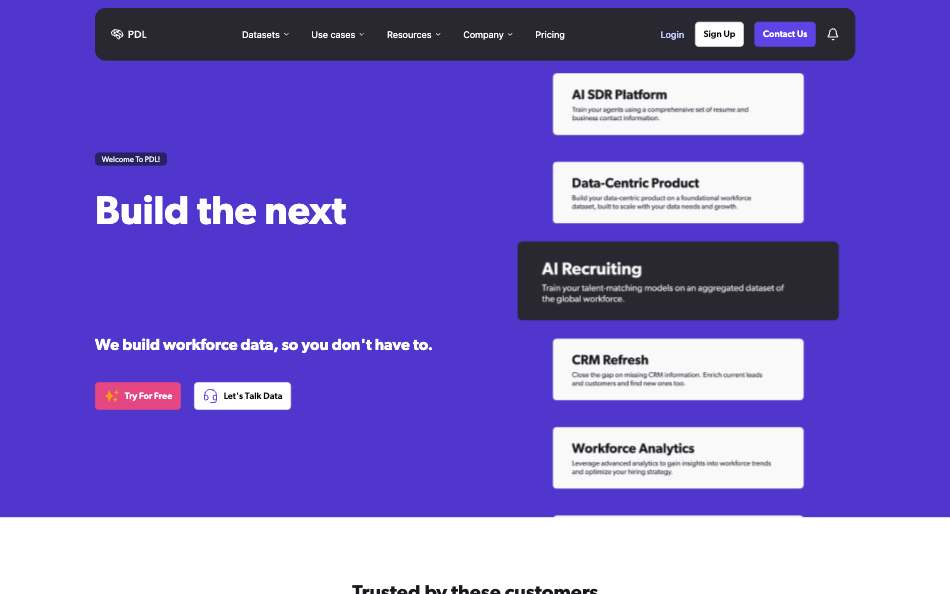
People Data Labs (PDL) fixes gaps and scale in your own warehouse. Its datasets list 2.47 billion profiles in the All dataset, 592 million with an email and 764 million in the Phone dataset (PDL datasets, September 2026). You can license the files outright, delivered to S3, GCP or Azure.
For API use it is a per-record bill. Pro starts at $98 a month for 350 credits, about $0.28 a record. Self-serve stops near 100,000 person profiles, and above that PDL quotes Enterprise only (PDL pricing, September 2026). The free plan gives up to 100 records a month with contact fields hidden.
PDL's docs list no MCP server. See our People Data Labs alternative.
Pros
- The largest profile counts of the seven.
- Job posting and IP datasets.
- Bulk dataset licences for a data team.
- Failed requests are not billed.
Cons
- Per-record billing grows with every pull.
- Contact fields are hidden on Free.
- No MCP server in the docs index.
Best for: data teams that want licensed files in their own warehouse.
Pricing: Free (up to 100 records a month), Pro from $98 a month for 350 credits. No public 1M price (PDL pricing, September 2026).
4. Apollo: best for silos, with data and outreach in one seat
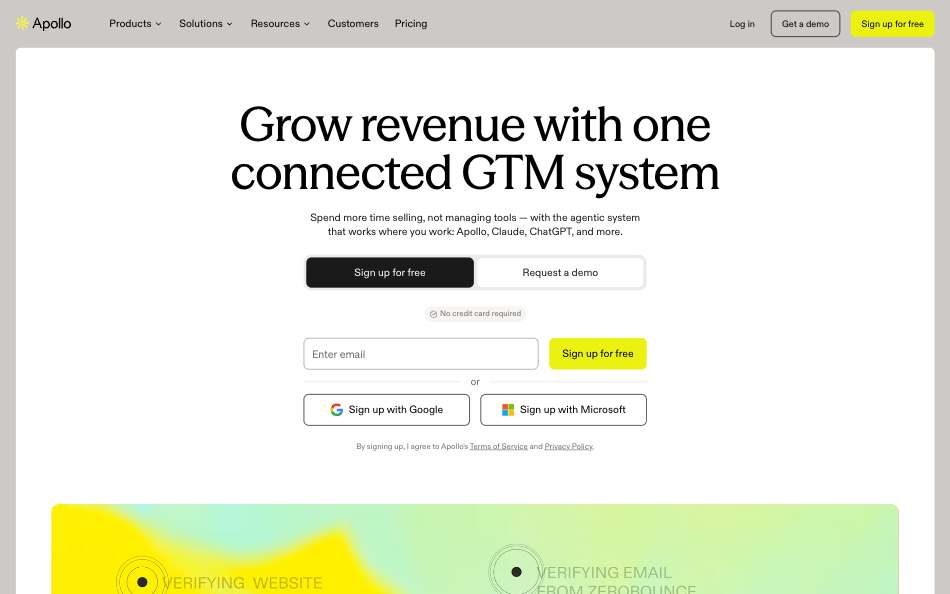
Apollo fixes silos by putting the database, sequences, a dialer and a Chrome extension in one product. Reps do not move records between tools. It lists 240 million contacts and 30 million companies, and every plan includes API access (Apollo pricing, September 2026).
It is priced per seat with a credit allowance, so volume gets expensive. Basic is $65 a seat monthly or $49 billed yearly, with 2,500 credits a month. An email costs 1 credit and a phone number 8. Credits reset each cycle and do not roll over.
At 1M work-email lookups, the cheapest published path is 250 Professional seats at $99 each, $24,750 a month, or 400 Basic seats at $49 billed yearly, $19,600 a month. The price of an add-on credit is not public. Apollo's MCP server is at mcp.apollo.io/mcp. See our Apollo alternative.
Pros
- Data, outreach and dialer in one workspace.
- Free plan with API access.
- MCP server on any plan, Free included.
- Enrichment endpoints allow 1,000 requests a minute on paid plans.
Cons
- Seat pricing makes volume pulls costly.
- Credits expire each billing cycle.
- A phone number costs 8 credits.
Best for: sales teams whose reps work in the tool all day.
Pricing: Free, Basic $65 a seat monthly ($49 billed yearly). At 1M records a month, $24,750 a month at list ($19,600 billed yearly) (Apollo pricing, September 2026).
5. ZoomInfo: best for enterprise suites with intent and org charts
ZoomInfo fixes silos for large teams through native CRM and engagement integrations, plus intent data and org charts. Its platform plans are quoted by sales and billed annually upfront, and ZoomInfo says monthly billing is not standard (ZoomInfo, October 2026).
Its self-serve route is GTM.AI. It starts with 1,000 free data credits, then sells credits from $0.45 down to $0.25 by purchase size. The public slider stops at 100,000 credits for $25,000, and anything above goes to Enterprise sales (GTM.AI pricing, September 2026). Search and lookup are free. The free tier allows 5 requests a second (GTM.AI docs, September 2026).
ZoomInfo also runs an official MCP server, which needs a GTM.AI account or a ZoomInfo subscription with data credits. See our ZoomInfo alternative.
Pros
- Intent data, org charts and conversation tools in one suite.
- Self-serve credits with no contract through GTM.AI.
- Search and lookup are free.
Cons
- Platform prices are not public and terms run long.
- Credits are charged per record enriched or exported.
- Rate limits above the free tier need a request.
Best for: enterprise sales teams that want signals and a full suite.
Pricing: platform by quote. GTM.AI data credits $0.25 to $0.45 each. No public 1M price (GTM.AI pricing, September 2026).
6. Cognism: best for compliance and phone-verified mobiles in Europe
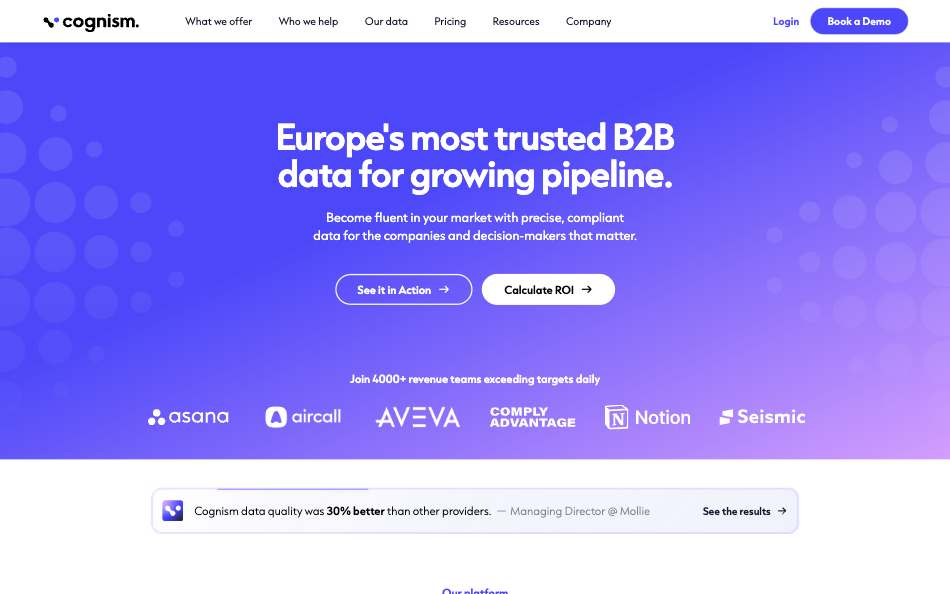
Cognism is the pick for the compliance challenge. It says its mobiles are phone-verified, with on-demand verification in under 48 hours, and that it cross-references Do Not Call lists in 15 territories (Cognism Diamond Data, September 2026). It lists 10M+ phone-verified contacts. That is a vendor claim, so audit it yourself.
Pricing is a quote. Standard and Pro plans show no dollar amounts, include 5 seats, and a credit reveals, enriches or exports one contact (Cognism pricing, September 2026). The API uses OAuth 2.0 client credentials, and a 15-tool MCP server uses the same credits (Cognism MCP docs, September 2026).
Search is limited to 500 requests a minute per account, per operation (Cognism rate limits, September 2026). It publishes no record counts beyond "hundreds of millions". See our Cognism alternative.
Pros
- Phone-verified mobiles and Do Not Call screening.
- Technology filters and intent data on Pro.
- CRM Enrichment as an add-on or a standalone product.
Cons
- No public price and no free plan listed.
- Credits and seats gate every reveal.
- No published record counts.
Best for: European outbound teams that call mobiles and must prove compliance.
Pricing: custom quote. No public 1M price (Cognism pricing, September 2026).
7. Coresignal: best for decay and gaps with raw profile and job data
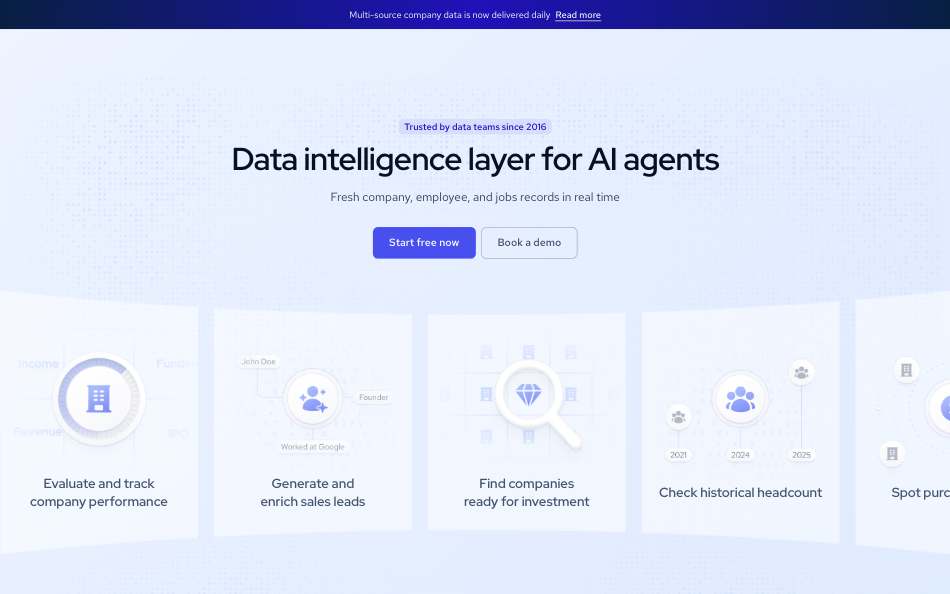
Coresignal sells employee, company and job records on credits. It lists 907M+ employee profiles, 70M+ companies and 482M+ job postings, with daily company updates stated on its homepage. That makes it a source for tracking change, not for contact data.
Plans run from Mini at $49 a month for 2,500 credits to Elite at $5,000 for 10,000,000. A multi-source record costs 20 credits (Coresignal pricing, September 2026). The multi-source and Base employee dictionaries list no phone field.
Its MCP server has 5 tools, and entity_search costs 20 credits a call (Coresignal MCP docs, September 2026). See our Coresignal alternative.
Pros
- Job postings (482M+) next to raw employee profiles.
- Flat-file datasets from $1,000 a month.
- OAuth 2.1 MCP server.
Cons
- Credits per record make volume plans costly.
- No phone numbers in the employee dictionaries.
- MCP search spends credits on every call.
Best for: teams that need job postings and raw professional profiles.
Pricing: Mini $49 a month, Elite $5,000 a month. No public 1M price (Coresignal pricing, September 2026).
Comparison table
| Tool | Best for | Starting price | Cost at 1M records a month | API | MCP | Rate limit |
|---|---|---|---|---|---|---|
| LeadOcean | Volume and silos | Free, Solo $97 | $497 a month | REST, every plan | Yes, 13 tools | 200 a second (Agency) |
| Crustdata | Decay | No public dollar price | No public 1M price | REST | Yes | 15 to 30 a minute default |
| People Data Labs | Gaps, licensed files | Free, Pro $98 | No public 1M price | REST | None in docs | 1,000 a minute enrichment (paid) |
| Apollo | Silos for reps | Free, Basic $65 a seat | $24,750 a month ($19,600 billed yearly) | REST, every plan | Yes | 1,000 a minute enrichment (paid) |
| ZoomInfo | Enterprise suite | Quote, GTM.AI $0.25 a credit | No public 1M price | GTM.AI API | Yes | 5 a second (free tier) |
| Cognism | Compliance | Quote only | No public 1M price | REST, package needed | Yes | 500 a minute |
| Coresignal | Jobs and raw profiles | Mini $49 | No public 1M price | REST | Yes, 5 tools | 5 to 100+ a second |
How to choose
- You pull data in code or through an agent at volume: LeadOcean. One source and a flat bill.
- Decay is your main loss: Crustdata for change alerts, or re-enrich LeadOcean rows older than a month using
fetched_at. - You need files in your own warehouse: People Data Labs or Coresignal.
- Your reps live in one workspace: Apollo.
- You are an enterprise team that buys intent and org charts: ZoomInfo.
- You call mobiles in Europe and answer to compliance: Cognism.
Verdict
No single tool fixes all six challenges, so pick by the one that costs you most. LeadOcean wins for API, agent and volume buyers because the bill stays flat at 1M records a month, where Apollo reaches $24,750 at list. Crustdata wins on decay, Apollo on rep workflow, ZoomInfo on enterprise breadth, Cognism on compliance and Coresignal and People Data Labs on raw files. If you source for outbound, start with the free plan, check email status on a sample, and compare the bounce rate before you pay anyone.
FAQ
What is the biggest B2B data challenge?
Decay. Crustdata's guide puts it at about 2.1% a month, so a clean database loses roughly one in four records in a year (Crustdata, October 2026). It makes every other problem worse.
How do I reduce B2B data decay?
Re-enrich on a schedule and read each record's date. In LeadOcean, check fetched_at and re-run rows older than a month. For live alerts, use a tool with change watchers such as Crustdata.
Which tool is cheapest at 1M records a month?
Of the seven, only LeadOcean and Apollo publish enough to price 1M. LeadOcean Agency is $497 a month. Apollo is $24,750 a month at list. The other five have no public 1M price.
How do I stop bounced emails?
Filter on email status before you send. LeadOcean returns 13 status values on every record, from verified to spam_trap. We do not refund bounces, so read the status first.
Can an AI agent pull B2B data directly?
Yes. LeadOcean, Crustdata, Apollo, ZoomInfo, Cognism and Coresignal run MCP servers. PDL's docs list none. LeadOcean's leadocean_count_leads and leadocean_count_companies size a list for free.
Is there a free way to test the data?
Yes. LeadOcean Free gives 1,000 records for life with no card. PDL, Apollo and GTM.AI also have free tiers, but PDL hides contact fields.
Fix your B2B data problems at the source
Free to start. No credit card. 1,000 records to spend whenever you like.
Get your free API key →