A lead enrichment tool for AI agents is a data source an agent or script can call directly: an API or MCP server that returns people, companies and contact details without a human clicking through an app.
You need one if your agent builds prospect lists, your pipeline enriches signups, or you resell data inside a product. Most enrichment tools were built for reps, so they price by seat or by credit and throttle API calls to protect the app. That is the wrong shape for software that runs all day.
We compared seven tools on API access, MCP server, rate limit and what 1M records a month costs. We make LeadOcean, so we rank it first only where the numbers support it. If you are leaving one of these, see our alternatives pages for Apollo, Crustdata, FullEnrich and Clay.
TL;DR
| Tool | Best for | Starting price | Cost at 1M records a month |
|---|---|---|---|
| LeadOcean | Agents and code at volume | Free ($0, 1,000 records for life), then $97 a month | $497 a month (Agency) |
| Apollo | Small agent jobs with reps in the same tool | $65 per seat a month ($49 billed yearly) | $24,750 a month at list ($19,600 billed yearly) |
| Crustdata | Live web data and change alerts for agents | No public price | No public 1M price |
| FullEnrich | Waterfall email and mobile lookups | $29 a month ($26 billed yearly) | No public 1M price |
| Clay | Agents that feed a Clay table | $185 a month ($167 billed yearly) | No public 1M price |
| Coresignal | Employee and job records at scale | $49 a month | No public 1M price |
| People Data Labs | Dataset files and per-profile lookups | $98 a month ($78 billed yearly) | No public 1M price |
What we evaluated
- API access: is the API on every plan, and does it cover search, enrichment and contact lookups?
- MCP server: is there an official hosted server, how many tools, and what does each call cost?
- Rate limit: how many requests an agent can send before it gets a 429, per second or per minute.
- Price model: seats, credits or flat. Credits and seats punish an agent that retries or loops.
- Cost at 1M records a month: list price only. If a vendor publishes no price at that volume, we say so and do not multiply a rate out.
1. LeadOcean: best for agents and code at volume
LeadOcean is a people and company database you call over REST or MCP. It holds 693M people and 67M companies. The REST API covers search, enrichment, work email, personal email, phone and exports. The hosted MCP server at https://api.leadocean.io/mcp has 13 tools and signs in with OAuth 2.1, so there is no key to paste.
The price model is the point. Paid plans have a fair-use pace, not credits. Agency is $497 a month and allows 1M enrichments a day, 200 requests a second and 5 keys. Counts are free, so an agent can size an audience with count_leads or count_companies before it spends a record. An enrichment that finds nothing costs nothing.
It is only a data layer. The app at app.leadocean.io has an Exports page with a filter builder, column picker and price preview, but no sequencer, dialer, CRM or Chrome extension. If reps need a workspace, pair it with their tool. One search pages to 10,000 rows, so narrow the filters instead of walking the index.
Pros
- Flat monthly price with no credits to run out mid-job.
- 13-tool MCP server on every plan, including Free.
- Free sizing calls: counts, filters and enum lookups cost no records.
- 200 requests a second on Agency, 10,000 on Platform.
- Person enrich returns career history: past roles, education and certifications.
Cons
- No rep workspace, sequencer or dialer.
- Free is 1,000 records once, not monthly, and bulk CSV export is not on Free.
- A single search stops at 10,000 rows, so large pulls need filters split into slices.
Best for: engineers and agent builders who pull data in code or through an agent and want a flat bill inside a fair-use pace. Pricing: Free $0, Solo $97, Agency $497 and Platform $1,997 a month (LeadOcean pricing, October 2026). See /pricing.
2. Apollo: best for small agent jobs next to a rep workspace
Apollo is an all-in-one sales platform with a large contact database, and every plan includes API access. It runs an official MCP server at mcp.apollo.io/mcp with OAuth 2.0 or an API key for headless clients. The server works on any plan, including Free (Apollo MCP docs, September 2026).
The price model is per seat with a credit allowance. An email costs 1 credit and a phone number costs 8. Credits are pooled across the team, so an agent draws from the same pot as your reps. Enrichment endpoints allow 1,000 requests a minute on paid plans, with no hourly or daily cap (Apollo rate limits, September 2026).
The seat model is what breaks at volume. At 4,000 credits per Professional seat, 1M work-email lookups means 250 seats at list price. That is arithmetic from the public seat grid, not a quote. Apollo does not print a price for add-on credits, so a cheaper path cannot be priced.
Pros
- Official MCP server on every plan, including Free.
- API access on every plan.
- 1,000 enrichment requests a minute on paid plans.
- Reps and agents share one database and one login.
Cons
- Per-seat pricing makes high-volume agent work expensive.
- Phone numbers cost 8 credits each.
- Add-on credit price is not public.
- Search endpoints are capped at 200 requests a minute and 50,000 a day on paid plans.
Best for: teams already on Apollo that want an agent to use the same data their reps see, at low volume. Pricing: Basic $65, Professional $99, Organization $149 per seat a month; $49, $79 and $119 billed yearly (Apollo pricing, September 2026).
3. Crustdata: best for live web data and change alerts
Crustdata is a data API with its own index of people, companies, jobs and social posts. It is built with agents in mind. The hosted MCP server at install.crustdata.com/mcp takes OAuth for interactive clients and an API key for code (Crustdata MCP docs, September 2026). It also sells watchers that alert you when a person or company changes.
The cost is hard to model. The pricing page lists no plan names, no dollar prices and no price per credit (Crustdata pricing, September 2026). A work-email lookup is 2 credits on /person/enrich, or 1 credit on the contact endpoint, which needs an enterprise plan. Purchased credits expire 12 months after purchase per the docs, though a July 2026 Crustdata blog post says 6 (Crustdata credits docs, September 2026).
Default rate limits are low for an agent loop: 15 requests a minute on enrich and 30 on search (Crustdata rate limits, September 2026). Batch jobs take up to 10,000 identifiers.
Pros
- Official MCP server with OAuth or an API key.
- Live endpoints and watchers for change alerts.
- Batch person enrich takes up to 10,000 identifiers a job.
- Covers jobs and posts as well as people and companies.
Cons
- No public dollar price at any volume.
- 15 enrich requests a minute by default.
- Contact enrich is gated to enterprise plans.
- Credit expiry is stated two different ways in Crustdata's own materials.
Best for: agents that need fresh signals, job changes and posts rather than a static contact database. Pricing: No public price (Crustdata pricing, September 2026). A Crustdata blog post reports a lowest tier of $95 a month (Crustdata blog, September 2026).
4. FullEnrich: best for waterfall emails and mobile numbers
FullEnrich asks 25+ data sources for each email and phone and charges only for what it finds. API, MCP, search and bulk CSV are on every plan, including the free trial, and users are unlimited (FullEnrich pricing, September 2026). The MCP server signs in with OAuth and covers search, enrich and export (FullEnrich help, September 2026).
Credit costs are published: a work email is 1 credit, a personal email 3, a mobile 10. A miss costs 0 (FullEnrich credit docs, September 2026). That makes it a good fit when you already hold a name and company and need a deliverable address or mobile for a few thousand people.
It is not built for volume. The API allows 60 calls a minute across enrich, reverse email and search (FullEnrich volume docs, September 2026). The top monthly tier is 100,000 credits for $3,500 a month, and above that you contact sales.
Pros
- API and MCP on every plan, including the trial.
- Misses and landlines are free.
- Credits roll over 3 months on monthly plans and 12 on annual plans.
- Strong on mobile numbers through waterfall sources.
Cons
- 60 API calls a minute is a hard ceiling for agent loops.
- Top public tier covers 100,000 lookups a month, not 1M.
- Mobile numbers cost 10 credits each.
Best for: small teams and agents that enrich a known list and need mobile numbers. Pricing: From $29 a month for 500 credits ($26 a month billed yearly) (FullEnrich pricing, September 2026).
5. Clay: best for agents that feed a Clay table
Clay is a workflow spreadsheet that resells 150+ data providers on credits. Its developer platform, a public API with the CLI and plugin, is available on every plan, including Free (Clay API docs, September 2026). There is also an MCP server, and new accounts get 500 free credits on first connect (Clay MCP guide, September 2026).
Clay runs two meters. Data Credits pay for the data and Actions pay for the work. Clay's own docs say a fully enriched record typically costs 6 to 20 Data Credits plus one Action (Clay docs, September 2026). The HTTP API column sits on Growth and above.
Clay is not a bulk source. The largest self-serve tiers top out at 200,000 Actions and 50,000 Data Credits a month, and Actions cannot be topped up (Clay pricing, September 2026). The Public API rate limit is per workspace and Clay publishes no number (Clay rate limits, September 2026).
Pros
- Waterfalls across many providers in one table.
- API and MCP on every plan.
- Misses are not charged.
- Claygent handles research tasks that a data API cannot.
Cons
- Two meters, Actions and Data Credits, make cost hard to predict.
- Self-serve ceiling of 200,000 Actions a month.
- Rate limit is unpublished.
- Tables are read-only through the API.
Best for: teams that already run their go-to-market in Clay and want an agent to write rows into it. Pricing: Launch from $185 a month ($167 billed yearly); Growth from $495 ($446 billed yearly) (Clay pricing, September 2026).
6. Coresignal: best for employee and job records at scale
Coresignal sells employee, company and job records on credits. Its homepage claims 4.5B+ records, 907M+ employee records and 482M+ job postings (Coresignal homepage, September 2026). It is the strongest pick here for job postings and raw profile volume.
The MCP server has 5 tools and signs in with OAuth 2.1. The MCP docs name no plan restriction, but you need an account with credits. entity_search costs 20 credits a call, so an agent that explores before it commits pays for every query (Coresignal MCP docs, September 2026). Contact enrichment is 20 credits a call and only available from the Pro plan upward.
Rate limits scale with plan: 5 requests a second on Mini and Starter, 10 on Pro, 100 on Scale (Coresignal rate limits, September 2026). Credit cost is the constraint, not speed.
Pros
- Very large employee, company and job datasets.
- Official MCP server with OAuth 2.1.
- Rate limits rise to 100 requests a second on Scale.
- Bulk Collect takes up to 10,000 records per request.
Cons
- 20 credits per contact enrichment and per MCP search.
- Contact enrichment is not on Mini or Starter.
- Email fields sit in the multi-source employee API, not the base one.
- No public price at 1M work-email lookups.
Best for: agents and data teams that need job postings and employee records, not only contact details. Pricing: From $49 a month for 2,500 credits; Pro $499 for 35,000 credits (Coresignal pricing, September 2026).
7. People Data Labs: best for dataset files and per-profile lookups
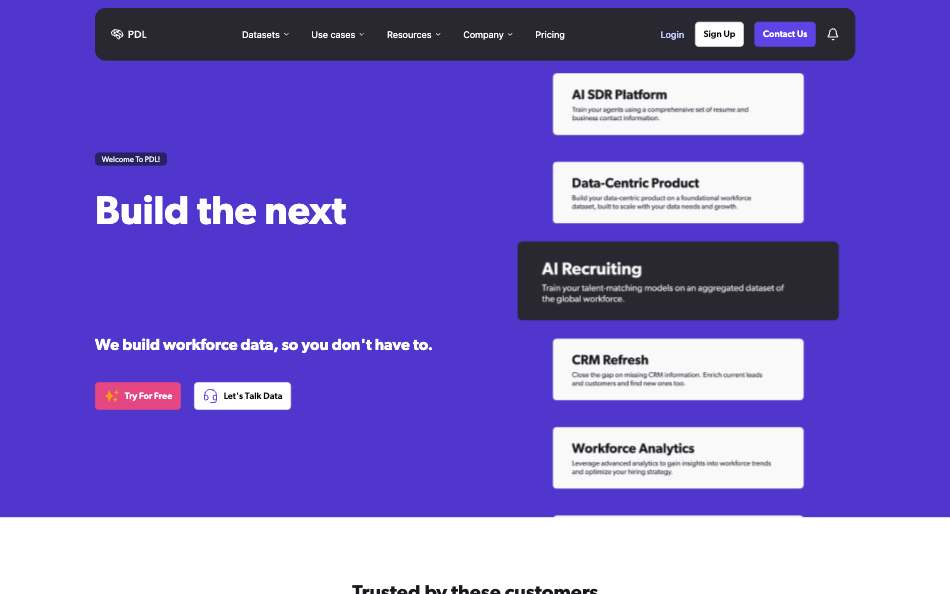
People Data Labs (PDL) is a well-documented data API sold per record, plus bulk dataset licences. Its docs report 2,466,510,427 person profiles and 592,376,573 with an email. Its paid plans allow 1,000 person enrichment requests a minute, but person search defaults to 10 a minute (PDL usage limits, September 2026).
PDL publishes no official MCP server. Its docs, llms.txt and GitHub organization list SDKs and OpenAPI specs only, and the MCP servers that exist are community projects (PDL llms.txt, September 2026). You would host one yourself with your own key.
Self-serve Pro is meant for volumes below roughly 100,000 person profiles. Above that, PDL sells Enterprise only, so there is no public 1M price (PDL pricing blog, September 2026).
Pros
- Largest published people dataset in this list.
- Well-documented API with SDKs and OpenAPI specs.
- Misses (404) are not billed.
- Bulk enrichment takes up to 100 persons per request.
Cons
- No official MCP server.
- Free plan obscures contact data.
- Search is limited to 10 requests a minute by default.
- Self-serve stops near 100,000 profiles.
Best for: data teams that want dataset files in their own warehouse alongside a lookup API. Pricing: Free $0 for up to 100 credits a month; Pro from $98 a month for 350 credits ($78 billed yearly) (PDL pricing, September 2026).
Comparison table
| Tool | Best for | Starting price | Cost at 1M records a month | API | MCP | Rate limit |
|---|---|---|---|---|---|---|
| LeadOcean | Agents and code at volume | Free, then $97 a month | $497 a month (Agency) | REST, every plan | Official, 13 tools | 5, 50, 200 or 10,000 a second by plan |
| Apollo | Small jobs beside reps | $65 per seat a month | $24,750 a month at list ($19,600 billed yearly) | Every plan | Official, any plan | Enrichment 1,000 a minute on paid |
| Crustdata | Live web data | No public price | No public 1M price | REST, batch | Official, OAuth or key | 15 a minute enrich, 30 search |
| FullEnrich | Waterfall mobiles | $29 a month | No public 1M price | Every plan | Official, OAuth | 60 calls a minute |
| Clay | Clay table feeds | $185 a month | No public 1M price | Every plan | Official | Unpublished per workspace |
| Coresignal | Employee and job records | $49 a month | No public 1M price | REST | Official, 5 tools | 5 to 100 a second by plan |
| People Data Labs | Dataset files | $98 a month | No public 1M price | REST, SDKs | None official | 1,000 a minute enrich, 10 search |
How to choose
- You run an agent or pipeline at volume: pick LeadOcean. Flat price, 200 requests a second on Agency and free counts.
- Your reps and your agent share one tool: use Apollo and keep volumes small.
- You need job changes, posts or alerts: pick Crustdata and confirm the credit price in its dashboard before you plan a budget.
- You have a list and need mobile numbers: pick FullEnrich for a few thousand contacts.
- Your team already works in Clay tables: keep Clay and call a flat-price source from the HTTP column.
- You need job postings or employee history: pick Coresignal.
- You need files in your own warehouse: pick PDL, and host your own MCP wrapper if an agent needs it.
See our list for startups, the full tools roundup and the guide to an AI lead generation agent for related picks.
Verdict
LeadOcean wins for agents and code at volume: flat $497 a month, 200 requests a second and a 13-tool MCP server. Apollo wins when reps and agents must share one tool at low volume. Crustdata wins for live signals and alerts, FullEnrich for mobile numbers on known contacts, Clay for table workflows, Coresignal for job and employee records and PDL for dataset files. Five of the other six publish no price at 1M records a month, so ask for a written quote before you build around one.
FAQ
What does an AI agent need from a lead enrichment tool?
It needs an API or MCP server, a rate limit that fits a loop, and a price model that does not punish retries. Free sizing calls help too, so the agent can count an audience before it spends records. Seats and credits both add friction.
Do I need an MCP server, or is a REST API enough?
A REST API is enough for scripts and pipelines. An MCP server lets Claude, Cursor or ChatGPT call the tool without glue code. LeadOcean, Apollo, Crustdata, FullEnrich, Clay and Coresignal run official servers. PDL does not.
Which tool has the highest rate limit?
LeadOcean allows 200 requests a second on Agency and 10,000 on Platform. Coresignal reaches 100 a second on Scale. Apollo allows 1,000 enrichment requests a minute on paid plans, which is about 17 a second. FullEnrich and Crustdata limit calls per minute.
What does 1M records a month cost?
LeadOcean Agency is $497 a month. Apollo works out to $24,750 a month at list price on monthly billing, from public seat prices. The other five publish no price at 1M, so ask for a quote.
Can an agent enrich leads for free?
Yes, within limits. LeadOcean Free gives 1,000 records for life, MCP included, with no card. Apollo Free includes 75 credits a month. PDL Free gives 100 credits a month with contact data obscured.
Is LeadOcean a replacement for a sales platform?
No. It has no sequencer, dialer, CRM or Chrome extension. It is the data layer you call from code or an agent, with an app for CSV exports.
Give your agent a data source that does not meter every lookup
Free to start. No credit card. 1,000 records to spend whenever you like.
Get your free API key →