A sales intelligence platform is a database of people and companies, with contact details and signals, that you search and enrich before you sell. Teams that buy one fall into two camps. Reps want a seat and a screen. Engineers and agent builders want an API, an MCP server and a price they can model.
This list is written for the second camp, with notes for the first. Most platforms below hide their price, meter by credits or cap the API well below volume. We checked each one against the same five questions using public docs and pricing pages. If you are leaving a specific tool, read the matching page first: ZoomInfo, Apollo, Cognism, Lusha, Crustdata or People Data Labs.
We did not run a live benchmark. The comparison is a desk check of public pages, dated September 2026. We own LeadOcean, so read its entry with that in mind.
TL;DR
| Tool | Best for | Starting price | Cost at 1M records a month |
|---|---|---|---|
| LeadOcean | API, agent and volume buyers | Free, then $97 a month | $497 a month (Agency plan) |
| Apollo | Reps who want a seat and a screen | Free, then $65 per seat a month ($49 billed yearly) | $24,750 a month list price on monthly billing; $19,600 a month billed yearly |
| ZoomInfo | Enterprise sales teams buying a full suite | $20 pay as you go (GTM.AI); platform by quote | No public 1M price |
| Cognism | EMEA teams that need verified mobiles | No public price | No public 1M price |
| Lusha | Individual reps who need quick contact lookups | Free, then $49.90 a month ($37.45 billed yearly) | No public 1M price |
| Crustdata | Teams that need fresh person and company signals | No public price | No public 1M price |
| People Data Labs | Developers building on a raw people dataset | Free, then $98 a month ($78 billed yearly) | No public 1M price |
Cost at 1M means 1,000,000 work-email lookups in one month at list price. Where a vendor publishes no price at that size, we say so and do not multiply a small-plan rate.
What we evaluated
- API access: Is there a documented REST API on a self-serve plan, and what does it cost to call?
- MCP server: Does the vendor run an official hosted MCP server that an agent can connect to?
- Rate limit: How many requests a key can send, on the plan a buyer would actually use.
- Public pricing: Can you read the price without a sales call, and does it count seats, credits or records?
- Cost at 1M records a month: What 1,000,000 work-email lookups cost at list price, if the vendor publishes it.
1. LeadOcean: best for API, agent and volume buyers
LeadOcean is a people and company data API with a hosted MCP server. The database holds 693M people and 67M companies. 366M people have an email and 166M have a phone. It is not a rep workspace. There is no sequencer, dialer, CRM or Chrome extension, so reps who live in a browser tab should look elsewhere.
The pricing is the point. Four plans: Free at $0 (1,000 records for life, no card), Solo at $97 a month, Agency at $497 a month and Platform at $1,997 a month. Every plan gets the same data and every feature. The price buys speed, pace, keys and rights. Paid plans have a fair-use pace, not credits, so there is no per-record price and no overage invoice (LeadOcean pricing, October 2026).
For an agent, the 13 MCP tools cover search, enrichment, phone lookup, company data and export, with OAuth sign-in and no key pasted into a chat. The count tools are free, so an agent can size a list before it spends anything. The October 2026 additions are career history on person enrich and a free company count. The main REST calls are POST /v1/people/enrich, /v1/people/search and POST /v1/exports (LeadOcean MCP docs, October 2026).
Pros
- A public flat price, with an Agency plan at $497 a month for volume work.
- 13 MCP tools with OAuth, on every plan including Free.
- Rate limits are published per plan: 5, 50, 200 and 10,000 requests a second.
- Free counts let you size a list at no cost.
Cons
- No rep workspace: no sequences, dialer, CRM or Chrome extension.
- Bulk CSV export is not on the Free plan.
- Paid plans run on a fair-use pace, so a very heavy key is slowed until the window resets.
Best for: Engineers, RevOps teams and agent builders who pull data through an API or at volume.
Pricing: Free $0, Solo $97, Agency $497, Platform $1,997 a month (LeadOcean pricing, October 2026).
2. Apollo: best for reps who want a seat and a screen
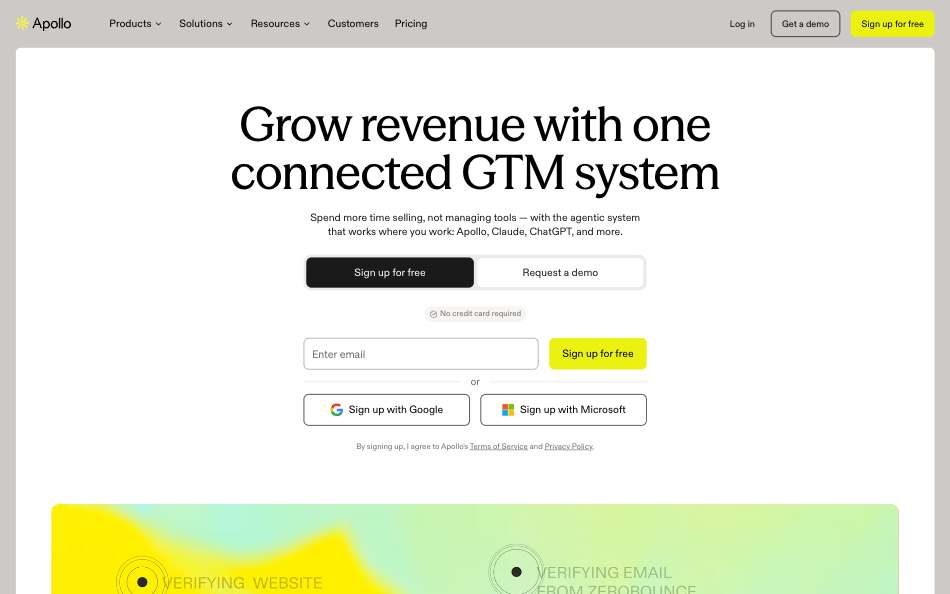
Apollo is the default pick for a rep or a small sales team. It combines a database, outreach sequences and a dialer in one app. Every plan includes API access, Free included, and the company runs an official MCP server at mcp.apollo.io/mcp on any plan (Apollo MCP docs, September 2026).
The catch is the meter. Plans are per seat, and credits are pooled per team and expire at the end of each billing cycle. An email costs 1 credit and a phone number costs 8. People enrichment by API runs 1 to 9 credits (Apollo API pricing, September 2026). The price per extra credit is not public.
At volume the seat model gets expensive. One million email lookups at 1 credit each needs 250 Professional seats at $99, which is $24,750 a month at list price. Billed yearly, the cheapest route is 400 Basic seats at $49, or $19,600 a month equivalent. Apollo does not say whether self-serve allows that many seats.
Pros
- Database, sequences and dialer in one product.
- A Free plan and API access on every plan.
- An official MCP server on any plan.
- Enrichment endpoints allow 1,000 requests a minute on paid plans (Apollo rate limits, September 2026).
Cons
- Per-seat credits expire each cycle and do not roll over.
- Phone numbers cost 8 credits each.
- Cost at 1M is a large seat count, not a volume price.
- Search endpoints cap at 50,000 requests a day on paid plans.
Best for: Reps and small sales teams who want prospecting and outreach in one app.
Pricing: Basic $65, Professional $99 and Organization $149 per seat a month; $49, $79 and $119 billed yearly (Apollo pricing, September 2026).
3. ZoomInfo: best for enterprise sales teams buying a full suite
ZoomInfo is the largest suite in the category. It adds intent data, org charts and workflow tools on top of contact data. Its platform plans are quoted by sales, and zoominfo.com/pricing did not return a readable price to us.
For developers there is GTM.AI, a pay-as-you-go API and MCP server. Data credits list from $0.45 each down to $0.25 at 100,000 credits. One credit covers one company, contact or intent record, charged once per 12 months. Search is free (GTM.AI pricing, September 2026). The free signup gives 1,000 data credits, with API and MCP access at 5 requests a second.
The public slider stops at 100,000 credits. Above that is Enterprise sales, so there is no public price at 1M. Batch enrichment takes at most 25 records per call (GTM.AI docs, September 2026).
Pros
- The widest product: intent, org charts, workflows and data.
- GTM.AI has no seat fee and no contract.
- An official MCP server that works with Claude, ChatGPT and Cursor.
- Search, lookup and find similar are free on GTM.AI.
Cons
- Platform pricing is quote-only.
- GTM.AI package limits run from 5 to 35 requests a second (GTM.AI rate limits, September 2026).
- No public price above 100,000 credits.
Best for: Enterprise sales teams that want intent and a full suite and can buy through sales.
Pricing: GTM.AI from $20 pay as you go; platform plans by quote (GTM.AI pricing, September 2026).
4. Cognism: best for EMEA teams that need verified mobiles
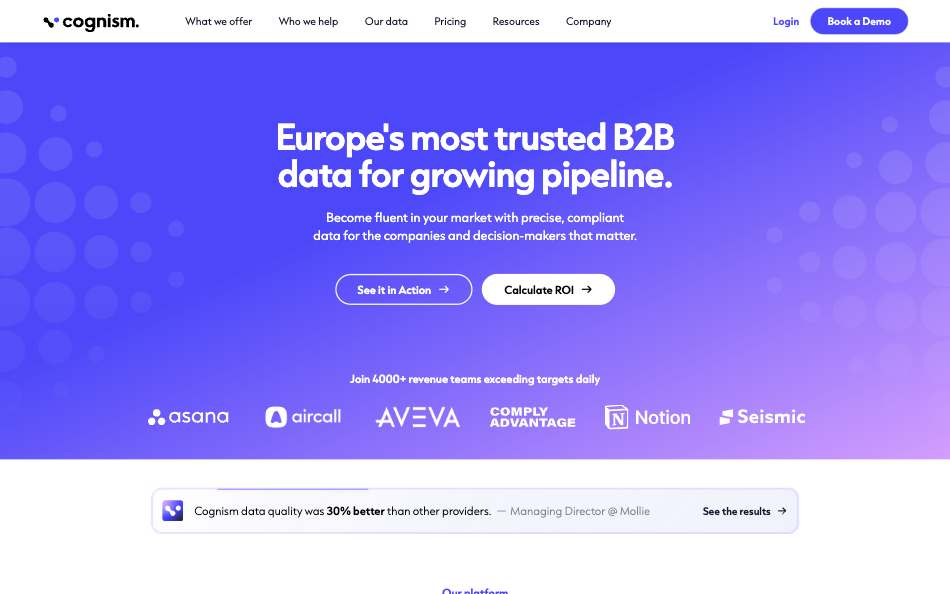
Cognism sells to sales teams that call mobiles, mostly in Europe. Its pitch is phone-verified contacts and Do Not Call screening in 15 territories (Cognism Diamond Data, September 2026). It publishes no dollar price. The pricing page lists two plans, Standard and Pro, at 5 seats each, tailored by quote (Cognism pricing, September 2026).
The API is real. It limits you to 500 requests a minute per account, per operation. Search pages run up to 100 records, with cursor pagination to 100,000 records (Cognism rate limits, September 2026). The MCP server at mcp.cognism.com/mcp has 15 tools that map to the API and use the same credits (Cognism MCP docs, September 2026).
One credit is one revealed contact, and search tokens are charged per record returned. You pay twice at volume, in credits and in tokens, and neither has a public price. API and MCP access need a package that includes it.
Pros
- Strong phone data and Do Not Call screening for EMEA.
- Official MCP server with 15 tools.
- Seat credits cover the platform, Enrich and the API.
Cons
- No public price for any plan, seat or credit.
- Two meters at volume: credits and search tokens.
- API and MCP access depend on the package.
Best for: EMEA outbound teams that dial mobiles and can run a sales process to buy.
Pricing: No public price; Standard and Pro are quote only (Cognism pricing, September 2026).
5. Lusha: best for individual reps who need quick contact lookups
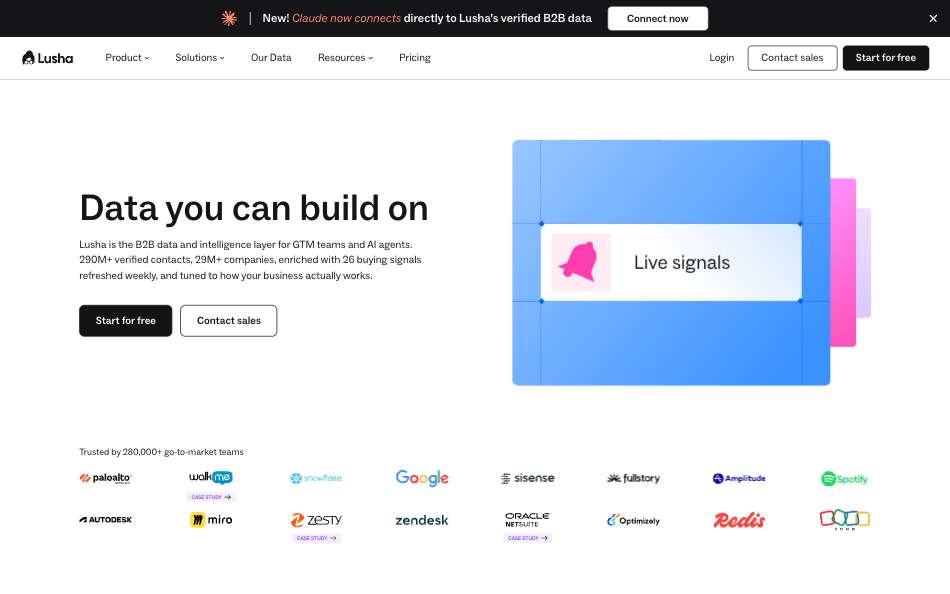
Lusha is built for the single rep. A browser extension and an app return an email or a phone in a click. Every plan, including Free, gets an API key, and the MCP server has 50 tools (Lusha MCP tools, September 2026).
Prices are public and low at the start. Free is 40 credits a month. Starter is $49.90 a month (400 credits), Pro is $69.90 and Premium is $399.90 for 3,400 credits. An email costs 1 credit and a phone costs 5 (Lusha pricing, September 2026).
It does not scale to an API workload. The top public tier is Premium at 10,000 credits a month, $977.40 billed monthly. Premium allows 300 requests a minute per key, and Starter allows 40 (Lusha API guide, September 2026). Scale is custom. Lusha's docs disagree on whether a no-match request is charged, so confirm that before you build on it.
Pros
- Public prices and a Free plan.
- A Chrome extension and an app for reps.
- A 50-tool MCP server on the shared credit pool.
Cons
- Low rate limits on cheap plans.
- Credit-based, with 5 credits per phone.
- The largest public tier is 10,000 credits a month.
Best for: Individual reps and small teams who need contact lookups on demand.
Pricing: Free; Starter $49.90, Pro $69.90, Premium $399.90 a month; $37.45, $52.45 and $299.95 billed yearly (Lusha pricing, September 2026).
6. Crustdata: best for teams that need fresh person and company signals
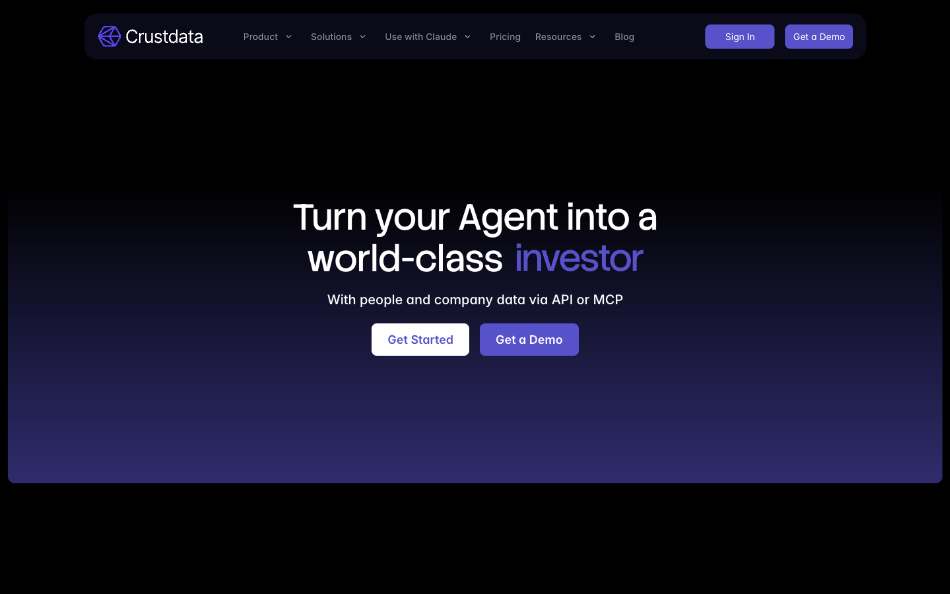
Crustdata is an API-first vendor focused on fresh data and change signals. It offers person and company search and enrichment, job search and watchers that alert you when a person or company changes. A hosted MCP server runs at install.crustdata.com/mcp with OAuth sign-in (Crustdata MCP docs, September 2026).
Pricing is in credits, with no dollar price on the pricing page. Search costs 0.03 credits per result. Person enrich costs 1 to 7 credits, and a work email adds 1 (Crustdata pricing docs, September 2026). The dollar value depends on your plan, so you check it in the dashboard.
Default limits are tight for volume work: 15 requests a minute on person enrich and 30 on search (Crustdata rate limits, September 2026). The cheaper contact endpoint needs an enterprise plan. Self-serve keys get a 403 there.
Pros
- Watchers that flag changed people and companies and new records.
- A hosted MCP server with OAuth.
- Batch person enrich takes up to 10,000 identifiers a job.
Cons
- No public dollar price and no plan list.
- Default rate limits start at 15 requests a minute on enrich.
- The cheaper contact endpoint is enterprise only.
Best for: Teams that build signal-based workflows on fresh people and company data.
Pricing: Credit-based; no public dollar price (Crustdata pricing, September 2026).
7. People Data Labs: best for developers building on a raw people dataset
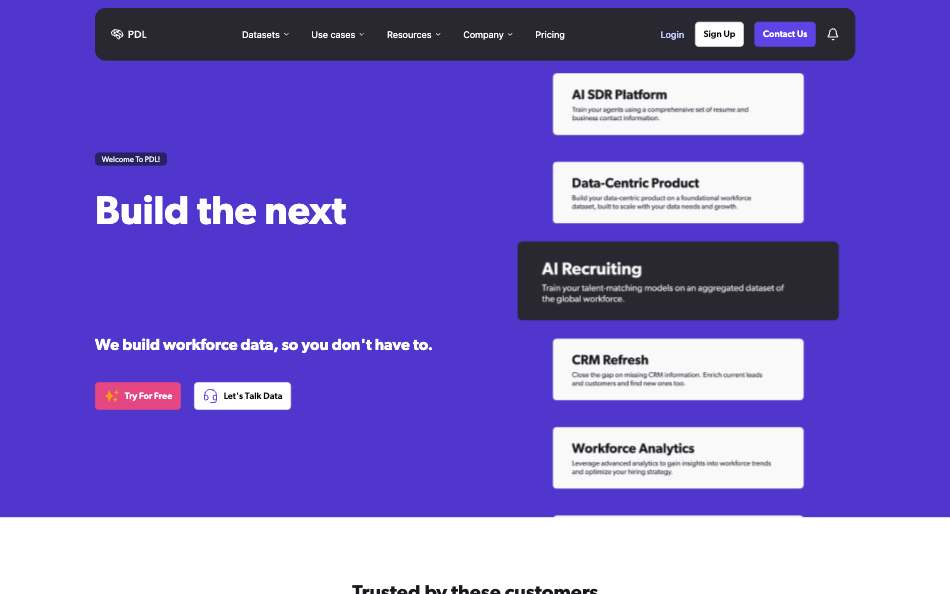
People Data Labs sells a very large people dataset to developers. Its own stats list 592M profiles with an email and 470M with a mobile (PDL datasets, September 2026). It is a data supplier, not a sales app. You build the product around it.
Pricing is public at the entry level. Pro starts at $98 a month for 350 credits, or $78 a month billed yearly (PDL pricing, September 2026). One credit is one successful match. Self-serve is meant for volumes below about 100,000 profiles, and above that PDL sends you to sales (PDL pricing guide, September 2026).
Person enrichment allows 1,000 requests a minute on paid plans, but person search allows 10 a minute by default (PDL usage limits, September 2026). There is no official MCP server in PDL's docs, llms.txt or GitHub. Only community servers exist (PDL llms.txt, September 2026).
Pros
- A large dataset with published profile counts.
- Public entry pricing and a Free plan.
- Failed matches (404) are not billed.
Cons
- No official MCP server.
- Search is limited to 10 requests a minute by default.
- No public price at 1M.
Best for: Developers who build their own product on a raw people dataset.
Pricing: Free; Pro from $98 a month for 350 credits, $78 billed yearly; Enterprise custom (PDL pricing, September 2026).
Comparison table
| Tool | Best for | Starting price | Cost at 1M records a month | API | MCP | Rate limit |
|---|---|---|---|---|---|---|
| LeadOcean | API, agent and volume buyers | Free, then $97 a month | $497 a month (Agency) | REST, all plans | Official, 13 tools | 5, 50, 200 or 10,000 a second by plan |
| Apollo | Reps with a seat | Free, then $65 per seat | $24,750 a month monthly billing; $19,600 yearly | REST, all plans | Official, any plan | 1,000 a minute on enrichment, paid plans |
| ZoomInfo | Enterprise suites | $20 pay as you go (GTM.AI) | No public 1M price | REST via GTM.AI | Official | 5 to 35 a second by package |
| Cognism | EMEA mobiles | No public price | No public 1M price | REST, package dependent | Official, 15 tools | 500 a minute per operation |
| Lusha | Individual reps | Free, then $49.90 a month | No public 1M price | REST, all plans | Official, 50 tools | 40 to 300 a minute by plan |
| Crustdata | Fresh signals | No public price | No public 1M price | REST | Official | 15 to 30 a minute by default |
| People Data Labs | Raw dataset builds | Free, then $98 a month | No public 1M price | REST | None official | 1,000 a minute enrich; 10 a minute search |
How to choose
- You pull data through an API or an agent at volume: pick LeadOcean. The price is flat and the MCP server is on every plan.
- You are a rep who wants a screen and sequences: pick Apollo, and watch the credit meter.
- You need intent data and a full enterprise suite: pick ZoomInfo and plan for a sales-quoted contract.
- You call mobiles in Europe: pick Cognism and expect a quote.
- You need a few lookups a day: pick Lusha.
- You want fresh change signals in code: pick Crustdata, and confirm your rate limits first.
- You build a product on a raw dataset: pick People Data Labs and budget for Enterprise above 100,000 profiles.
Verdict
For API, agent and volume buyers, LeadOcean wins: it is the only one here with a public price at 1M records a month that is not a seat count, and its MCP server is on every plan. Apollo wins for reps who need outreach tools in the same app. ZoomInfo wins for enterprise teams that want intent data and will buy through sales. Cognism wins for EMEA mobile calling. Lusha wins for a single rep. Crustdata wins for fresh signals, and People Data Labs wins for developers building on a raw dataset. Pick by buyer, not by logo.
FAQ
What is a sales intelligence platform?
It is a database of people and companies with contact details and buying signals. You search it, enrich your own records with it and export lists. Some add outreach tools, and others only sell data through an API.
Which sales intelligence platform has the best API?
For volume, LeadOcean and Apollo both document REST APIs on every plan. LeadOcean publishes per-plan rate limits up to 200 requests a second on Agency. Apollo allows 1,000 enrichment requests a minute on paid plans.
Which platforms have an official MCP server?
LeadOcean, Apollo, ZoomInfo (through GTM.AI), Cognism, Lusha and Crustdata run one. People Data Labs has no official server, only community ones, as of September 2026.
How much does a sales intelligence platform cost at 1M records a month?
Only two vendors here let you work it out from public prices. LeadOcean is $497 a month on Agency. Apollo is $24,750 a month at list price on monthly billing, or $19,600 billed yearly. The others publish no price at that size.
Is a sales intelligence platform the same as a data enrichment tool?
They overlap. Enrichment fills gaps in records you already hold. A sales intelligence platform also lets you search for people you do not have yet. Most tools here do both.
Do I need a rep workspace?
Only if your reps work inside the vendor's app. If your team uses its own CRM and sequencer, an API and an MCP server are enough, and LeadOcean, Crustdata and People Data Labs are built for that.
Related: sales intelligence and prospecting platforms, usability guide, lead gen and sales intelligence companies, pricing.
Pull sales intelligence through an API or an agent, with a price you can read
Free to start. No credit card. 1,000 records to spend whenever you like.
Get your free API key →