A sales MCP is a hosted endpoint that lets an AI assistant such as Claude or ChatGPT search, count and enrich buyers through tool calls. Founders, RevOps and SDR leads who build prospecting agents need one.
Most lists stop at "has an MCP server". The server is only the door. The meter behind it decides whether an agent loop costs $497 or $24,750 a month. So we ranked seven servers on how prospecting actually runs: size the list, search it, enrich the people, then price the volume.
Competitor pages cover this keyword already. This one adds a dated count run on 21 October 2026 and a cost at 1M records for each tool. Where a vendor publishes no 1M price, we say so. Head-to-head pages: Apollo, ZoomInfo, Cognism, Lusha, Clay and Crustdata.
TL;DR
| Tool | Best for | Starting price | Cost at 1M records a month |
|---|---|---|---|
| LeadOcean | Agents that prospect at volume | Free (1,000 records, one-off, no card). Agency $497 a month | $497 a month flat. Fair use applies |
| Apollo | Reps who prospect and sequence in one tool | Free. Basic $65 per seat a month, $49 billed yearly | Seat arithmetic, not a quote: about $24,750 a month billed monthly, $19,600 billed yearly |
| ZoomInfo | Teams already on ZoomInfo data | Free: 1,000 data credits. Pay as you go from $20 | No public 1M price. The slider stops at 100,000 credits for $25,000 |
| Cognism | European mobiles for call-led teams | No public price. Quote only | No public 1M price |
| Lusha | Browser-first reps | Free: 40 credits a month. Starter $49.90 a month, $37.45 billed yearly | No public 1M price. Top public tier is 10,000 credits a month |
| Clay | Workflow tables with many data providers | Free. Launch $185 a month, $167 billed yearly | No public 1M price. Largest self-serve tier is 200,000 Actions a month |
| Crustdata | Live signals and change alerts | No public price list | No public 1M price. Person enrich takes 2,000,000 credits |
"1M records" means 1M work-email lookups that return a result. Credits per lookup differ by vendor. Figures are list prices.
What we evaluated
- Sizing before spending: can an agent count a segment without paying for it?
- Search and enrichment in one server: people, companies, emails and phones through MCP, not only documentation.
- Auth and plan gate: OAuth or API key, and which plan opens the server.
- Price model at volume: what one agent call costs and what 1M records cost at list price.
- Limits that stall an agent: rate limits, expiring credits and enterprise-only endpoints.
We gave each vendor the same jobs on paper and read their pricing pages and docs in September 2026. We ran one live check, a free LeadOcean count on 21 October 2026, shown below. We ran no find-rate test, so accuracy claims are the vendor's own.
1. LeadOcean: best for agents that prospect at volume
LeadOcean's MCP server at https://api.leadocean.io/mcp signs in with OAuth 2.1, so no key is pasted into the client. It has 13 tools, from count_leads and search_leads to find_phone and export_leads. Behind it sit 693M people and 67M companies (LeadOcean docs, October 2026).
The prospecting job that matters first is sizing. On 21 October 2026 we asked count_leads for US sales VPs: jobLevel VP, jobFunction Sales & Business Development, country US. It returned 129,494 people with a mailable email (verified, catch_all_valid or catch_all), across about 58,000 companies. Without the email condition the same filters match 350,517. The call spent 0 records.
That is the loop to give an agent. Count, narrow the filters, then search. count_companies sizes company lists the same way, and one search pages to 10,000 rows before it asks the agent to narrow. A prospecting agent never pays to find out a list is too big.
The price model is the second point. Free is 1,000 records for life with every feature. Agency is $497 a month with no per-record price and no overage invoice. Paid plans have a fair-use pace instead of credits, and that pace is what to read before a very large run.
Pros
- MCP on every plan, Free included.
- Free counts, filter lists and enum lookups.
- 200 requests a second on Agency, 5 on Free.
- Email status on every record, so the agent can skip risky addresses.
Cons
- No sequencer, dialer, CRM or browser extension. The app is an Exports page.
- No waterfall enrichment, job postings or intent data.
- Bulk CSV export is not on Free.
Best for: agents, developers and RevOps that need volume and a fixed bill.
Pricing: Free is 1,000 records, one-off, no card. Solo $97 and Agency $497 a month (LeadOcean pricing, October 2026).
2. Apollo: best for reps who prospect and sequence in one tool
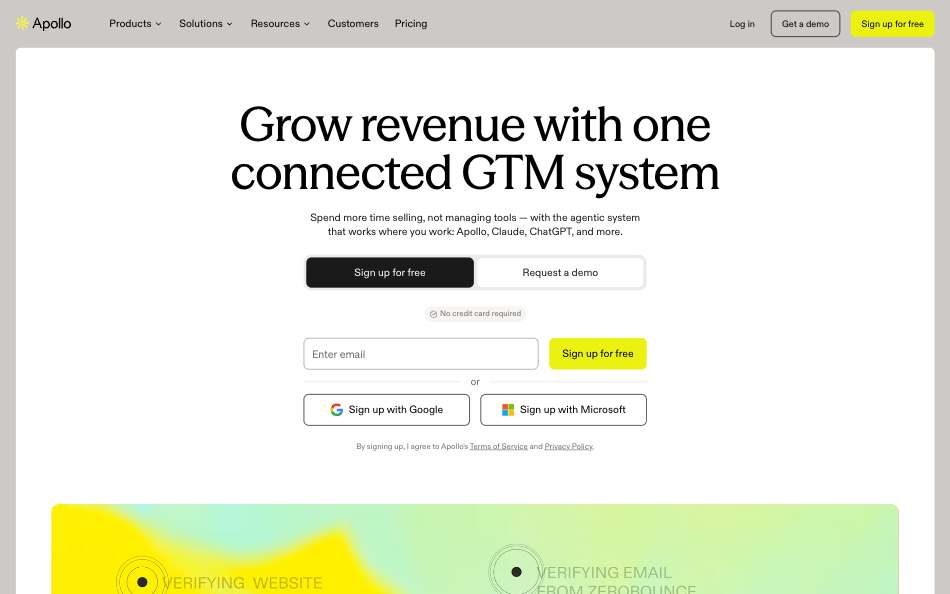
Apollo runs an official MCP server at https://mcp.apollo.io/mcp over Streamable HTTP. It signs in with OAuth 2.0, or takes an API key for headless clients. Any plan qualifies, Free included (Apollo developer docs, September 2026).
Through it an agent can search, enrich, add contacts to sequences and update the CRM (Apollo MCP, September 2026). So the agent can act after the lookup, not only read. The meter is seats plus credits. An email costs 1 credit and a phone number 8, and credits expire each cycle (Apollo API pricing, September 2026).
At volume the seat model bites. Basic gives 2,500 credits per seat a month, so 1M email lookups mean hundreds of seats.
Pros
- MCP on every plan at no extra cost.
- The agent can act: sequences and CRM updates.
- Enrichment runs at 1,000 requests a minute on paid plans (Apollo rate limits, September 2026).
Cons
- Credits are pooled by seat and expire at the end of each billing cycle.
- No public price for add-on credits.
- Built around a rep workspace, not a data feed.
Best for: reps who prospect and send from one workspace.
Pricing: Free with 75 credits a month. Basic $65, Professional $99, Organization $149 per seat a month. Billed yearly: $49, $79, $119 (Apollo pricing, September 2026).
3. ZoomInfo: best for teams already on ZoomInfo data
ZoomInfo has an official MCP server that works with Claude, ChatGPT, Cursor and Copilot. ZoomInfo claims 100M+ companies and 500M+ contacts. It needs a free GTM AI account or an existing ZoomInfo subscription with data credits (GTM AI docs, September 2026).
The GTM AI route is the self-serve one. Search, lookup and find-similar are free, and one data credit enriches or exports one record. A record is charged once per 12 months, so re-enriching it inside that window costs nothing (ZoomInfo API docs, September 2026).
The ladder falls from $0.45 a credit at 100 credits to $0.25 at 100,000 credits for $25,000. Past that it is Enterprise sales (GTM AI pricing, September 2026).
Pros
- Free search and lookup. The free tier includes MCP, API and CLI access.
- Records are charged once per 12 months.
- Enterprise accounts get custom rate limits.
Cons
- Accounts that hold only recurring monthly credits cannot use the server.
- The self-serve slider stops at 100,000 credits.
- Platform plan prices sit behind a human check on zoominfo.com, so we print none.
Best for: teams already on ZoomInfo data that want an agent in front of it.
Pricing: GTM AI is pay as you go from $20, with 1,000 data credits free at signup and no card. The Builder package is capped at 5 requests a second (GTM AI pricing, September 2026).
4. Cognism: best for European mobiles for call-led teams
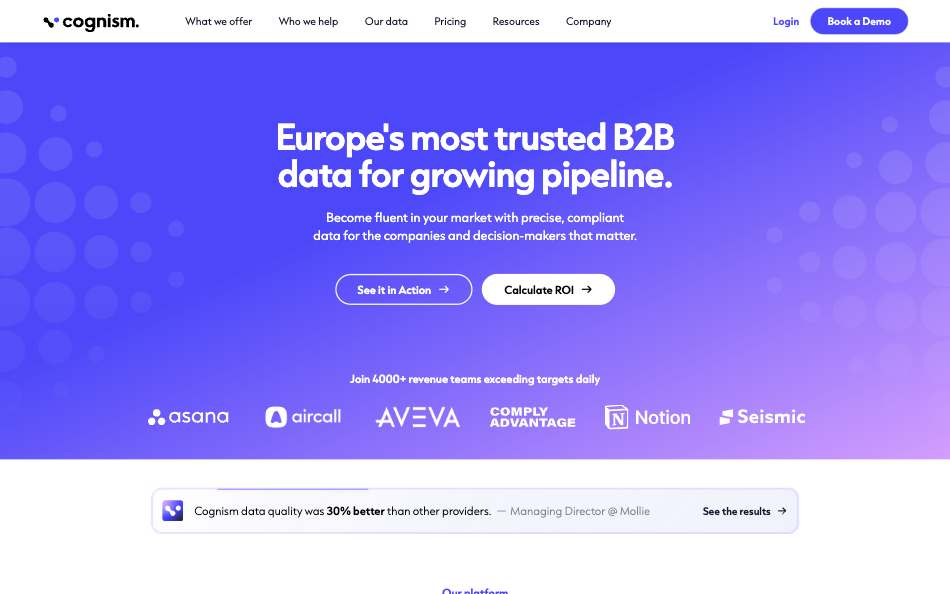
Cognism's MCP server is at https://mcp.cognism.com/mcp, over Streamable HTTP with OAuth 2.0. It has 15 tools: company and people search and count, eight dictionary lookups and three account tools. They map one to one onto the API and spend the same tokens and credits (Cognism docs, September 2026).
Cognism sells phone-verified mobiles, with Do Not Call checks in 15 territories (Cognism Diamond Data, September 2026), to teams that call Europe. One credit is one revealed contact, and a credit is used again only if the contact changes jobs. API and MCP access need a package that includes it (Cognism pricing, September 2026).
The catch for an agent is that no price is public: no plan, seat or credit figure. You cannot cost a 1M run without a quote.
Pros
- Search and count tools on the MCP server.
- A revealed contact is not charged again until it changes jobs.
- 500 requests a minute per operation on the API (Cognism rate limits, September 2026).
Cons
- No public price at any volume.
- API and MCP access need a package that includes them.
- Docs disagree on count-call cost: the Credits page says 1 search token, other pages say free (Cognism credits, September 2026).
Best for: call-led teams that sell into Europe and want an agent in front of mobile data.
Pricing: Quote only. Plans are Standard and Pro, with 5 seats each (Cognism pricing, September 2026).
5. Lusha: best for browser-first reps
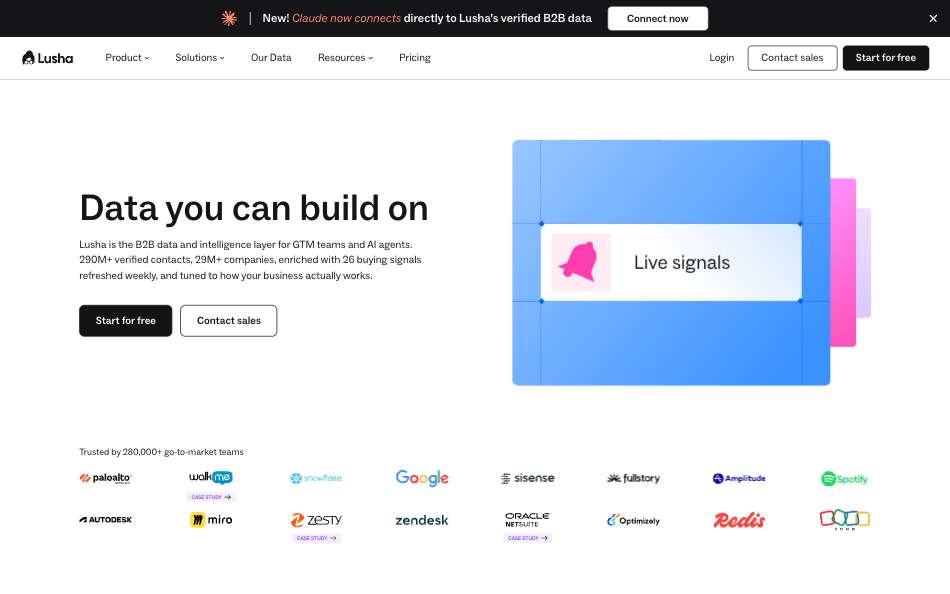
Lusha's MCP server at https://mcp.lusha.com has 50 tools. It shares the REST API credit pool (Lusha MCP tools, September 2026). Every user gets an API key on every plan, Free included (Lusha API guide, September 2026).
An email costs 1 credit and a phone number 5. One contact with both is up to 7 credits through a single API request. Lusha's docs disagree on one point: whether a request with no match costs a credit. The API guide says at least 1, and the MCP tools page says none. Test one miss before a large run.
Pros
- 50 MCP tools on a shared credit pool.
- A free plan with an API key.
- A browser extension for reps who work outside the agent.
Cons
- Plans are built for seats, so volume is quoted. The top public tier holds 10,000 credits a month.
- Per-key quotas are small: Pro is 50 requests a minute and Premium 300.
- The no-match billing rule is unsettled in the docs.
Best for: reps who want contact data in the browser with an MCP server on top.
Pricing: Free is 40 credits a month. Starter $49.90, Pro $69.90, Premium $399.90 a month. Billed yearly: $37.45, $52.45, $299.95 (Lusha pricing, September 2026).
6. Clay: best for workflow tables with many data providers
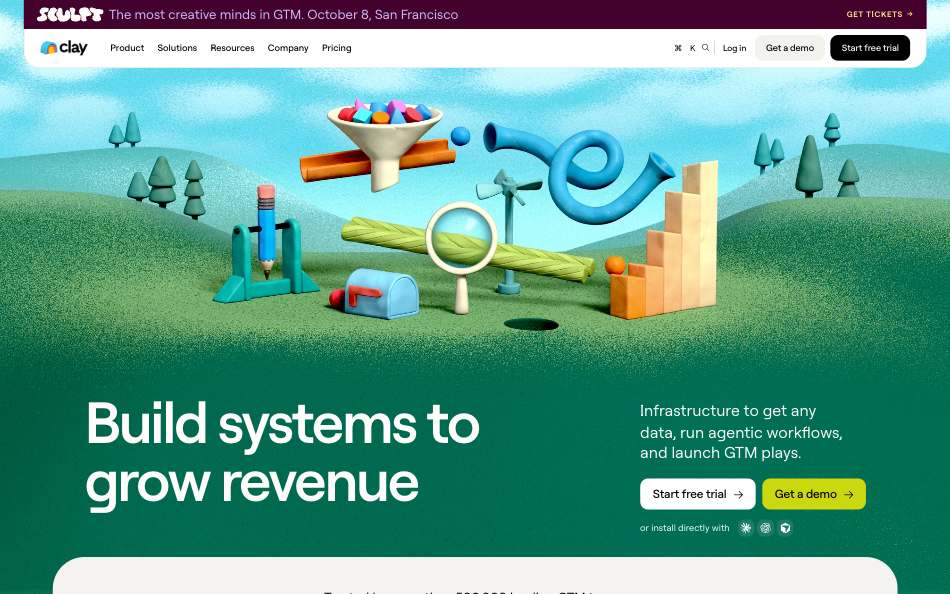
Clay is a table that runs enrichment workflows across many data providers. Its MCP server works in Claude and ChatGPT, and new accounts get 500 free credits on first connect (Clay MCP guide, September 2026). The Public API and CLI are on every plan, including Free (Clay docs, September 2026).
Clay has two meters. Each enrichment uses one Action and some Data Credits. Clay's own doc says a fully enriched record typically costs 6 to 20 Data Credits (Clay docs, September 2026). Actions cannot be bought as top-ups.
That makes 1M a month impossible on self-serve. The largest public tiers are 200,000 Actions and 50,000 Data Credits a month, about $2,975 a month billed monthly. Above that Clay sells Enterprise by quote (Clay pricing, September 2026).
Pros
- Many providers behind one workflow.
- Claygent runs web research per row, on every plan including Free.
- An enrichment that returns nothing is not charged.
Cons
- Two meters, Actions and Data Credits, to forecast.
- Self-serve stops at 200,000 Actions a month.
- Extra credits on Launch and Growth cost a 30 percent premium.
Best for: RevOps who build multi-step prospecting workflows in a table.
Pricing: Free is $0. Launch $185 a month, $167 billed yearly. Growth $495 a month, $446 billed yearly (Clay pricing, September 2026).
7. Crustdata: best for live signals and change alerts
Crustdata's hosted server is at https://install.crustdata.com/mcp. Interactive clients use OAuth, and code uses an API key as a bearer token (Crustdata docs, September 2026).
Search is cheap at 0.03 credits per result. Person enrich is 1 to 7 credits, and a work email through it totals 2 credits. The 1-credit contact endpoint is for enterprise plans only (Crustdata docs, September 2026).
The pricing page lists no plan names and no dollar price per credit (Crustdata pricing, September 2026). 1M work-email lookups need 2,000,000 credits, and you need a quote to turn that into dollars.
Pros
- OAuth for clients, API key for code.
- Cheap search at 0.03 credits a result.
- Live and change-based data that a static database lacks.
Cons
- No public dollar price per credit.
- Default limits are 15 requests a minute on enrich and 30 on search (Crustdata docs, September 2026).
- Purchased credits expire 12 months after purchase, per the docs (Crustdata pricing docs, September 2026).
Best for: signal-driven agents that need fresh data more than volume.
Pricing: Credit based, with no public price list (Crustdata pricing, September 2026).
Comparison table
| Tool | Best for | Starting price | Cost at 1M records a month | API | MCP | Rate limit |
|---|---|---|---|---|---|---|
| LeadOcean | Agents at volume | Free. Agency $497 a month | $497 flat. Fair use applies | REST on every plan | Yes. OAuth 2.1, 13 tools, every plan | 200 requests a second (Agency) |
| Apollo | Reps who sequence | Basic $65 per seat a month, $49 billed yearly | About $24,750 a month, $19,600 billed yearly | Every plan, Free included | Yes. OAuth or API key, any plan | 1,000 a minute on enrichment |
| ZoomInfo | Existing ZoomInfo teams | Pay as you go from $20 | No public 1M price | Included in the free tier | Yes. Free GTM AI account or subscription | 5 a second on Builder, 25 on Standard |
| Cognism | Call-led European teams | Quote only | No public 1M price | Needs a package that includes it | Yes. OAuth 2.0, 15 tools | 500 a minute per operation |
| Lusha | Browser-first reps | Starter $49.90 a month | No public 1M price | Key on every plan | Yes. 50 tools | 300 a minute on Premium |
| Clay | Workflow tables | Launch $185 a month | No public 1M price | Public API on every plan | Yes. 500 free credits on connect | Not published |
| Crustdata | Live signals | No public price list | No public 1M price | REST | Yes. OAuth or API key | 15 a minute enrich, 30 search |
Sources are in each tool section, checked September 2026 (LeadOcean October 2026).
How to choose
- Your agent prospects at volume and needs a fixed bill: LeadOcean.
- Your reps prospect and send from one workspace: Apollo.
- You already pay for ZoomInfo data: ZoomInfo through GTM AI.
- Your reps call Europe and want mobiles: Cognism, after a quote.
- You want contact data in the browser for a few reps: Lusha.
- You build multi-step enrichment workflows: Clay.
- You need fresh signals more than volume: Crustdata.
Verdict
For AI-powered prospecting, the best sales MCP is the one whose meter you can forecast. LeadOcean wins for agents that pull at volume: free counts size the list first, and the bill stays $497 a month. Apollo wins for reps who sequence, since its agent can act after the lookup. ZoomInfo fits teams already on its data, Cognism fits call-led European teams, and Lusha suits browser-first reps. Clay wins for table workflows, and Crustdata wins on live signals. Start on the free plan.
FAQ
What is the best sales MCP for AI prospecting?
LeadOcean, for agents that pull at volume. Agency is $497 a month flat, MCP is on every plan, and counts are free. For reps who also send sequences, Apollo is the better fit.
What does a sales MCP do for prospecting?
It lets an AI assistant size a segment, search it and enrich the people through tool calls. Some servers also write back, such as Apollo adding contacts to sequences. See what is an MCP server for sales.
Can an agent size a list without paying?
On LeadOcean, yes. count_leads and count_companies are free, and our 21 October 2026 count of mailable US sales VPs spent 0 records. ZoomInfo's GTM AI makes search free too. Check the others in their docs.
Which sales MCP is cheapest at 1M records?
LeadOcean at $497 a month flat, with fair use applying. Apollo works out to about $24,750 a month in seats. Cognism, ZoomInfo, Lusha, Clay and Crustdata publish no 1M price.
Do these servers work in Claude and ChatGPT?
Apollo, ZoomInfo and Clay state support for Claude and ChatGPT. Each server here is a remote MCP endpoint that a client can add by URL. See the best AI tools for sales prospecting for tools beyond MCP.
Can I try one free?
Yes. LeadOcean gives 1,000 records for life with no card, on the same MCP server as Agency. ZoomInfo's GTM AI gives 1,000 data credits and Lusha gives 40 credits a month.
Give your prospecting agent a sales MCP with one flat price. Start free.
Free to start. No credit card. 1,000 records to spend whenever you like.
Get your free API key →