A B2B contact database is a store of people records, with titles, work emails and phones, that you search and pull into your own list. Untapped leads are the people your competitors are not already mailing. Outbound teams, agencies and agent builders need them.
Nobody can prove a lead is untouched. You control the filter and the size of the segment. So we compare how each database lets you size a niche before you pay, and what 1M records cost.
LeadOcean is first for readers who pull data by API, by agent or at volume. Rival pages: Apollo, ZoomInfo, Cognism, Lusha, People Data Labs and Crustdata. Related: best lead databases, how B2B data is collected and waterfall providers.
TL;DR
| Tool | Best for | Starting price | Cost at 1M records a month |
|---|---|---|---|
| LeadOcean | API, agent and volume buyers | Free (1,000 records, one-off). Solo $97 a month | $497 a month on Agency. Fair use applies |
| Apollo | Sales teams that want an app plus a database | Free with 75 credits a month. Basic $65 per seat a month ($49 billed yearly) | $24,750 a month at list on monthly billing, $19,600 billed yearly |
| ZoomInfo | Enterprise teams that want intent data | GTM AI credits from $20, $0.45 each down to $0.25 at 100,000 | No public 1M price |
| Cognism | EU outbound teams that call mobiles | No public price | No public 1M price |
| Lusha | Small sales teams on self-serve credits | Free with 40 credits a month. Starter $49.90 a month ($37.45 billed yearly) | No public 1M price |
| People Data Labs | Licensed datasets and per-match enrichment | Pro from $98 a month for 350 credits ($78 billed yearly) | No public 1M price |
| Crustdata | Fresh people and company data for builders | No public price | No public 1M price |
"1M records" means 1M work-email lookups that return a result, at list price. Where a vendor publishes no price at that size, we say so and do not multiply a small-plan rate.
What we evaluated
- Sizing before you pay: whether you can count a segment, by title, country and email status, without spending a credit.
- Filters: how finely you can cut a niche, such as one title in one country.
- Price at volume: flat, credits, seats or quote, and the cost of 1M records.
- API and MCP: whether search and enrichment run from code and from an agent.
- Rate limit: the default per second or minute, and what raises it.
We ran no accuracy test and quote no match rates. Each vendor figure links to its source.
A test you can run in a minute
The test is to count a niche on each database before buying anything. We ran it on LeadOcean with free counts.
On 2026-09-30, VPs in Sales & Business Development located in Canada had 5,066 mailable records. A search for the exact title "GTM Engineer", worldwide, had 154. Europe, mailable, had 52.7M (LeadOcean counts, 2026-09-30).
"Mailable" here means verified, catch-all valid or catch-all emails, the default for leadocean_count_leads. The same count over REST is a free call:
curl -s "https://api.leadocean.io/v1/people/search?jobLevel=VP&jobFunction=Sales%20%26%20Business%20Development&country=CA&count=true&limit=1" \
  -H "x-api-key: $LEADOCEAN_API_KEY"
meta.total is capped at 100,000, so narrow a broad segment until the number is exact. Then price the pull. For 5,066 work emails, Apollo needs 5,066 credits, which is three Basic seats at $65, or $195 for the month, if its records match yours (Apollo pricing, September 2026). The same pull fits inside one LeadOcean Solo month at $97.
1. LeadOcean: best for API, agent and volume buyers
LeadOcean holds 693M people, 366M with an email and 166M with a phone number, plus 67M companies. The data is refreshed monthly. You search with 50 people filters and 34 company filters.
Counting is free. leadocean_count_leads and GET /v1/companies/count size a list before you spend, and a people count returns meta.distinctCompanies. One search pages to 10,000 rows, so split a big niche into narrower searches.
Enrichment is POST /v1/people/enrich, phones are GET /v2/people/phone, and POST /v1/exports returns up to 50,000 rows a request. Every record has an email_status with 13 values. The MCP server at https://api.leadocean.io/mcp signs in with OAuth 2.1 and exposes 13 tools.
Pros
- Free counts, so you size a niche before you spend a record.
- REST and MCP on every plan, Free included, with the same data on each.
- Flat monthly price with a fair-use pace, not credits. A miss on
POST /v1/people/enrichis a free 404.
Cons
- No rep workspace, sequencer, dialer, CRM or Chrome extension. The app has an Exports page, nothing more.
- No name plus domain lookup. Search by domain first, then enrich by
person_id. - No refund for bounced emails, so read
email_statusbefore you send.
Best for: engineers, RevOps teams and agents that need volume and a fixed bill.
Pricing: Free is 1,000 records, one-off, no card. Solo is $97 a month, Agency $497 a month and Platform $1,997 a month. Rate limits run 5 to 10,000 requests a second (LeadOcean pricing, October 2026).
2. Apollo: best for sales teams that want an app plus a database
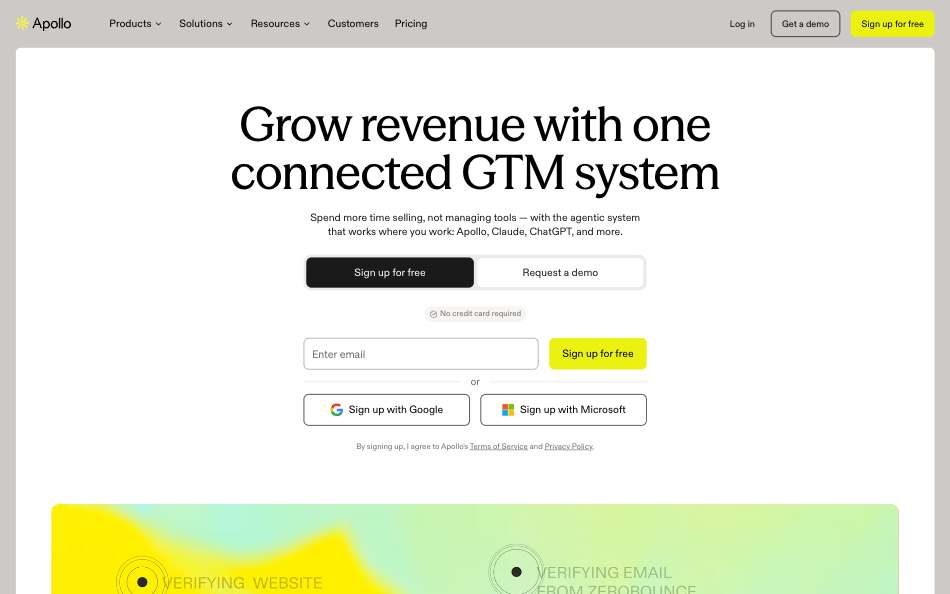
Apollo is a prospecting app with a database behind it. Every plan, Free included, has API access (Apollo developer FAQ, September 2026).
Plans bill per seat. Free is $0 with 75 credits a month. Basic is $65 a seat a month with 2,500 credits, Professional is $99 with 4,000 and Organization is $149 with 6,000 and a three-seat minimum. An email costs 1 credit and a phone 8 (Apollo API pricing, September 2026).
Credits are pooled and expire each billing cycle. Paid plans allow 1,000 enrichment requests a minute and 200 search requests a minute (Apollo rate limits, September 2026). The official MCP server works on any plan (Apollo MCP docs, September 2026).
Pros
- A full sales app, with sequences, on the same login as the data.
- API and an official MCP server on every plan, Free included.
- Enrichment at 1,000 requests a minute.
Cons
- Seats set your credits, so 1M email lookups a month works out to about 250 Professional seats.
- A phone number costs 8 credits, and unused credits expire each cycle.
- The price of an add-on credit is not public.
Best for: sales teams that want one app to find, sequence and call.
Pricing: Free, then $65, $99 and $149 per seat a month, or $49, $79 and $119 billed yearly (Apollo pricing, September 2026).
3. ZoomInfo: best for enterprise teams that want intent data
ZoomInfo is an enterprise sales intelligence suite. We could not read its platform plan prices, so this section covers GTM AI only.
For code, ZoomInfo sells GTM AI, an API, MCP server and CLI on pay-as-you-go credits. A data credit enriches or exports one company or contact. List price falls from $0.45 each to $0.25 at 100,000 credits, which is $25,000 (GTM AI pricing, September 2026). Search and lookup are free.
A record is charged once per 12 months (ZoomInfo API docs, September 2026). Rate limits are 5 requests a second on Builder, 25 on Standard and 35 on Scaling (ZoomInfo API docs, September 2026). The MCP server needs a GTM AI account or a ZoomInfo subscription with data credits (GTM AI docs, September 2026).
Pros
- Free search and lookup, so you can browse a niche before paying.
- A free tier of 1,000 data credits and 1,000 AI credits, with API and MCP, no card.
- A record is charged once per 12 months, so repeat enrichment inside that window costs nothing.
Cons
- The credit slider stops at 100,000 credits. Beyond that is a quote.
- MCP access needs data credits, so a plan with only recurring monthly credits cannot use it.
Best for: enterprise sales teams that want signals and one login.
Pricing: GTM AI credits from $20, $0.45 down to $0.25 each (GTM AI pricing, September 2026).
4. Cognism: best for EU outbound teams that call mobiles
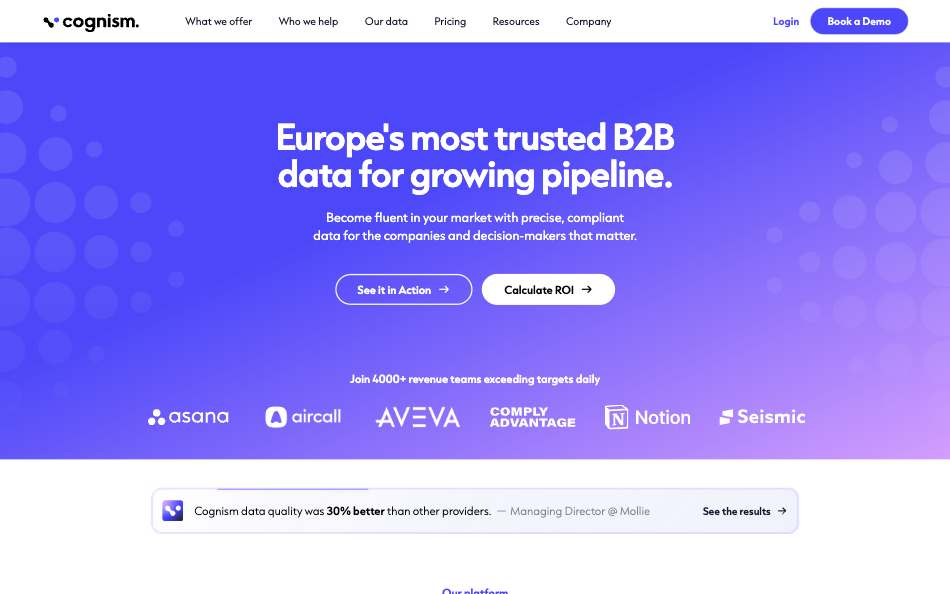
Cognism sells sales prospecting with a focus on phone-verified mobiles. It publishes no dollar price. The pricing page lists Standard and Pro, five seats each, and says pricing is tailored to product, team setup and usage (Cognism pricing, September 2026).
One credit reveals one contact. Each seat includes credits, more can be bought, and the same credits work in the platform, Enrich and the API. Cognism claims over 10M phone-verified contacts and Do Not Call checks in 15 territories (Cognism Diamond Data, September 2026). It gives no total profile count (Cognism FAQ, September 2026).
The API allows 500 requests a minute per account, per operation (Cognism rate limits, September 2026). The MCP server has 15 tools and OAuth 2.0 sign-in, with search and count tools (Cognism MCP docs, September 2026).
Pros
- Phone-verified mobiles with Do Not Call checks, which suits cold calling.
- API and MCP use the same credits as the app, and both have count routes.
- A revealed contact is not charged twice.
Cons
- No public price at any size, so 1M needs a sales call.
- No published coverage count and no credit allocation per seat.
- API and MCP need a package that includes them.
Best for: EU outbound teams that call mobiles and can buy through sales.
Pricing: Quote only. Standard and Pro (Cognism pricing, September 2026).
5. Lusha: best for small sales teams on self-serve credits
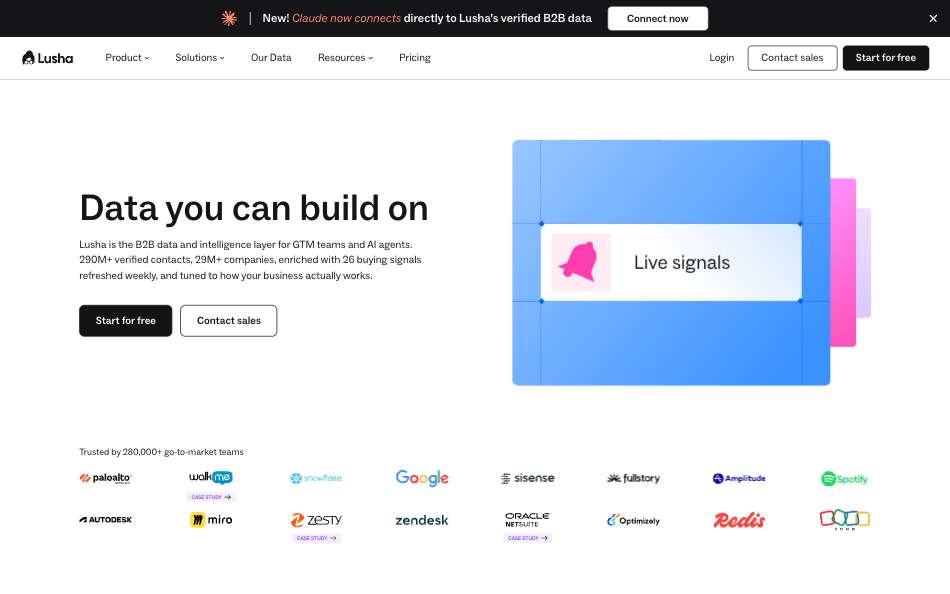
Lusha sells contact data on self-serve credit plans, with a browser extension and an API. Every plan, Free included, gets an API key (Lusha API guide, September 2026).
Free is $0 for 40 credits a month. Starter is $49.90 a month for 400 credits, or $37.45 billed yearly. Pro is $69.90 for 600, or $52.45 yearly. Premium is $399.90 for 3,400, or $299.95 yearly (Lusha pricing, September 2026). Scale is custom.
An email costs 1 credit and a phone 5. Free and Starter allow 40 requests a minute and 100 a day, and Premium allows 300 a minute. The MCP server has 50 tools on the REST credit pool (Lusha MCP docs, September 2026).
Pros
- API key and a 50-tool MCP server on the same credits.
- Data Waterfall, 2 credits per work email, on paid plans.
- A free plan with no card.
Cons
- The top public tier is 10,000 credits a month. 1M is 100 times that.
- Free and Starter cap API use at 100 requests a day.
- Yearly credits reset at the end of the cycle.
Best for: small sales teams that want a self-serve extension and a light API.
Pricing: Free, then $49.90, $69.90 and $399.90 a month, or $37.45, $52.45 and $299.95 billed yearly (Lusha pricing, September 2026).
6. People Data Labs: best for licensed datasets and per-match enrichment
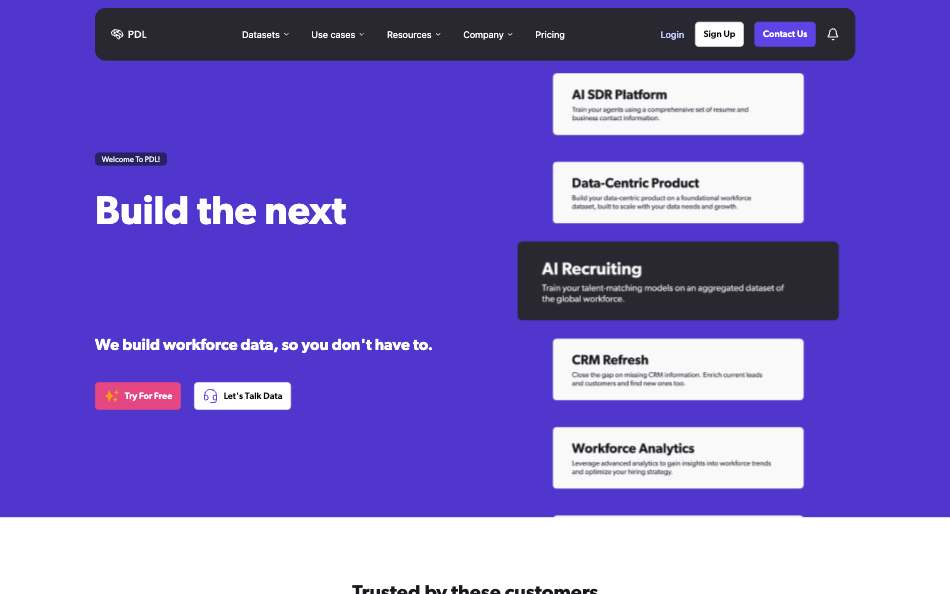
People Data Labs (PDL) is a long-running person and company data API with bulk licences. Its person dataset holds about 2.47 billion profiles (PDL docs, September 2026).
Pro starts at $98 a month for 350 credits, which is $0.28 each. Billed yearly it is $940, or $78 a month. Free gives 100 credits a month with contact data obscured (PDL pricing, September 2026). One credit buys one match, and a 404 is free.
Self-serve is meant for about 100,000 profiles, and above that PDL quotes (PDL blog, February 2026). Enrichment allows 1,000 requests a minute on paid plans, and Person Search allows 10 (PDL docs, September 2026). PDL's docs list no official MCP server (PDL docs, September 2026).
Pros
- The largest stated dataset on this list, with licences for your own warehouse.
- Pay per match, and no charge for a 404.
- Enrichment at 1,000 requests a minute.
Cons
- $0.28 a record at the entry rate, with no public price at 1M.
- No official MCP server.
- Search defaults to 10 requests a minute, which slows niche exploration.
Best for: teams that license data into a warehouse or enrich one match at a time.
Pricing: Free up to 100 credits a month. Pro from $98 a month for 350 credits, or $78 billed yearly (PDL pricing, September 2026).
7. Crustdata: best for builders who want fresh people and company data
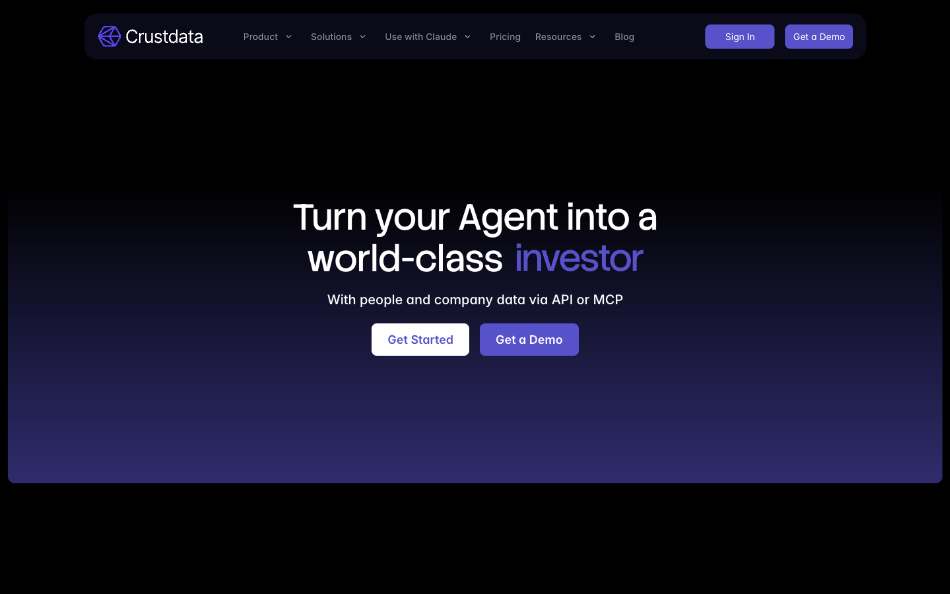
Crustdata is a data API for people and companies, with watchers that alert you when a record changes. Its pricing page lists no plan names and no dollar prices, only credit-based tiers and a contact-sales route (Crustdata pricing, September 2026).
The docs give credits per call. Search is 0.03 credits per result. A person enrich is 1 to 7 credits, and a work-email lookup is 2 credits on /person/enrich (Crustdata docs, September 2026). The 1-credit contact endpoint needs an enterprise plan (Crustdata docs, September 2026).
Default limits are 15 requests a minute on enrich and 30 on search (Crustdata rate limits, September 2026). The hosted MCP server uses OAuth for interactive clients and an API key for code (Crustdata MCP docs, September 2026).
Pros
- Hosted MCP server with OAuth and API-key sign-in.
- Search is cheap at 0.03 credits a result, and misses on contact enrich are not billed.
- Watchers flag changed people and companies.
Cons
- No public dollar price per credit, so 1M needs a quote. It is 2,000,000 credits on
/person/enrich. - Self-serve keys get a 403 on the contact endpoints.
Best for: builders who want fresh records and change alerts and can buy through sales.
Pricing: Credits, no public dollar price (Crustdata pricing, September 2026).
Comparison table
| Tool | Best for | Starting price | Cost at 1M records a month | API | MCP | Rate limit |
|---|---|---|---|---|---|---|
| LeadOcean | API, agent and volume buyers | Free. Solo $97 a month | $497 a month on Agency. Fair use applies | REST on every plan, Free included | Yes. OAuth 2.1, 13 tools | 5, 50, 200 or 10,000 a second by plan |
| Apollo | App plus database | Free. Basic $65 per seat a month ($49 yearly) | $24,750 a month monthly, $19,600 yearly | REST on every plan | Yes. Official, any plan | 1,000 a minute enrichment, 200 search |
| ZoomInfo | Enterprise suite | GTM AI from $20 | No public 1M price | GTM AI API, free tier | Yes. Needs data credits | 5 to 35 per second by package |
| Cognism | EU mobiles | No public price | No public 1M price | REST, package that includes it | Yes. OAuth 2.0, 15 tools | 500 a minute per operation |
| Lusha | Self-serve credits | Free. Starter $49.90 a month ($37.45 yearly) | No public 1M price | REST on every plan | Yes. 50 tools | 40 a minute on Free and Starter, 300 on Premium |
| People Data Labs | Licensed datasets | Pro from $98 a month ($78 yearly) | No public 1M price | REST, bulk endpoints | None official | 1,000 a minute enrichment, 10 search |
| Crustdata | Fresh data and change alerts | No public price | No public 1M price | REST, contact endpoints enterprise only | Yes. OAuth or API key | 15 a minute enrich, 30 search |
How to choose
- Code, agents or volume: LeadOcean. Free counts, REST and MCP on every plan, a flat monthly price.
- A sales app with sequences: Apollo, if seat-based credits fit your team.
- Intent data: ZoomInfo, whose GTM AI credits also cover intent records.
- EU mobiles for a calling team: Cognism, on a quote.
- A cheap self-serve start: Lusha, if 100 API requests a day is enough.
- Licensed files in your own warehouse: PDL.
- Change alerts on people and companies: Crustdata, on a quote.
Verdict
LeadOcean wins for API, agent and volume buyers. You can count a niche for free, pull it on a flat plan, and give an agent the same data through MCP. Apollo wins for a sales team that wants an app and sequences, ZoomInfo for enterprise signals and Cognism for EU mobiles. Lusha is the cheap self-serve start, PDL wins for licensed datasets, and Crustdata suits builders who want change alerts. Count the same niche on any two of them, then compare the price of pulling it.
FAQ
What are untapped leads?
Untapped leads are people your competitors are not already contacting, such as a niche title or a smaller country. No database can prove a lead is untouched. You find them by sizing narrow segments.
Which B2B contact database finds the best untapped leads?
The one with the finest filters and a free way to count a segment. LeadOcean has 50 people filters and free counts. ZoomInfo offers free search, and Cognism has count routes in its API.
What is the cheapest B2B contact database at 1M records a month?
On list price, LeadOcean at $497 a month on Agency. Apollo works out to $24,750 a month on monthly billing. The other five publish no price at 1M, so ask each for a quote.
How do I size a niche before I buy data?
Run a count with your filters first. On LeadOcean, count=true with limit=1 on search is free, and meta.total is capped at 100,000. Narrow the filters until the number is exact.
Which databases have an MCP server that returns data?
LeadOcean, Apollo, ZoomInfo, Cognism, Lusha and Crustdata do. PDL's docs list no official server.
Do I need a credit card to try LeadOcean?
No. The free plan needs no card. It gives you 1,000 records, one-off, with the same API and MCP server as the paid plans.
Find the niche others skip. Count it free, then pull it by API or agent.
Free to start. No credit card. 1,000 records to spend whenever you like.
Get your free API key →