A data enrichment tool takes a thin record, such as an email or a domain, and returns the missing fields: title, company, phone, funding, tech stack. Sales teams, RevOps, growth engineers and anyone building an agent that needs people data buy one.
The right tool depends on how you call it. Reps in a table want Clay or Apollo. Pipelines need a rate limit and a bill you can forecast, and that is where seats and credits hurt. Apollo credits expire each cycle, Clay needs one Action per enrichment, and Crustdata publishes credits with no dollar price. This guide ranks seven tools by buyer, then prices 1M work-email lookups for each. Related reading: what data enrichment is and enrichment use cases that drive revenue.
TL;DR
Cost at 1M is 1,000,000 work-email lookups in a month, at published list price, monthly billing first and billed-yearly after it. "No public 1M price" means the vendor publishes no price at that volume.
| Tool | Best for | Starting price | Cost at 1M records a month |
|---|---|---|---|
| LeadOcean | APIs, agents and volume | Free ($0, 1,000 records), then Solo $97 a month | Agency $497 a month, flat, fair-use pace |
| Clay | No-code workflows and waterfalls | Free; Launch $185 a month ($167 billed yearly) | No public 1M price |
| Apollo | Reps who want data plus sequencing | Free; Basic $65 per seat a month ($49 billed yearly) | $24,750 a month ($19,600 billed yearly) |
| FullEnrich | Waterfall email and mobile finding | $29 a month ($26 billed yearly) | No public 1M price |
| Prospeo | Verified email at a low credit price | Starter $49 per user a month ($37 billed yearly) | $14,456 a month ($12,529 billed yearly) |
| People Data Labs | Raw profile data inside a product | Pro $98 a month ($78 billed yearly) | No public 1M price |
| Crustdata | Live signals and job changes | No public price | No public 1M price |
What we evaluated
- Published price. Is there a dollar figure on the pricing page, and does it hold at volume?
- Cost at 1M. What do 1M work-email lookups cost on the cheapest public path? We never multiply a rate out where the vendor publishes none.
- API and rate limit. Can you call it from code on any plan, and how fast?
- MCP support. Does the vendor run an official MCP server that an agent can connect to?
- Fit for the buyer. Is it a table for reps, a sales suite, or a data layer for engineers?
We did not run a head-to-head find-rate test for this page. Every number below comes from vendor pricing and docs read in September 2026, or from LeadOcean's own pricing.
1. LeadOcean: best for API, agent and volume buyers
LeadOcean is a people and company data API with a hosted MCP server. It holds 693M people and 67M companies, and every plan gets the same data. Paid plans differ in speed, pace and rights, not in features. It is rank one for anyone who pulls data through code or an agent.
Pricing is flat. Free gives 1,000 records for life with no card. Solo is $97 a month, and Agency is $497 a month with a fair-use pace instead of credits. Searching with count=true and limit=1 is free, so you size a list before you spend a record. This counts VPs in Canada:
curl -s -X POST "https://api.leadocean.io/v1/people/search?count=true" \
  -H "x-api-key: $LEADOCEAN_API_KEY" \
  -H "content-type: application/json" \
  -d '{"jobLevel":["VP"],"country":["CA"],"limit":1}'
Enrichment is POST /v1/people/enrich, and a person we hold nothing for is a 404 that costs nothing. Phones come from GET /v2/people/phone. The MCP server has 13 tools and signs in with OAuth 2.1, so an agent needs no pasted key. The app has an Exports page for CSV downloads. It has no sequencer, dialer or CRM.
Pros
- One flat price, with no seats, credits or per-record price.
- 50 people filters and 34 company filters, and counts are free.
- 5 requests a second on Free, 50 on Solo and 200 on Agency, per account.
- REST and MCP on every plan, Free included.
Cons
- No rep workspace, so reps still need a CRM or sequencer.
- One dataset, so there is no waterfall across other vendors.
- Bulk CSV export is not on Free.
Best for: engineers, RevOps teams and agents that need volume at a forecastable price.
Pricing: Free $0, Solo $97, Agency $497, Platform $1,997 a month (LeadOcean pricing, October 2026).
2. Clay: best for no-code workflows and waterfalls
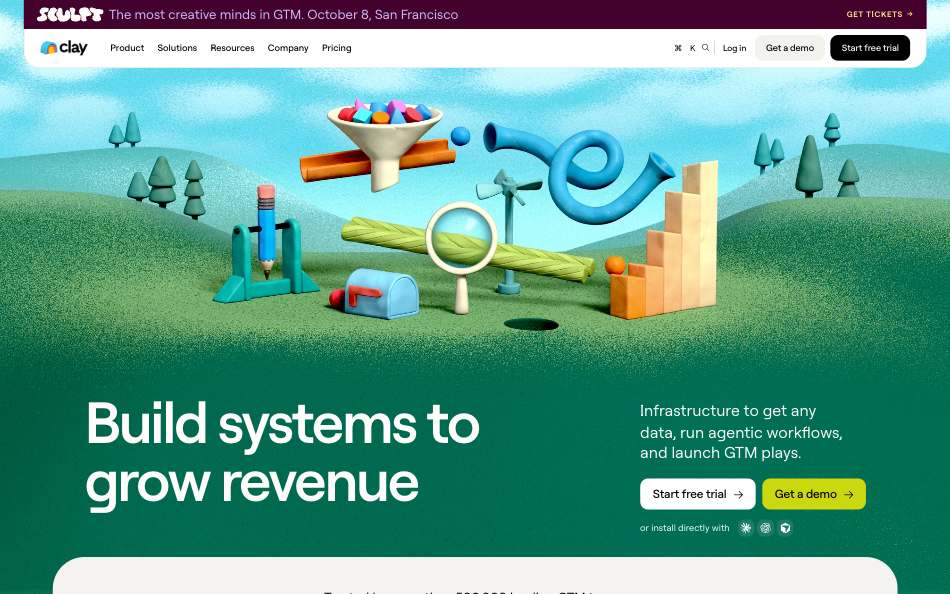
Clay is a spreadsheet for enrichment. You build a table, add columns that call data providers, and chain fallbacks so the next provider runs when the first finds nothing. It is the best option when the person doing the work is not an engineer.
The cost is the credit model. Clay's own docs say a fully enriched record typically costs 6 to 20 Data Credits, plus one Action per enrichment (Clay docs, September 2026). Data Credits start at $0.05 each. The largest self-serve tiers stop at 200,000 Actions and 50,000 Data Credits a month, so 1M lookups in a month needs an Enterprise quote.
The Public API and CLI are on every plan, Free included. The HTTP API column that calls out of a table starts on Growth (Clay docs, September 2026). Clay publishes no number for its Public API rate limit.
Pros
- Waterfalls and conditional runs without code.
- An AI research column, Claygent, on every plan.
- Public API and CLI on every plan, including Free.
- An official MCP server.
Cons
- No dataset of its own, and each provider call spends credits.
- Table rows cap at 50,000 on Launch and Growth.
- Actions cannot be bought as top-ups, so 1M lookups needs a quote.
Best for: growth and ops people building enrichment workflows in a table.
Pricing: Free $0, Launch from $185 a month ($167 billed yearly), Growth from $495 a month ($446 billed yearly) (Clay pricing, September 2026).
3. Apollo: best for reps who want data and sequencing together
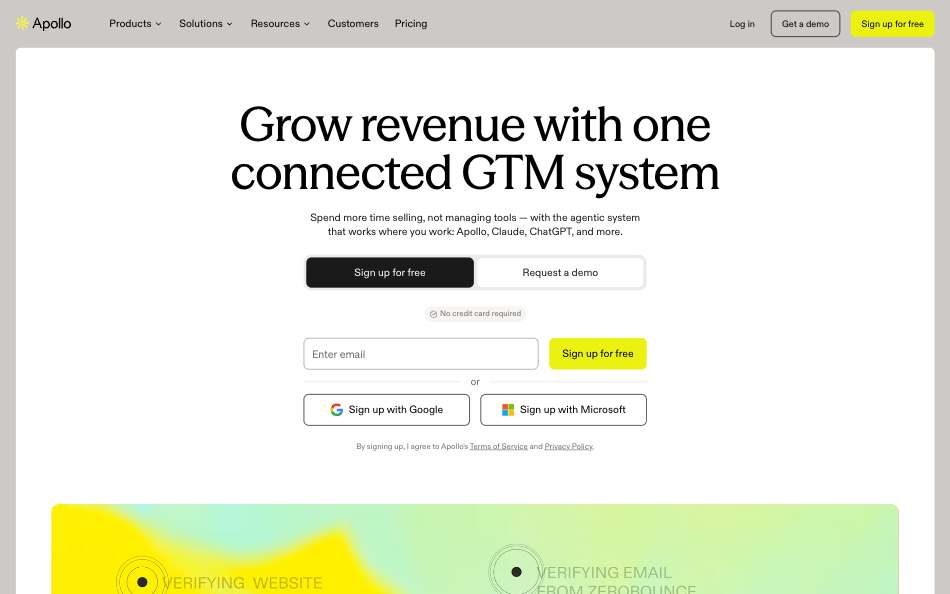
Apollo is a sales platform with a contact database, sequences, a dialer and a rep workspace. Enrichment is one feature among many. If your reps already live in Apollo, enriching there is the shortest path.
Pricing is per seat. Basic is $65 a month per seat with 2,500 credits, or $49 billed yearly. An email costs 1 credit and a phone number costs 8. Credits are pooled across the team and expire at the end of each cycle, including purchased add-ons (Apollo pricing, September 2026).
The cost at volume is seats, not a rate. 1M work-email lookups is 250 Professional seats at $99, or $24,750 a month on monthly billing. On yearly billing, 400 Basic seats come to $19,600 a month. Every plan includes API access, and enrichment endpoints allow 1,000 requests a minute on paid plans (Apollo API docs, September 2026).
Pros
- Database, sequencer and dialer in one product.
- API access on every plan, Free included.
- Official MCP server on every plan, at no extra cost.
- Low entry price for one rep.
Cons
- Seats set the price, so a data pipeline pays for logins nobody opens.
- Credits expire each billing cycle and do not roll over.
- Selection caps per action: 25 on Free, 10,000 on Organization.
- The price of extra credits is not public.
Best for: sales teams that want one tool for data and outreach.
Pricing: Free $0, Basic $65 per seat a month ($49 billed yearly), Professional $99 ($79), Organization $149 ($119) (Apollo pricing, September 2026).
4. FullEnrich: best for waterfall email and mobile finding
FullEnrich runs a waterfall for you. You send a name and a company, and it queries 25+ sources and returns the first verified email or mobile. You get the waterfall without building a Clay table.
Credits are cheap at entry. Pro starts at $29 a month for 500 credits, or $26 billed yearly. A work email costs 1 credit, a personal email 3 and a mobile 10. A miss costs nothing (FullEnrich credits, September 2026).
The ceiling is the rate. The API allows 60 calls a minute across Enrich, Reverse Email and Search, with up to 100 contacts per bulk request (FullEnrich docs, September 2026). The top public tier is 100,000 credits for $3,500 a month. Above that it is contact sales.
Pros
- A waterfall across 25+ sources behind one call.
- API, MCP, search and bulk CSV on every plan, including the free trial.
- Not-found results cost 0 credits.
- Unused credits roll over 3 months on monthly plans and 12 on annual plans.
Cons
- 60 calls a minute is slow for a streaming pipeline.
- No public price at 1M, since the top tier covers 100,000 credits.
- Mobile at 10 credits adds up fast.
Best for: teams that want maximum email and mobile find rate and do not want to build the waterfall.
Pricing: Pro from $29 a month for 500 credits, up to $3,500 a month for 100,000 (FullEnrich pricing, September 2026).
5. Prospeo: best for verified email at a low credit price
Prospeo sells verified emails and mobiles through a web app, an API and an MCP server. Among the credit-based tools here, it has the lowest price per credit if you only need email. One credit buys a verified email, 10 buy a mobile with the email included, and a no-result costs 0.
Plans are per user. Starter is $49 a month for 2,000 credits, Growth $99 for 5,000 and Pro $249 for 15,000. On a paid plan that is $0.0245 down to $0.0166 per credit. Credits do not roll over (Prospeo help, September 2026).
No single tier reaches 1M. The cheapest public path is 44 Pro seats plus the 350,000-credit add-on, or $14,456 a month. On yearly billing it is 67 Pro seats, a $12,529 a month equivalent (Prospeo pricing, September 2026). Enrich allows 5 requests a second on Starter and 30 on Pro.
Pros
- 1 credit per verified email, and 0 for re-enriching within 90 days.
- Hosted MCP server with 8 tools, OAuth or API key.
- Credits pooled across the team.
Cons
- Per-user plans, so volume means many seats.
- Credits expire at the end of each cycle.
- Free-plan API access is described differently across Prospeo's own pages.
Best for: small teams that need verified emails and occasional mobiles at a low unit price.
Pricing: Free $0, Starter $49, Growth $99, Pro $249 per user a month (Prospeo pricing, September 2026).
6. People Data Labs: best for raw profile data inside a product
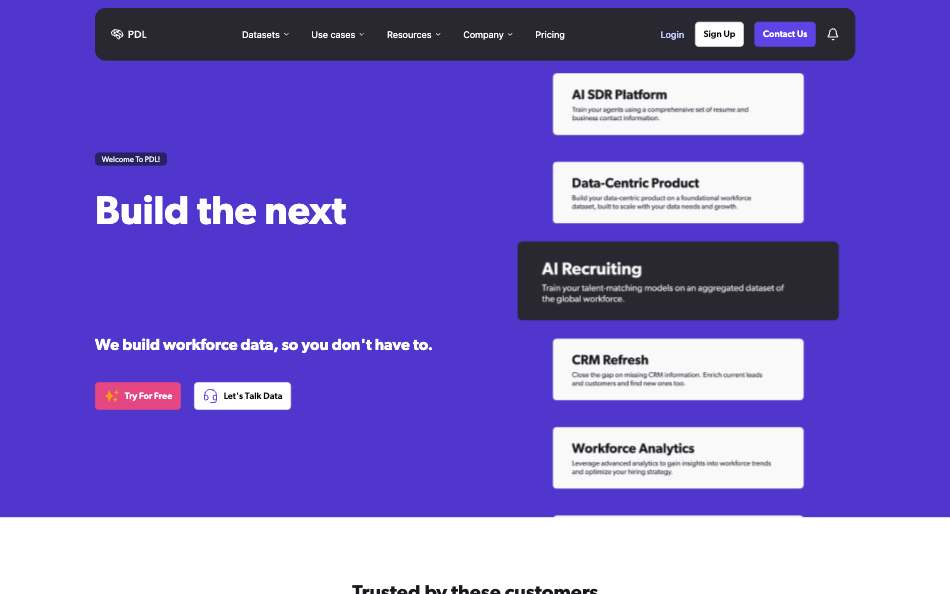
People Data Labs sells data, not a workspace. Its person dataset holds 2,466,510,427 profiles, and 592,376,573 of them have at least one email (PDL docs, September 2026). It is a good fit when you build the user interface yourself.
Self-serve is small. Pro starts at $98 a month for 350 credits, which is $0.28 a credit, or $78 billed yearly. PDL says Pro profiles run about $0.20 to $0.28 each (PDL blog, September 2026). Self-serve is meant for under roughly 100,000 profiles a year. Above that, PDL quotes Enterprise.
Person enrichment allows 1,000 requests a minute on paid plans. Person Search allows only 10 a minute by default (PDL docs, September 2026). PDL's llms.txt lists no official MCP server.
Pros
- The largest person dataset on this list.
- One credit per match, and a 404 is free.
- Bulk enrichment takes up to 100 persons per request.
Cons
- No official MCP server.
- Search is limited to 10 requests a minute by default.
- Self-serve stops near 100,000 profiles a year.
Best for: product teams that embed profile data and negotiate an Enterprise contract.
Pricing: Free $0 (100 credits a month), Pro from $98 a month, Enterprise custom (PDL pricing, September 2026).
7. Crustdata: best for live signals and job changes
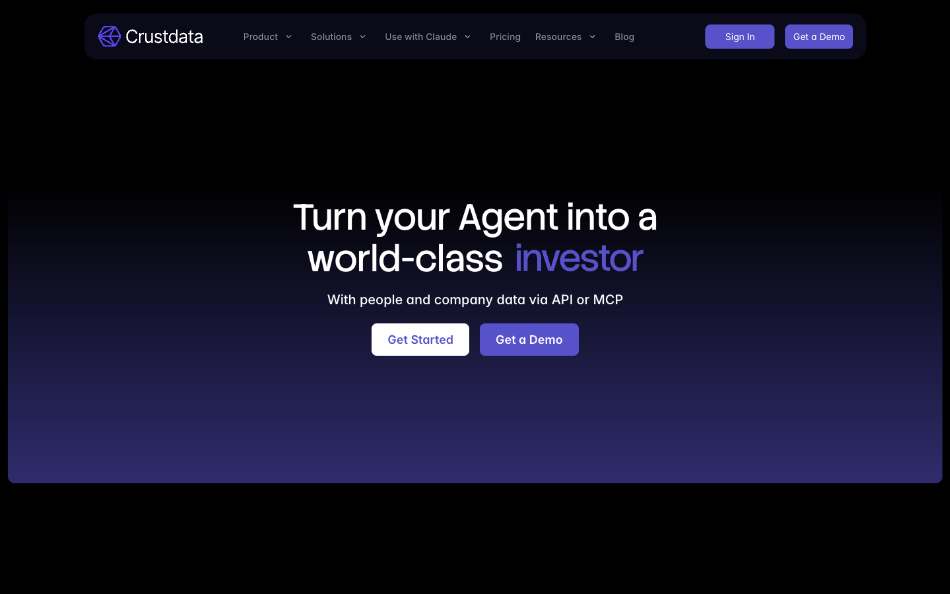
Crustdata is a data API with job search, social posts, live web endpoints and change watchers. It does things a static database does not. If you need to know the day someone changes jobs, this is the tool.
The bill is the problem. The pricing page lists no plan names, no dollar prices and no price per credit. The docs give credits per call and tell you to confirm the dollar value in your dashboard (Crustdata pricing docs, September 2026). A person enrich is 1 to 7 credits. A work email on a self-serve key is 2 credits.
Defaults are tight: 15 requests a minute on person enrich and 30 on search (Crustdata rate limits, September 2026). There is a hosted MCP server at install.crustdata.com with OAuth.
Pros
- Watchers alert you when a tracked person or company changes.
- Job search and live web endpoints.
- Hosted MCP server.
Cons
- No public dollar price, so you cannot forecast a month.
- Contact enrich needs an enterprise plan.
- Low default rate limits.
Best for: teams that act on signals such as job changes and hiring.
Pricing: No public plan prices. Credits per call are published, dollars per credit are not (Crustdata pricing docs, September 2026).
Comparison table
| Tool | Best for | Starting price | Cost at 1M records a month | API | MCP | Rate limit |
|---|---|---|---|---|---|---|
| LeadOcean | APIs, agents, volume | Free; Solo $97 a month | $497 a month (Agency, flat) | Yes, every plan | Yes, 13 tools | 5, 50, 200 or 10,000 a second by plan |
| Clay | No-code workflows | Free; Launch $185 a month | No public 1M price | Yes, every plan | Yes | Per workspace, no number published |
| Apollo | Data plus sequencing | Free; Basic $65 per seat | $24,750 a month ($19,600 yearly) | Yes, every plan | Yes | 1,000 a minute on enrichment, paid plans |
| FullEnrich | Waterfall finding | $29 a month | No public 1M price | Yes, every plan | Yes | 60 calls a minute |
| Prospeo | Verified email | Starter $49 per user | $14,456 a month ($12,529 yearly) | Yes | Yes, 8 tools | 5 a second Starter, 30 a second Pro |
| People Data Labs | Raw profile data | Pro $98 a month | No public 1M price | Yes | No official server | 1,000 a minute enrich, 10 a minute search |
| Crustdata | Live signals | No public price | No public 1M price | Yes | Yes | 15 a minute enrich, 30 a minute search |
How to choose
- You call it from code or an agent: LeadOcean. A flat price and 200 requests a second on Agency beat per-seat or per-credit bills at volume.
- You are not an engineer and want a table: Clay, as long as you stay under its self-serve tiers.
- Your reps need data and outreach in one place: Apollo. Keep a data API for any pipeline that would otherwise buy seats.
- You need the highest email and mobile find rate: FullEnrich, for its waterfall.
- You need verified emails cheaply: Prospeo, at 1 credit per verified email.
- You build a product on profile data: People Data Labs, on an Enterprise contract.
- You need job-change alerts: Crustdata.
Verdict
LeadOcean wins for API, agent and volume buyers, because 1M lookups cost $497 a month on Agency while Apollo needs $24,750 and four vendors publish no price at all. Clay wins for no-code teams, and Apollo wins for reps who want outreach in the same tool. FullEnrich wins on waterfall find rate, Prospeo on cheap verified email, People Data Labs on raw dataset size, and Crustdata on live signals. Start with a free LeadOcean key, run your real filters and compare email status against the tool you use today. The pricing detail is on our pricing page, and the wider use-case view is in the B2B data API guide.
FAQ
What is the best data enrichment tool?
It depends on how you call it. LeadOcean is best for APIs and agents at volume, Clay for no-code workflows, and Apollo for reps who want data and sequencing together. FullEnrich is the pick for a built-in waterfall.
Which data enrichment tool is cheapest at 1M records?
LeadOcean Agency at $497 a month is the lowest published price for 1M lookups. Prospeo comes next at $14,456 a month, then Apollo at $24,750. Clay, FullEnrich, People Data Labs and Crustdata publish no price at 1M.
Do these tools have an API?
Yes, all seven. LeadOcean, Clay, Apollo and FullEnrich put the API on every plan, free tiers included. Check the rate limit in the comparison table before you commit, because it ranges from 15 requests a minute to 200 a second.
Which tools have an MCP server?
LeadOcean, Clay, Apollo, FullEnrich, Prospeo and Crustdata run official MCP servers. People Data Labs lists none in its docs, only community servers. LeadOcean's server has 13 tools and uses OAuth 2.1 sign-in.
What is a waterfall in data enrichment?
A waterfall asks one data source, then falls back to the next when it finds nothing. Clay and FullEnrich both do this. LeadOcean is one dataset, so it does not.
How did you price 1M records?
We used 1,000,000 work-email lookups in a month at published list price. Where no tier reaches 1M and no price is published, we say so and do not multiply a per-credit rate. Prices were checked in September 2026, and LeadOcean's in October 2026.
Run your own enrichment test on 1,000 free records
Free to start. No credit card. 1,000 records to spend whenever you like.
Get your free API key →