A decision maker finder is a tool that takes a company or a title and returns the senior people who sign, with a way to contact them. API and agent buyers need three things. A seniority filter, a free way to size a list, and a price that does not move with every lookup.
Most teams start with a rep tool and outgrow it. Credits run out, API limits cap a scheduled job, and the best title filter sits behind a seat. If you are leaving one of them, see our pages on Apollo, ZoomInfo, Lusha, Cognism, Crustdata and RocketReach.
This page ranks seven tools for API and agent buyers. We compared them on the same five questions, from public docs and pricing pages read in September 2026. We did not run live lookups against vendor accounts.
TL;DR
| Tool | Best for | Starting price | Cost at 1M records a month |
|---|---|---|---|
| LeadOcean | API and agent buyers who need volume | Free, then $97 a month | $497 a month (Agency) |
| Apollo | Reps who want data and outreach in one app | Free, then $65 per seat a month | $24,750 a month monthly list, $19,600 billed yearly |
| ZoomInfo | Enterprise teams that already buy it | Pay as you go from $20 | No public 1M price |
| Cognism | European and mobile-first outbound teams | Quote only | No public 1M price |
| Crustdata | Signals and company graph builders | No public dollar price | No public 1M price |
| Lusha | Individual reps in a browser extension | Free, then $49.90 a month | No public 1M price |
| RocketReach | Small teams that look up people one by one | Free, then $69 a month (reported) | No public 1M price |
Cost at 1M means 1,000,000 work-email lookups. Prices are monthly list first, billed-yearly figure after it. Sources are in each section below.
What we evaluated
- Seniority and function filters. Can you ask for VPs in sales, or only search a title string?
- Free sizing. Can you count a list before you spend records or credits?
- API and agent access. REST on every plan, a hosted MCP server, and the rate limit you get.
- Contact data. Work email, phone, and how each is priced.
- Cost at volume. What 1M lookups cost, only when the vendor publishes enough to say.
1. LeadOcean: best for API and agent buyers
LeadOcean finds decision makers with three filters. jobLevel has six values (C-Team, VP, Director, Manager, Staff, Other), seniority has 12 bands such as c_suite and vp, and jobFunction has 22 functions. It holds 693M people, 366M with an email and 166M with a phone, plus 67M companies (LeadOcean coverage, measured October 2026). Filter counts are free.
The count is the part that matters for planning. On 30 September 2026, a count of VP-level people in Sales & Business Development in Canada returned 5,066 mailable contacts, where mailable means verified, catch_all_valid or catch_all. A count with an email filter is a count of that filter, not a promise of deliverability. Read email_status before you send.
For one company, GET /v1/companies/{domain}/people lists its people up to 10,000 rows. POST /v1/people/enrich takes a LinkedIn URL, email, phone or person_id and returns the profile, including career history. Phones come from GET /v2/people/phone. The Decision Maker Mapper skill wraps this into one Claude command, and the find decision makers page has the filters and curl calls.
Pros
- Seniority, level and function filters that map directly to "who signs".
- Free counts, so you size a list before spending a record.
- REST and a hosted MCP server with 13 tools on every plan, Free included.
- Flat monthly price on paid plans, with a fair-use pace instead of credits.
- Phone and bulk CSV export are included on paid plans.
Cons
- No rep workspace: no sequencer, dialer, CRM or Chrome extension.
- Free is 1,000 records for life, and bulk CSV export is not on Free.
- A search pages to 10,000 rows, so wide pulls need narrower filters.
Best for: Developers, RevOps teams and agent builders who pull decision makers by API or MCP, at any volume.
Pricing: Free $0 (1,000 records for life, no card), Solo $97 a month, Agency $497 a month, Platform $1,997 a month. Agency has no per-record price. See /pricing. Source: LeadOcean pricing, October 2026.
2. Apollo: best for reps who want data and outreach together
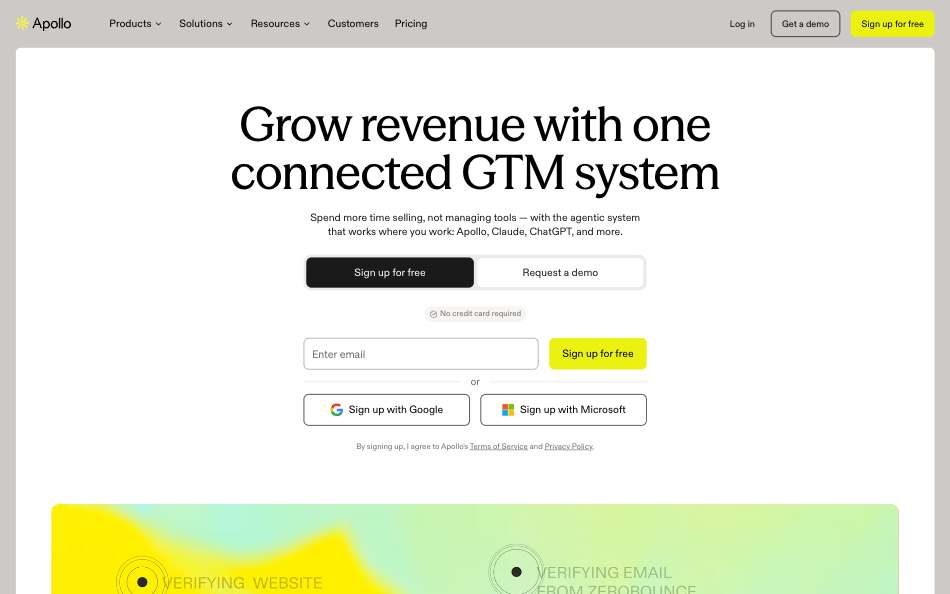
Apollo is a sales platform with a contact database, sequences and a dialer. For decision makers, you search by title and seniority in the app and send from the same place. It is the right pick when the person using the data is a rep, not a pipeline.
The API works on every plan, Free included, and enrichment reaches 1,000 requests a minute on paid plans. Database search endpoints allow 200 a minute and 50,000 a day on paid plans (Apollo rate limits, September 2026). An official MCP server runs at https://mcp.apollo.io/mcp and works on any plan (Apollo MCP docs, September 2026).
Cost grows with volume because credits are per seat. A work email is 1 credit and a phone number is 8, and credits expire at the end of each billing cycle (Apollo API pricing, September 2026). The price of extra credits is not public.
Pros
- Search, sequencing and dialing in one product.
- API and MCP on every plan, Free included.
- Low entry price per seat.
Cons
- Credits are per seat and expire each cycle.
- Phone numbers cost 8 credits each.
- At 1M work emails the seat math reaches 250 to 400 seats.
Best for: Reps and small sales teams who want one app for finding and contacting decision makers.
Pricing: Free $0 with 75 credits a month. Basic $65, Professional $99 and Organization $149 per seat a month; billed yearly they are $49, $79 and $119 (Apollo pricing, September 2026). At 1M work emails the cheapest path is $24,750 a month on Professional, or $19,600 a month equivalent billed yearly on Basic.
3. ZoomInfo: best for enterprises already on it
ZoomInfo data is now also sold by credit through GTM AI. Search, lookup and find-similar are free. One data credit enriches one contact, and a record is charged once per 12 months (ZoomInfo credit docs, September 2026).
That free search matters for decision makers: you can size a title list before you buy. The free plan gives 1,000 data credits, API and MCP access, and 5 requests a second. API limits rise to 25 a second on Standard and 35 on Scaling (ZoomInfo rate limits, September 2026).
The public price list stops at 100,000 credits for $25,000. Anything larger is an Enterprise quote, so there is no public 1M price. The platform plan prices on zoominfo.com were behind a bot check when we looked.
Pros
- Search and lookup are free.
- Official MCP server, with a free GTM AI account to start.
- Credits do not expire while the account is active.
Cons
- No public price above 100,000 credits.
- The MCP server needs a plan with data credits.
- Batch enrichment takes 25 records per call.
Best for: Enterprise sales teams with an existing ZoomInfo contract.
Pricing: GTM AI data credits from $20, at $0.45 each for 100 credits down to $0.25 at 100,000 credits ($25,000) (GTM AI pricing, September 2026).
4. Cognism: best for European and mobile-first outbound
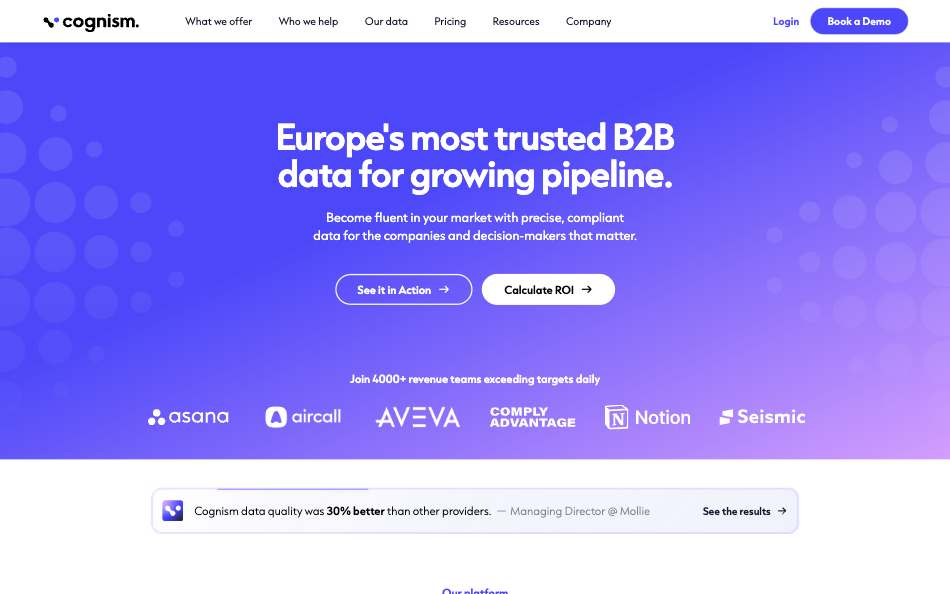
Cognism sells a sales prospecting product and a data API on quote. Its person search has 13 filter fields including seniority, department and jobTitle, plus 21 company filters (Cognism API reference, September 2026). That is a solid decision maker filter set.
Its Diamond Data page claims over 10M phone-verified contacts and Do Not Call checks in 15 territories (Cognism Diamond Data, September 2026). That is a vendor claim, not a test result. The API allows 500 requests a minute per account, per operation (Cognism rate limits, September 2026).
The MCP server has 15 tools. API and MCP both need a package that includes them, and no price is published for any plan, seat or credit.
Pros
- Seniority and department filters in the API.
- MCP server that maps one to one onto the API.
- Phone-verified data with Do Not Call cross-referencing.
Cons
- No public price at any tier.
- API and MCP need a qualifying package.
- Cognism's own docs disagree on whether a count call costs a search token.
Best for: Outbound teams selling into Europe that want verified mobiles and accept a sales process.
Pricing: Quote only. Standard and Pro each include 5 seats (Cognism pricing, September 2026).
5. Crustdata: best for signals and company graph builders
Crustdata is an API-first dataset with people search, company search, enrichment and watchers that report job changes. For decision makers it is strongest when you want to be told that a VP changed jobs, not just to list VPs. Person search costs 0.03 credits per result (Crustdata pricing docs, September 2026).
Self-serve keys run slow: 15 requests a minute on person enrich and 30 on search (Crustdata rate limits, September 2026). The contact enrich route that returns work email for 1 credit needs an enterprise plan. A self-serve work email is 2 credits.
A hosted MCP server is at https://install.crustdata.com/mcp. The pricing page lists no plan names and no dollar price, so you cannot price 1M lookups from public pages.
Pros
- API-first design with batch jobs up to 10,000 identifiers.
- Watchers for job changes on tracked people.
- Hosted MCP server.
Cons
- No public dollar price per credit.
- Low default rate limits on self-serve keys.
- Contact enrichment is gated to enterprise plans.
Best for: Teams building signal-driven workflows who accept a sales conversation for pricing.
Pricing: No public dollar price. A Crustdata blog post reports a lowest tier at $95 a month; the pricing page does not list it (Crustdata pricing, September 2026).
6. Lusha: best for individual reps in a browser extension
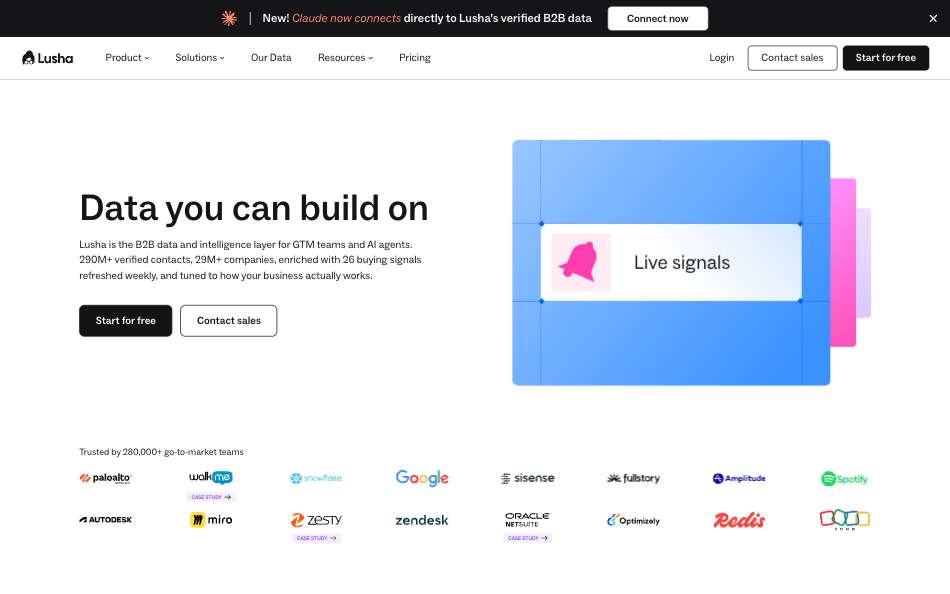
Lusha is a rep tool built around a Chrome extension, with an API and an MCP server on top. You find a person on LinkedIn, reveal their contact data, and move on. For one rep chasing a few dozen accounts a week, that is quick.
It is priced in credits: an email is 1 and a phone is 5. One contact with both costs 7 credits through a single API request (Lusha API guide, September 2026). The MCP server has 50 tools and shares the REST credit pool (Lusha MCP tools, September 2026).
API limits scale with plan. Free and Starter allow 40 requests a minute and 100 a day, and Premium allows 300 a minute and 18,000 a day. A bulk request caps at 100 contacts.
Pros
- Fast for one-off lookups from a browser.
- API key on every plan, Free included.
- MCP server with a wide tool set.
Cons
- Credits, with a ceiling well under 1M at public prices.
- Low daily API limits on small plans.
- Docs disagree on whether a no-match request costs a credit.
Best for: Individual reps who prospect from LinkedIn and need a contact or two at a time.
Pricing: Free $0 with 40 credits a month. Starter $49.90 a month ($37.45 billed yearly), Pro $69.90 ($52.45), Premium $399.90 ($299.95) (Lusha pricing, September 2026). No public 1M price: the largest public tier is 10,000 credits a month.
7. RocketReach: best for small teams looking people up one by one
RocketReach is a people lookup tool with a web app, an API and an MCP server. You search by title and company, then reveal a profile. It works for small lists of senior contacts where each lookup is a deliberate decision.
Credits are documented: person search is 1 per page of up to 100 results, a professional email is 2 and a phone is 6 (RocketReach credits docs, September 2026). Monthly lookup caps run from 5,000 on Essentials to 200,000 on Custom, with a global limit of 10 requests a second (RocketReach rate limits, September 2026). The MCP server exposes 9 tools (RocketReach MCP docs, September 2026).
RocketReach publishes no dollar price per credit, and API access is set up through its API team.
Pros
- Credit costs are documented per action.
- No charge when no data is found.
- MCP server with OAuth 2.1.
Cons
- No public API plan price or price per credit.
- API access goes through the API team.
- Plan prices here are reported by G2, because RocketReach's pricing page shows a bot check (October 2026).
Best for: Small teams that look up senior contacts one by one and do not need volume.
Pricing: Reported at $69 (Essentials), $119 (Pro) and $209 (Ultimate) a month on monthly billing (G2 RocketReach pricing, September 2026). No public 1M price.
Comparison table
| Tool | Best for | Starting price | Cost at 1M records a month | API | MCP | Rate limit |
|---|---|---|---|---|---|---|
| LeadOcean | API and agent volume | Free, then $97 a month | $497 a month (Agency) | REST, every plan | Yes, 13 tools | 5, 50, 200 or 10,000 a second by plan |
| Apollo | Reps, all in one | Free, then $65 per seat | $24,750 monthly, $19,600 yearly | REST, every plan | Yes | Enrichment 1,000 a minute on paid |
| ZoomInfo | Enterprise | From $20 | No public 1M price | REST | Yes | 5, 25 or 35 a second by package |
| Cognism | EU and mobiles | Quote only | No public 1M price | REST, package needed | Yes, 15 tools | 500 a minute per operation |
| Crustdata | Signals | No public dollar price | No public 1M price | REST | Yes | 15 a minute enrich, 30 search |
| Lusha | Browser reps | Free, then $49.90 | No public 1M price | REST, every plan | Yes, 50 tools | 40 to 300 a minute by plan |
| RocketReach | Small lookups | Free, then $69 (reported) | No public 1M price | REST, via API team | Yes, 9 tools | 10 a second global |
How to choose
- You pull decision makers in code or through an agent. Pick LeadOcean. Size the list with a free count, then enrich.
- You want one app to find and email decision makers. Pick Apollo.
- You already hold a ZoomInfo contract. Stay and use the free search.
- You sell into Europe and need verified mobiles. Ask Cognism for a quote.
- You want job-change alerts on named people. Look at Crustdata.
- You prospect on LinkedIn, one contact at a time. Lusha or RocketReach fit.
- You need more than 100,000 lookups a month at a known price. Only LeadOcean and Apollo publish enough to price it.
Verdict
LeadOcean wins for developers, RevOps teams and agent builders because it has the seniority filters, free counts and a flat price at volume. Apollo wins for reps who want search and outreach in one app. ZoomInfo wins for enterprises already under contract, and Cognism wins for European outbound that needs mobiles. Crustdata fits teams building around job-change signals, Lusha fits solo reps in a browser, and RocketReach fits small teams with a short list. For the full workflow from title to outreach, see the job-signal decision maker recipe.
FAQ
What is a decision maker finder?
It is a tool that returns the senior people at a company who approve a purchase, usually with a work email or phone. The useful ones filter by seniority and function, not just a title string.
How do I find decision makers by API?
Filter people search by jobLevel, seniority and jobFunction, then enrich the matches. With LeadOcean that is POST /v1/people/search, then POST /v1/people/enrich. The find decision makers page has the calls.
Can an AI agent find decision makers?
Yes, through an MCP server. LeadOcean, Apollo, ZoomInfo, Cognism, Crustdata, Lusha and RocketReach all run one. The Decision Maker Mapper skill maps four buying-committee roles from one domain.
Which tool has the cheapest decision maker data at volume?
Only LeadOcean and Apollo publish enough to price 1M work-email lookups. LeadOcean Agency is $497 a month. Apollo is $24,750 a month at monthly list price. The others publish no 1M price.
Do any of these let me count decision makers for free?
LeadOcean counts are free, and ZoomInfo search and lookup are free. Cognism's docs disagree on whether a count costs a search token. Check each vendor before you plan a large sizing run.
Is the contact data verified?
LeadOcean returns an email_status on each address, so you filter before sending. LeadOcean gives no refund for bounced emails, so read the status. Vendors' own accuracy claims are marketing, not tests.
Find the decision makers in your market, free
Free to start. No credit card. 1,000 records to spend whenever you like.
Get your free API key →