A B2B contact database company sells verified people and company records, such as titles, work emails and phone numbers, that you search or enrich by API, export, or app. Sales teams, agencies, recruiters and engineers who build products on contact data all need one.
Most lists rank these tools on feature counts. The real split is how you pay and how you pull data. Seat-based tools like Apollo and ZoomInfo price by user. Credit tools like Crustdata, Lusha and Cognism price by record. At 1M lookups a month, Apollo's seat math comes to $24,750 against a flat $497 on LeadOcean Agency.
We did not run a lab test for this page. Every figure below comes from a vendor's own pricing or docs page, checked in September 2026, and the 1M math is shown. If a vendor publishes no price at that volume, we say "No public 1M price" and do not multiply a rate out.
If you are replacing one tool, start with the matching page: Apollo, ZoomInfo, Cognism, Lusha, Crustdata or People Data Labs.
TL;DR
| Tool | Best for | Starting price | Cost at 1M records a month |
|---|---|---|---|
| 1. LeadOcean | API, agent and volume pulls | Free (1,000 records for life); Solo $97 a month | $497 a month (Agency, fair-use pace) |
| 2. Crustdata | Fresh people and company signals | No public plan price | No public 1M price (2,000,000 credits) |
| 3. People Data Labs | Raw person and company datasets | Free; Pro from $98 a month | No public 1M price |
| 4. Apollo | Sales teams that want one app | Free; Basic $65 per seat a month | $24,750 a month list ($19,600 billed yearly) |
| 5. ZoomInfo | Enterprise teams on its platform | GTM AI credits from $20 | No public 1M price |
| 6. Cognism | EMEA phone-verified data | Quote only | No public 1M price |
| 7. Lusha | Small teams and browser prospecting | Free; Starter $49.90 a month | No public 1M price |
Prices are monthly list prices first, with the billed-yearly figure after where the vendor publishes one.
What we evaluated
- Access model. Can you pull data through a REST API, an MCP server and a bulk export, or only through an app with seats?
- Published price. Is there a public price, and what does it say about 10k and 1M records a month?
- Rate limits. How many requests per second or minute does a key allow on the plan you would buy?
- Agent readiness. Is there an official, hosted MCP server, and which plans can use it?
- Honesty of the numbers. Does the vendor publish dataset sizes and credit rules, or do you have to ask sales?
1. LeadOcean: best for API, agent and volume pulls
LeadOcean is a people and company data API with a hosted MCP server. It holds 693M people, 366M of them with an email, 166M with a phone, and 67M companies. There is no rep workspace, no sequencer and no dialer. It is the data layer only.
You reach it three ways. The REST API covers POST /v1/people/enrich, POST /v1/companies/enrich, /v1/people/search, /v1/companies/search and GET /v1/companies/{domain}/people. The MCP server at https://api.leadocean.io/mcp has 13 tools and signs in with OAuth 2.1. The app at app.leadocean.io has an Exports page with a filter builder, a column picker and a price preview before you download a CSV.
Sizing is free. The leadocean_count_leads and leadocean_count_companies tools return a count before you spend a record, and the company count adds breakdowns by industry, headcount band and HQ country. Work emails come from GET /v2/people/email/work, and phones from GET /v2/people/phone.
Pros
- Same data and every feature on every plan. The price buys speed, pace, keys and rights.
- No credits. Paid plans have a fair-use pace, so there is no per-record price and no overage invoice.
- Rate limits are published per plan: 5, 50, 200 and 10,000 requests a second.
- Free sizing calls for people and companies, through REST and MCP.
Cons
- No sequencer, dialer, CRM or Chrome extension. You bring your own sending tool.
- Bulk CSV export is not on the Free plan.
- Coverage depends on the country and role you target, so count first.
Best for: engineers, agencies and RevOps teams that pull contact data through an API or an agent at volume.
Pricing: Free is $0 for 1,000 records, once, with no card. Solo is $97 a month, Agency is $497 a month and Platform is $1,997 a month. Solo paces at 10k enrichments every 5 hours and 50k a week, so 1M a month needs Agency, which allows 1M enrichments a day. Source: LeadOcean pricing, October 2026.
2. Crustdata: best for fresh people and company signals
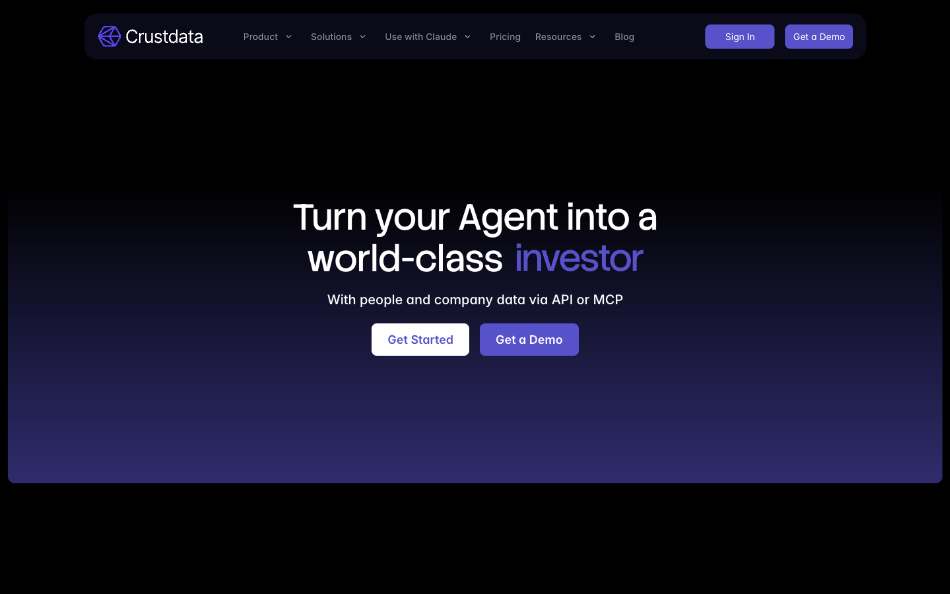
Crustdata sells people, company and job data through a credit-based API, plus watchers that alert you when a person or company changes. Its homepage claims 1B people and states both 60M and 200M+ companies in different places, so treat coverage figures as claims.
The credit rules are public in the docs. Search costs 0.03 credits per result. Person enrich costs 1 to 7 credits: 1 for the base profile, plus 1 for a business email, 2 for a personal email and 2 for a phone. A work-email lookup is 2 credits on a self-serve key, or 1 credit on the contact endpoint, which needs an enterprise plan.
Rate limits are tight for volume. Person enrich, company enrich and contact enrich default to 15 requests a minute. Batch person enrich takes up to 10,000 identifiers a job, which is the practical route at scale. Crustdata also runs a hosted MCP server at https://install.crustdata.com/mcp.
Pros
- Credit costs per endpoint are public in the docs.
- Watchers track job and company changes on a schedule.
- Official hosted MCP server with OAuth sign-in.
Cons
- The pricing page lists no plan names, no dollar prices and no price per credit.
- 15 requests a minute on enrich endpoints, before batch jobs.
- Credit expiry is stated two ways: 12 months in the docs, 6 months in a Crustdata blog post dated 30 July 2026.
Best for: teams that need job-change and company-change signals and will negotiate a contract.
Pricing: No public 1M price. 1,000,000 work-email lookups is 2,000,000 credits on /person/enrich, and the dollar cost depends on a per-credit price that is not published. A Crustdata blog post reports a lowest tier of $95 a month. Source: Crustdata pricing docs and pricing page, September 2026.
3. People Data Labs: best for raw person and company datasets
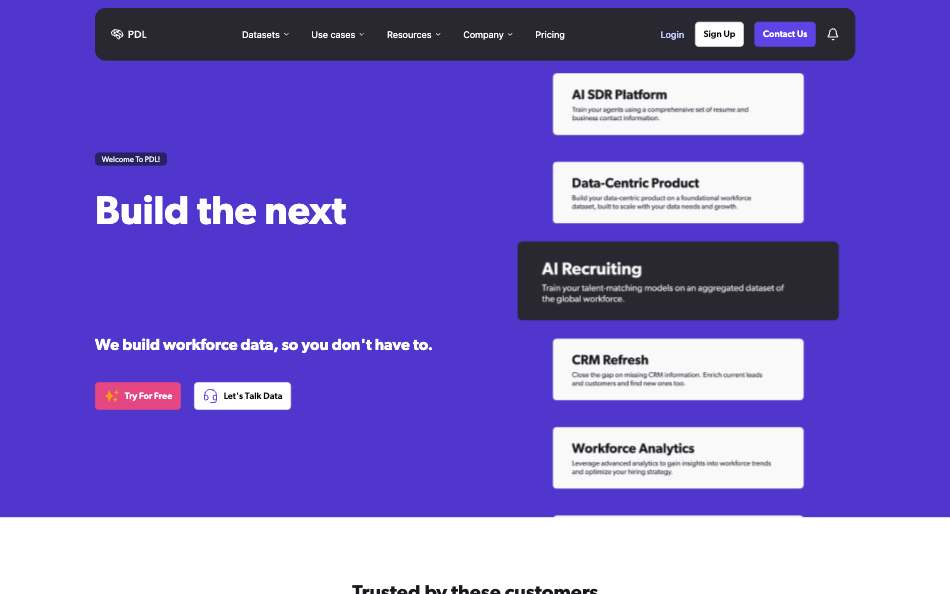
People Data Labs (PDL) sells person and company data by API and as bulk datasets. Its own stats page lists 2,466,510,427 person profiles, 592,376,573 profiles with at least one email, 470,338,967 with a mobile number and 76,606,079 company records. Its resume dataset adds work history.
The model is one credit per successful match or profile returned. A request that returns nothing is not billed. Bulk enrichment takes up to 100 persons per request, and paid plans allow 1,000 person-enrichment requests a minute, though person search is limited to 10 a minute by default.
PDL points self-serve buyers to Enterprise above roughly 100,000 person profiles. Anyone planning 1M records goes through sales. We found no official PDL MCP server in its llms.txt, docs or GitHub organization. Only community servers exist.
Pros
- Very large published dataset counts, with a separate mobile and email count.
- Failed lookups are not billed.
- Paid plans allow 1,000 person-enrichment requests a minute.
Cons
- Self-serve stops near 100,000 profiles. Larger volume is a sales conversation.
- Person search defaults to 10 requests a minute.
- No official MCP server in PDL's own docs.
Best for: data teams that want licensed datasets or a high-throughput enrichment API.
Pricing: Free is $0 for up to 100 credits a month, with contact data obscured. Pro starts at $98 a month for 350 credits ($0.28 a credit), or $940 a year ($78 a month) billed yearly. No public 1M price. Source: PDL person pricing, September 2026.
4. Apollo: best for sales teams that want one app
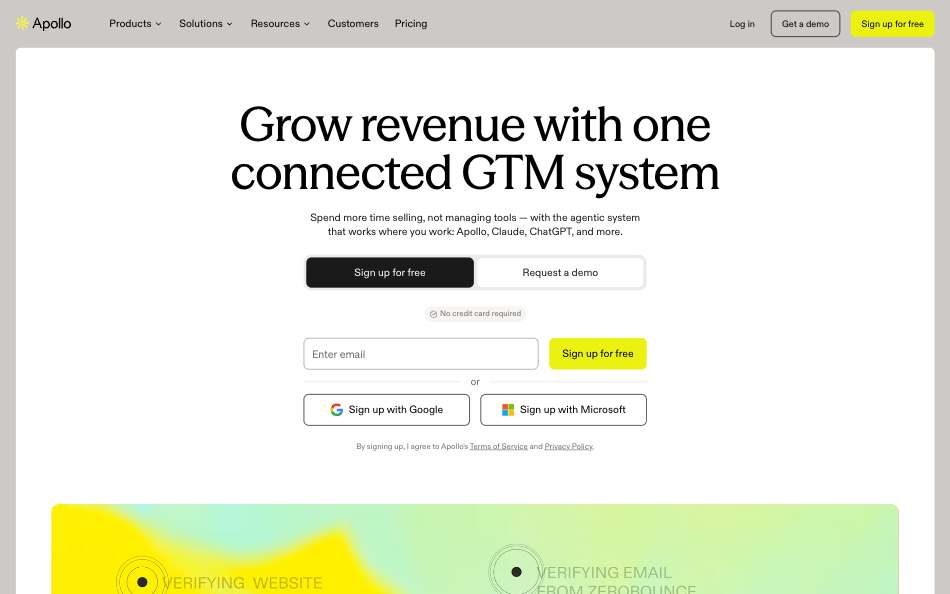
Apollo combines a contact database with sequencing, a dialer and a CRM-style workspace, priced per seat. Reps log in and work leads in the same place they send email. For a team of reps that is the draw.
As a data source it is costly at volume. An email is 1 credit. A phone number is 8 credits. People enrichment by API is 1 to 9 credits. Credits are pooled across the team and expire at the end of each billing cycle, including purchased add-ons.
Every plan includes API access. Paid plans allow 1,000 enrichment requests a minute with no hourly or daily cap. Search is capped at 50,000 a day on paid plans. Apollo runs an official MCP server at https://mcp.apollo.io/mcp on any plan, including Free.
Pros
- Data, sequencing and dialing in one product.
- Official hosted MCP server on every plan.
- Enrichment endpoints allow 1,000 requests a minute on paid plans.
Cons
- Per-seat pricing with credits that expire each cycle and do not roll over.
- Phones cost 8 credits each.
- The price of extra credits is not public.
Best for: sales teams that want contact data and outreach tools in one login.
Pricing: Free is $0 for 75 credits a month. Basic is $65 per seat a month with 2,500 credits ($49 billed yearly). Professional is $99 ($79 yearly) and Organization is $149 ($119 yearly, 3-seat minimum). For 1,000,000 work emails, 250 Professional seats cost $24,750 a month at list price. On yearly billing, 400 Basic seats come to $19,600 a month. Source: Apollo pricing and API pricing, September 2026.
5. ZoomInfo: best for enterprise teams on its platform
ZoomInfo is the large incumbent in sales intelligence, now selling data credits through GTM AI alongside its seat-based platform. The platform plans (Professional, Advanced, Elite) sit behind a human check on zoominfo.com/pricing, so we did not read them.
The GTM AI side is public. Search, lookup and find similar are free. One data credit enriches or exports one company, contact or intent record, and a record is charged once per 12 months. List price falls with purchase size: $0.45 per credit for 100 credits, $0.38 for 2,500 to 10,000, and $0.25 at the 100,000-credit pack for $25,000.
A free account includes 1,000 data credits and 1,000 AI credits, with MCP, API and CLI access at 5 requests a second. ZoomInfo's MCP server needs a free GTM AI account or an existing ZoomInfo subscription with data credits. Batch enrichment is capped at 25 records per call.
Pros
- Free sign-up with 1,000 data credits, no card.
- A record is charged once per 12 months, so re-enriching inside the window is free.
- Official MCP server, with API rate limits published by package.
Cons
- Platform plan prices are not readable without a human check.
- The 100,000-credit pack is the top of the public slider. Beyond it is Enterprise.
- Batch enrichment is only 25 records per call.
Best for: enterprise sales teams already on ZoomInfo that want API and agent access to the same data.
Pricing: GTM AI credits start from $20 pay as you go, no contract. No public 1M price. The public slider stops at 100,000 credits. Source: GTM AI pricing, September 2026.
6. Cognism: best for EMEA phone-verified data
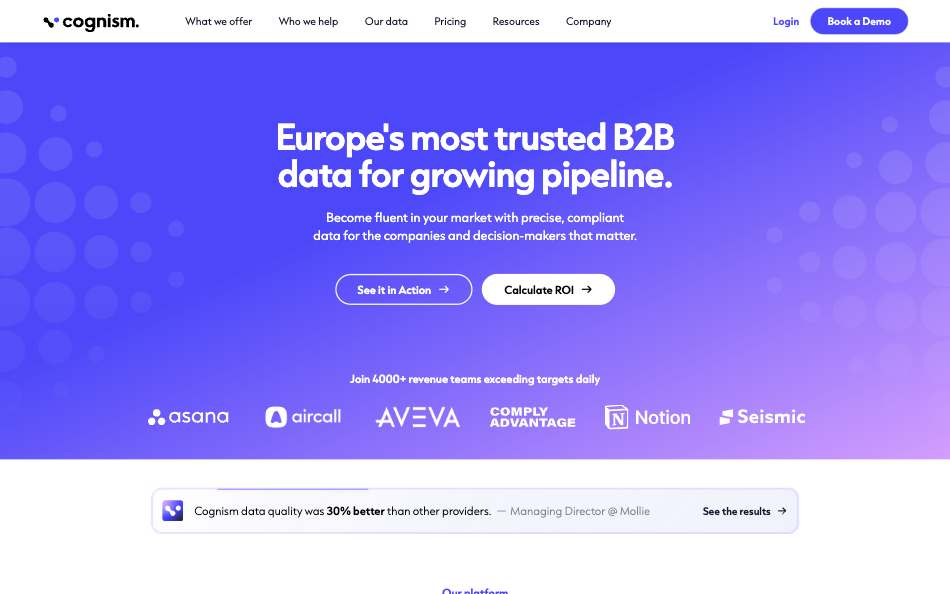
Cognism is a sales-prospecting platform known for phone-verified mobile numbers and Do Not Call cross-referencing. Its Diamond Data page claims over 10m phone-verified contacts and on-demand verification in under 48 hours. These are Cognism's own claims.
Cognism publishes no dollar price. The pricing page lists Standard and Pro, each with 5 seats, plus a CRM Enrichment add-on, and says pricing is tailored to team setup and usage. One credit is one revealed contact. A contact you already revealed is free to view again, unless the person changes jobs.
The API uses OAuth 2.0 client credentials and allows 500 requests a minute per operation. Search returns up to 100 records a page and cursor paging runs to 100,000 records per journey. The MCP server at https://mcp.cognism.com/mcp has 15 tools and shares the API's tokens and credits.
Pros
- Claims phone-verified mobiles and Do Not Call checks.
- Official MCP server mapped one to one onto the API.
- Revealed contacts stay free to view again.
Cons
- No public price at any volume.
- API and MCP access need a package that includes them.
- Credit and search-token metering varies between its docs pages.
Best for: EMEA outbound teams that need verified mobile numbers and will buy through sales.
Pricing: No public 1M price. Cognism publishes no price per plan, seat or credit; the highest public tier is Pro with 5 seats, quote only. Source: Cognism pricing, September 2026.
7. Lusha: best for small teams and browser prospecting
Lusha is a contact data tool built around a browser extension and a simple credit plan. It suits a small team that wants emails and phones while browsing LinkedIn. It also has a V3 API and an MCP server.
Credits are public and clear. An email is 1 credit, a phone is 5 credits, and company info is 1 credit. Email plus phone is up to 7 credits through one API request. A bulk request adds 1 credit per 25 results, up to 100 records a request. The Data Waterfall costs 2 credits per work email and 8 per phone, only on a match.
Plan limits are modest. Premium allows 300 requests a minute and 18,000 a day, and Pro allows 50 a minute and 1,500 a day. The MCP server has 50 tools and shares the REST credit pool. Lusha's docs disagree on whether a no-match API request is charged, so test before you buy.
Pros
- Public plan prices and credit costs.
- API key on every plan, including Free.
- MCP server with 50 tools on the shared credit pool.
Cons
- Rate limits cap high-volume work, at 18,000 requests a day on Premium.
- Phones cost 5 credits, or 8 through the waterfall.
- Docs conflict on charging for a no-match request.
Best for: small teams that want a browser extension and a clear credit plan.
Pricing: Free is $0 for 40 credits a month. Starter is $49.90 a month for 400 credits ($37.45 billed yearly). Pro is $69.90 for 600 credits ($52.45 yearly) and Premium is $399.90 for 3,400 credits ($299.95 yearly). The highest public tier is Premium at 10,000 credits for $977.40 a month. No public 1M price. Source: Lusha pricing, September 2026.
Comparison table
| Tool | Best for | Starting price | Cost at 1M records a month | API | MCP | Rate limit |
|---|---|---|---|---|---|---|
| LeadOcean | API, agents, volume | Free; Solo $97 a month | $497 a month (Agency) | Yes | Official, 13 tools | 5, 50, 200 or 10,000 a second by plan |
| Crustdata | Fresh signals | No public plan price | No public 1M price | Yes | Official | 15 a minute on enrich |
| People Data Labs | Raw datasets | Free; Pro from $98 a month | No public 1M price | Yes | None official | 1,000 a minute enrich on paid plans |
| Apollo | Sales teams, one app | Free; Basic $65 per seat | $24,750 a month list | Yes, every plan | Official | 1,000 a minute enrich on paid plans |
| ZoomInfo | Enterprise teams | GTM AI credits from $20 | No public 1M price | Yes | Official | 5 to 35 a second by package |
| Cognism | EMEA mobile data | Quote only | No public 1M price | Package-gated | Official, 15 tools | 500 a minute per operation |
| Lusha | Small teams | Free; Starter $49.90 | No public 1M price | Yes, every plan | Official, 50 tools | 50 to 300 a minute by plan |
How to choose
- You pull data through an API or an agent at volume. Pick LeadOcean, then check Crustdata if you also need change signals.
- You need raw datasets under licence. Pick People Data Labs and talk to sales early. Self-serve ends near 100,000 profiles.
- You want data and outreach in one login. Pick Apollo. Budget by seats and credits, not by records.
- You are an enterprise already on ZoomInfo. Use its GTM AI credits and MCP server for agent work.
- You sell in EMEA and need verified mobiles. Ask Cognism for a quote and a test file.
- You prospect in the browser with a small team. Pick Lusha and read the credit costs first.
Verdict
LeadOcean wins for developers, agencies and RevOps teams that pull contact data by API, agent or export, because the price does not scale with records. Apollo wins for sales teams that want one app for data and outreach. People Data Labs wins for licensed datasets, ZoomInfo for enterprise accounts already on its platform, Cognism for EMEA mobile data and Lusha for small teams working in the browser. Crustdata is the pick when change signals matter more than list price. Start with a free count on your own filters before you commit to any of them.
FAQ
What is the best B2B contact database in 2026?
It depends on how you pull data. For API, agent or volume work, LeadOcean is the strongest value because paid plans have no per-record price. For one app with outreach built in, Apollo fits better.
How much does a B2B contact database cost at 1M records a month?
Only two vendors on this list publish enough to calculate it. LeadOcean Agency is $497 a month. Apollo is $24,750 a month at list price on monthly billing, or $19,600 billed yearly. The other five publish no price at 1M.
Which B2B contact databases have an official MCP server?
LeadOcean, Crustdata, Apollo, ZoomInfo, Cognism and Lusha all run one. People Data Labs has none in its own docs, only community servers.
Can I get a B2B contact database for free?
Yes, several offer a free tier. LeadOcean gives 1,000 records for life with no card. Apollo gives 75 credits a month, Lusha 40 a month, PDL up to 100 credits a month with contact data obscured, and ZoomInfo's GTM AI gives 1,000 data credits.
Why do seat-based tools cost more at volume?
Credits are granted per seat, so a bigger monthly pull needs more seats. Apollo's 1M math needs 250 Professional seats at 4,000 credits each. A flat plan avoids that multiplier.
How do I size a list before I buy?
Use a free count. LeadOcean counts people with leadocean_count_leads and companies with leadocean_count_companies, and costs no records. Read how B2B data is collected, the B2B data building guide, and the waterfall providers comparison for the next step, or see pricing.
Size your list and pull it by API or MCP
Free to start. No credit card. 1,000 records to spend whenever you like.
Get your free API key →