A B2B data provider sells people and company records, such as titles, work emails and phone numbers, that you search, enrich or export. SaaS companies use one to enrich signups, score product-led leads, feed outbound and, for some, to ship data inside the product. Four things separate the options for this buyer: volume, price model (flat, credits or seats), API and MCP access, and how many seats you must buy.
This page ranks six providers on those points, with list prices checked in September 2026. LeadOcean is first for teams that pull data in code, with an agent or at volume. Apollo and ZoomInfo fit teams that want a rep UI. Each rival has its own comparison: Apollo, ZoomInfo, Clay, People Data Labs and Crustdata. For company records only, read best company data APIs.
TL;DR
| Tool | Best for | Starting price | Cost at 1M records a month |
|---|---|---|---|
| LeadOcean | Code, agents and volume | Free (1,000 records, one-off). Solo $97 a month | Agency $497 a month flat. Fair-use pace applies |
| Apollo | Sales teams that want seats and a UI | Basic $65 per seat a month ($49 billed yearly) | $24,750 a month at list on monthly billing ($19,600 billed yearly) |
| ZoomInfo | Enterprise suites and intent data | GTM AI credits from $20, at $0.45 a credit | No public 1M price. Public slider stops at 100,000 credits for $25,000 |
| Clay | No-code enrichment workflows | Launch $185 a month ($167 billed yearly) | No public 1M price. Largest public tier is 200,000 Actions and 50,000 Data Credits |
| People Data Labs | Licensed datasets | Pro from $98 a month for 350 credits ($78 billed yearly) | No public 1M price. Above about 100,000 records a year is Enterprise |
| Crustdata | Live data and change watchers | No public price list | No public 1M price. 1M work-email lookups is 2,000,000 credits |
"1M records" means 1M work-email lookups that return a result, at list price.
What we evaluated
- Volume: the largest monthly volume you can buy without a sales call.
- Price model: flat, credits or seats, and what 1M records costs.
- API and MCP: which plans include the API, and whether an agent can search and enrich.
- Seats: whether you pay per user, and what a RevOps or growth team of five to ten actually needs.
- Rate limit: the default per second or minute, which decides whether you can enrich signups as they arrive.
We ran no accuracy test, so we quote no quality numbers.
1. LeadOcean: best for SaaS teams that pull data in code or with an agent
LeadOcean is a people and company data API with a hosted MCP server. It holds 693M people, 366M with an email and 166M with a phone number, plus 67M companies. You filter with 50 people filters and 34 company filters.
A SaaS team needs four calls. POST /v1/people/enrich handles a signup and POST /v1/companies/enrich an account. /v1/people/search builds outbound lists, and POST /v1/exports returns CSV files up to 50,000 rows a request. Counts are free: send count=true as a query parameter with limit 1, or call GET /v1/companies/count.
curl -X POST "https://api.leadocean.io/v1/people/enrich" \
  -H "x-api-key: $LEADOCEAN_API_KEY" \
  -H "Content-Type: application/json" \
  -d '{"email": "jane.doe@acme.com"}'
There are no credits and no seats. Solo is $97 a month for one person, with 50 requests a second. Agency is $497 a month for teams, with 5 keys, 200 requests a second and 1M enrichments a day, raisable. Platform is $1,997 a month, sold through a talk with the team, and carries an embed and resell licence for SaaS products that show the data to their own customers. The MCP server at https://api.leadocean.io/mcp signs in with OAuth 2.1 and exposes 13 tools.
Pros
- Flat monthly price at any volume, with no credit meter and no seat count.
- REST and MCP on every plan, including Free, with the whole database behind them.
- Enrichment that finds nothing is a free 404, and counts are free.
- A resell and embed licence on Platform, with a published monthly price.
Cons
- No sequencer, dialer, CRM or Chrome extension. The app has an Exports page, not a rep workspace.
- Bulk CSV export is not on Free.
- v2 contact endpoints cost one record per call, including a call that finds nothing.
- No refund for bounced emails. Read
email_statusbefore you send.
Best for: SaaS engineers, RevOps and growth teams that need volume and a fixed bill.
Pricing: Free is 1,000 records for life, no card. Solo $97, Agency $497 and Platform $1,997 a month. Paid plans have a fair-use pace, not credits: past it the key slows until the window resets, and nothing is cut off (LeadOcean pricing, October 2026).
2. Apollo: best for sales teams that want seats and a UI
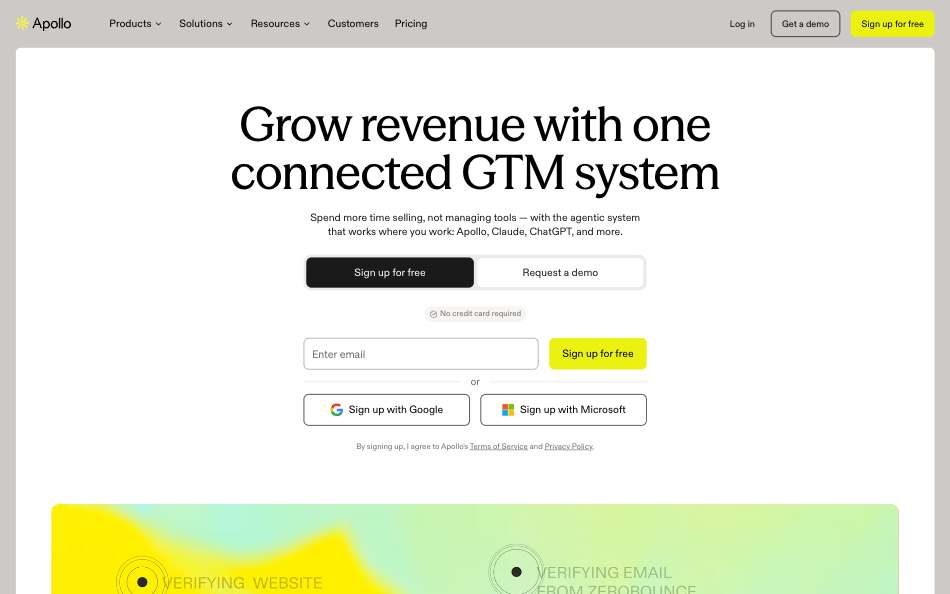
Apollo is a sales platform with a contact database and sequences. Its API is on every plan, including Free (Apollo developer FAQ, September 2026). It sells credits per seat, and the team pools them.
An email costs 1 credit and a phone number costs 8. People enrichment by API costs 1 to 9 credits, and organization enrichment costs 1 (Apollo API pricing, September 2026). Credits expire at the end of each billing cycle and do not roll over.
Paid plans allow 1,000 enrichment calls a minute with no hourly or daily cap. Search allows 200 a minute and 50,000 a day (Apollo rate limits, September 2026). Apollo runs an official MCP server on any plan, and enrichment through it spends the same credits (Apollo MCP docs, September 2026).
Pros
- A full sales UI with sequences next to the API, so reps and engineers share one database.
- API and MCP on every plan, including Free.
- 1,000 enrichment calls a minute on paid plans.
Cons
- Credits are per seat. 1M work-email lookups is 1,000,000 credits, which is 250 Professional seats.
- Credits do not roll over.
- Apollo prints no price for extra credits, so you cannot price an add-on path.
- The Organization plan has a 3-seat minimum.
Best for: SaaS sales teams that want a UI for reps and an API on the same data.
Pricing: per seat a month, billed monthly: Free $0 for 75 credits, Basic $65 for 2,500, Professional $99 for 4,000, Organization $149 for 6,000. Billed yearly: Basic $49, Professional $79, Organization $119 (Apollo pricing, September 2026). At 1M lookups, 250 Professional seats cost $24,750 a month, or $19,600 with 400 Basic seats billed yearly.
3. ZoomInfo: best for enterprise suites and intent data
ZoomInfo is an enterprise sales intelligence suite with buyer intent signals and conversation intelligence (ZoomInfo pricing, October 2026). Its newer GTM AI product sells an API and MCP server on pay-as-you-go credits, with no contract and no seat fee (GTM AI pricing, September 2026).
Search, lookup and find similar are free. One data credit enriches or exports one company, contact or intent record, and a record is charged once per 12 months. Credits start at $0.45 each and fall to $0.25 at 100,000 credits for $25,000. The $0.38 rate is the $1,000 spend tier only, not a volume rate (GTM AI pricing, September 2026).
The free tier gives 1,000 data credits, API and MCP access, and 5 requests a second. Paid packages run from 5 to 35 requests a second (GTM AI rate limits, September 2026). The MCP server works with Claude, ChatGPT and Cursor, and needs a GTM AI account or an existing ZoomInfo subscription (ZoomInfo MCP docs, September 2026).
Pros
- Buyer intent signals on Copilot Advanced and up.
- GTM AI is self-serve, with a free tier and no contract.
- Search and lookup are free, so you pay only to enrich or export.
Cons
- The public credit slider stops at 100,000 credits. Above it is Enterprise.
- A record costs a credit every time you export or enrich it for the first time in 12 months.
- 5 requests a second on the free tier, with higher limits by request.
Best for: SaaS companies that sell on buying signals and want one suite for a large sales team.
Pricing: GTM AI data credits from $20, at $0.45 down to $0.25 by purchase size (GTM AI pricing, September 2026). Ten 100,000-credit packs at $0.25 would be $250,000, but that is arithmetic and not a public 1M price.
4. Clay: best for no-code enrichment workflows
Clay is a workflow spreadsheet that runs many data providers in one table. Ops people build enrichment, scoring and routing without code, and Claygent runs web research per row on every plan (Clay pricing, September 2026).
Clay charges two meters. Actions pay for the work and Data Credits pay for the data. Clay's own docs say a fully enriched record typically costs 6 to 20 Data Credits, plus one Action per enrichment (Clay docs, September 2026).
The Public API and CLI are on every plan, including Free. The HTTP API column, which calls other APIs from a table, starts on Growth (Clay docs, September 2026). Clay publishes no rate-limit number for the Public API (Clay docs, September 2026). It also has an MCP server (Clay MCP guide, September 2026).
Pros
- A no-code table that RevOps can edit without an engineer.
- Many providers in one waterfall, plus AI research columns.
- Unlimited seats on every plan.
Cons
- Two meters make a monthly bill hard to forecast.
- Actions cannot be topped up, and the largest public tier is 200,000 a month.
- The HTTP API column needs Growth, from $495 a month.
Best for: SaaS RevOps teams that live in tables and want many sources in one place.
Pricing: Free $0, Launch $185 a month ($167 billed yearly), Growth $495 a month ($446 billed yearly). The largest public tiers are 200,000 Actions and 50,000 Data Credits a month, and above that Clay sells Enterprise by quote (Clay pricing, September 2026).
5. People Data Labs: best for licensed datasets
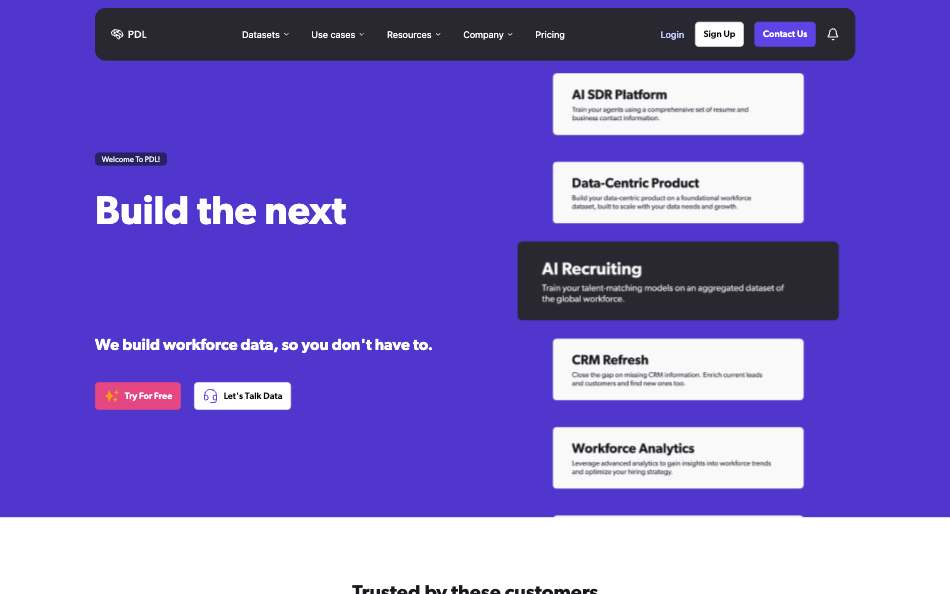
People Data Labs (PDL) is a long-running person and company data API with bulk dataset licences. Its person dataset holds 2.47B profiles, 592M with an email and 470M with a mobile number (PDL datasets, September 2026). That is larger than LeadOcean's 693M people.
One credit is used per successful match, and a 404 is not billed. Bulk enrichment takes up to 100 persons per request (PDL docs, September 2026). Paid plans allow 1,000 enrichment calls a minute, while person search defaults to 10 a minute (PDL docs, September 2026).
Self-serve is meant for volumes below roughly 100,000 person profiles a year. Above that, PDL sends buyers to Enterprise (PDL blog, September 2026). PDL's docs index lists no official MCP server (PDL docs, September 2026).
Pros
- The largest person dataset on this list, with licences for your own warehouse.
- 1,000 enrichment calls a minute on paid plans.
- Misses are not billed.
Cons
- $0.28 a credit at the entry rate.
- No official MCP server.
- Person search defaults to 10 requests a minute, too slow for real-time lookups at scale.
- Free hides contact data.
Best for: SaaS data teams that license data or need a copy in their warehouse.
Pricing: Free is up to 100 credits a month with contact data obscured. Pro starts at $98 a month for 350 credits, or $78 a month billed yearly. PDL says Pro profiles cost about $0.20 to $0.28 each, and there is no public price at 1M (PDL pricing, September 2026).
6. Crustdata: best for live data and change watchers
Crustdata sells real-time company and people data through APIs for search, enrichment, jobs and change watchers. Its pricing page lists no plans, no dollar prices and no price per credit (Crustdata pricing, September 2026).
The docs give credits per call, and the dollar value depends on your plan. Search is 0.03 credits per result. A work email through /person/enrich is 2 credits (Crustdata docs, September 2026). The 1-credit contact endpoint needs an enterprise plan, and self-serve keys get a 403 (Crustdata docs, September 2026).
Defaults are 15 requests a minute on enrich and 30 on search (Crustdata docs, September 2026). The hosted MCP server takes OAuth for interactive clients and an API key as a bearer token for code (Crustdata docs, September 2026).
Pros
- Change watchers for people and companies, useful for job-change and account signals.
- Hosted MCP with an API-key option for code.
- Batch person enrich takes up to 10,000 identifiers a job.
Cons
- No public price per credit, so you cannot price 1M from the site.
- 15 enrich requests a minute by default, too low to enrich signups in real time without a raise.
- The 1-credit work-email endpoint is enterprise only.
Best for: AI SDR and signal workflows that need fresh data more than raw volume.
Pricing: Credit based, with no public price list (Crustdata pricing, September 2026). 1M work-email lookups is 2,000,000 credits on /person/enrich, and the dollar cost is your quoted price per credit.
Comparison table
| Tool | Best for | Starting price | Cost at 1M records a month | API | MCP | Rate limit |
|---|---|---|---|---|---|---|
| LeadOcean | Code, agents and volume | Free. Solo $97 a month | Agency $497 flat. Fair-use pace applies | REST on every plan | Yes. OAuth 2.1, 13 tools | 5, 50, 200 or 10,000 a second by plan |
| Apollo | Seats and a UI | Basic $65 per seat a month | $24,750 a month at list | REST on every plan | Yes. OAuth 2.0 or API key | 1,000 a minute enrichment, 200 search |
| ZoomInfo | Enterprise suite and intent | GTM AI from $20 | No public 1M price | GTM AI API on the free tier and up | Yes, through GTM AI | 5 a second free. 5 to 35 by package |
| Clay | No-code workflows | Launch $185 a month | No public 1M price | Public API on every plan | Yes | No number published |
| People Data Labs | Licensed datasets | Pro from $98 a month | No public 1M price | REST, bulk endpoints | None listed in docs index | 1,000 a minute enrichment, 10 search |
| Crustdata | Live data and watchers | No public price list | No public 1M price | REST | Yes. OAuth or API key | 15 to 30 a minute by default |
How to choose
- Engineers enriching signups or building lead scoring: LeadOcean. Flat price, REST on every plan, 50 to 200 requests a second.
- Agents that research accounts: LeadOcean or Apollo, both with MCP servers that return records on any plan.
- A product that shows data to your customers: LeadOcean Platform, which carries an embed and resell licence. For a warehouse copy, People Data Labs.
- A sales team of ten reps that wants one login: Apollo, and price the seats first.
- Selling on buying signals at enterprise scale: ZoomInfo.
- RevOps that lives in spreadsheets: Clay, and watch Actions and Data Credits together.
- Fresh job-change and company signals: Crustdata.
Verdict
LeadOcean wins for SaaS companies that pull data in code, with an agent or at volume. It has a flat price, no seats and an MCP server on every plan, and Platform carries an embed and resell licence at a published price. Apollo wins when reps need a UI and a team will pay per seat. ZoomInfo wins for intent data, Clay for no-code workflows, People Data Labs for licensed datasets and Crustdata for live signals. Start on the free plan and run the same signups through two providers.
FAQ
What is the best B2B data provider for a SaaS company?
For code, agents and volume, LeadOcean has the flat price, no seats and an MCP server that returns records. For a rep UI, Apollo. For intent data, ZoomInfo.
What is the cheapest B2B data provider at 1M records a month?
On list price, LeadOcean at $497 a month on Agency, with a fair-use pace. Apollo runs to $24,750 a month at 1M on monthly billing. ZoomInfo, Clay, PDL and Crustdata publish no 1M price.
Should a SaaS company pay per seat or per record?
Per seat suits a sales team that works in a UI, because credits come with each user. Per record or flat suits code and agents, where volume does not track headcount. At 1M lookups a month, seats mean 250 Apollo Professional seats.
Can a SaaS company resell or embed B2B data in its product?
Only with a licence that allows it. LeadOcean Platform at $1,997 a month includes an embed and resell licence (LeadOcean pricing, October 2026). Check the terms of any other provider before you show its data to your customers.
Which providers have an MCP server that returns records?
LeadOcean, Apollo, ZoomInfo through GTM AI, Clay and Crustdata do. We found no official People Data Labs server.
Do I need a credit card to try LeadOcean?
No. The free plan needs no card. It gives you 1,000 records, one-off, with the same API and MCP server as the paid plans.
Enrich signups and build lead lists from one flat-price API. Start free.
Free to start. No credit card. 1,000 records to spend whenever you like.
Get your free API key →