A B2B sales prospecting tool finds the people and companies you should sell to and gives you a verified way to reach them. An agency owner needs one for two jobs: filling your own pipeline and building lists for clients.
The second job is where most tools break. Apollo prices per seat, so every extra account adds a bill (Apollo pricing, September 2026). Clay charges credits plus actions, and its largest self-serve tier stops at 200,000 actions a month (Clay pricing, September 2026). Lusha and ZoomInfo have no public price at 1M records.
On 2026-10-21 a free LeadOcean count found 105,301 US owners and C-level leaders in Advertising Services with a mailable email (verified, catch_all_valid or catch_all), across 41,226 companies. Without the email filter it is 390,488 people. Pulling 105,301 emails on Apollo means 27 Professional seats, $2,673 for the month. If you already use one of them, see our LeadOcean alternatives to Apollo, Clay, Hunter, Lusha and ZoomInfo.
TL;DR
| Tool | Best for | Starting price | Cost at 1M records a month |
|---|---|---|---|
| LeadOcean | Client lists at volume, API and agents | Free, then $97 a month (Agency $497) | $497 a month (Agency) |
| Apollo | One rep who wants data and sequences in one app | $65 per seat a month, $49 billed yearly | $24,750 a month list, $19,600 billed yearly |
| Clay | Building enrichment workflows without code | $185 a month, $167 billed yearly | No public price at 1M |
| Hunter | Email-only pulls at the lowest per-record rate | $49 a month, $34 billed yearly | $6,900 once (Data Platform) |
| Lusha | A small team that needs mobile numbers | $49.90 a month, $37.45 billed yearly | No public price at 1M |
| ZoomInfo | Enterprise sales teams with a budget | $20 pay as you go (GTM AI) | No public price at 1M |
What we evaluated
- Price at volume. The cost of 1M records a month at list price, monthly billing first and billed-yearly after it. With no public 1M price, we say so and do not multiply a rate.
- Seats versus usage. Whether an extra analyst, freelancer or client login changes the bill.
- API and rate limits. What the plan allows per second or per minute, and whether the API is on every plan.
- MCP support. Whether you can pull data inside Claude or ChatGPT without writing code.
- Fit for agencies. Whether the plan lets you use the data for client work, and what the tool does not do.
1. LeadOcean: best for client lists at volume
LeadOcean is a data layer, not a sales app. You search 693M people and 67M companies by 50 people filters and 34 company filters, then pull records over REST, MCP or a CSV export. It has no sequencer, dialer, CRM or Chrome extension.
Pricing is flat. Agency is $497 a month for agencies and RevOps teams. It includes 5 keys, 200 requests a second, phones and exports, and covers your own and your clients' work (LeadOcean pricing, October 2026). There are no credits and no per-record price. Paid plans have a fair-use pace instead.
Sizing is free. The intro count used leadocean_count_leads, one of 13 MCP tools, spent 0 records, and GET /v1/companies/count sizes a company list the same way. Pull the list with POST /v1/exports, up to 50,000 rows per request, or from the Exports page in the app at app.leadocean.io.
Pros
- One flat price: $497 a month on Agency, whether you pull 100,000 or 1M records.
- API, MCP and CSV export on the same plan, with 200 requests a second per account.
- Counts, filter lists and enum lookups cost nothing, so you size a list before you spend.
- Licensed for client work on Agency, with 5 keys for your team.
Cons
- No sequencer, dialer, CRM or Chrome extension. You send mail from another tool.
- Free is 1,000 records for life, and bulk CSV export is not on Free.
- Bounced emails are not refunded. Read
email_statusbefore you send.
Best for: agencies that build lists for clients, feed an agent, or pull data in code at volume.
Pricing: Free $0, Solo $97, Agency $497, Platform $1,997 a month (LeadOcean pricing, October 2026).
2. Apollo: best for one rep who wants data and sequences together
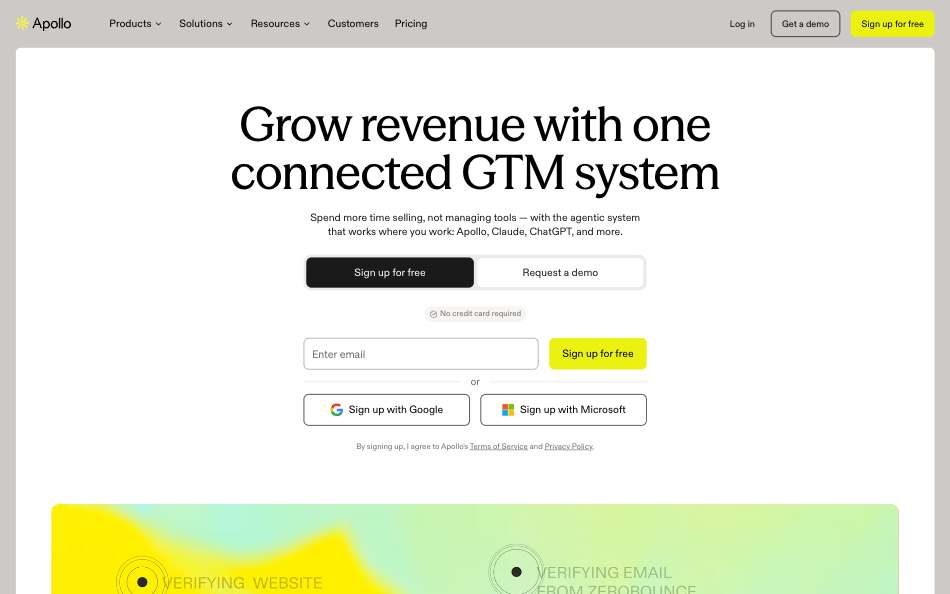
Apollo is the all-in-one pick. It has a contact database, sequences, a dialer and a rep workspace in one app. For an agency owner doing their own outreach, that is the shortest path to a first email.
The cost is the seat model. Credits are granted per seat each month, pooled across the team, and they expire at the end of the billing cycle, including purchased add-ons (Apollo pricing, September 2026). An email costs 1 credit and a phone number costs 8.
Every plan includes API access, and Apollo runs an official MCP server on any plan (Apollo developer docs, September 2026). Paid enrichment endpoints allow 1,000 requests a minute, but general endpoints allow only 200 a minute and 2,000 a day on Basic and Professional (Apollo API docs, September 2026).
Pros
- Data, sequences and a dialer in one app, so there is nothing else to buy to start.
- Free plan with API access and an MCP server.
- Pooled credits across seats.
Cons
- Credits are per seat and do not roll over, so volume means many seats.
- 1M work emails costs $24,750 a month at list price on monthly billing.
- Selecting records is capped per action, from 25 on Free to 10,000 on Organization.
Best for: a solo owner or small team that wants to find and email prospects in one place.
Pricing: Free, then Basic $65, Professional $99 and Organization $149 per seat a month, or $49, $79 and $119 billed yearly (Apollo pricing, September 2026).
3. Clay: best for building enrichment workflows without code
Clay is a spreadsheet that runs enrichment workflows across many data providers. It suits an agency that wants a repeatable recipe: find companies, enrich, score, then write a personalised line.
Cost depends on two meters. Launch starts at $185 a month with 15,000 actions and 2,500 data credits, and Growth starts at $495 a month (Clay pricing, September 2026). A fully enriched record typically costs 6 to 20 credits, plus an action.
The developer API is on every plan, but Clay publishes no rate-limit number (Clay API docs, September 2026). Clay also has an MCP server (Clay MCP guide, September 2026). Tables cap at 50,000 rows on Launch and Growth.
Pros
- Workflow builder with waterfalls and AI research columns.
- Free plan with unlimited seats.
- An enrichment that finds nothing costs no credits.
Cons
- Two meters, credits and actions, make cost hard to predict.
- Actions cannot be topped up, and the largest self-serve tier is 200,000 a month.
- No public price at 1M records.
Best for: operators who build outbound workflows in a table and care more about logic than raw volume.
Pricing: Free $0, Launch $185 a month ($167 billed yearly), Growth $495 a month ($446 billed yearly) (Clay pricing, September 2026).
4. Hunter: best for email-only pulls at the lowest rate
Hunter finds and verifies work emails. If your list job is "get me the email for these domains", it is the cheapest per-record route we found with a public price.
Hunter's all-in-one plans start at $49 a month for 2,000 credits, or $34 billed yearly (Hunter pricing, September 2026). The better deal at volume is the Data Platform, which sells API and bulk credits once. A million search credits is $6,900, valid 12 months (Hunter Data Platform, September 2026).
Rate limits are per endpoint: 15 requests a second on Domain Search and Email Finder, and 5 a second on Discover (Hunter API docs, September 2026). There is an official MCP server on every plan (Hunter MCP, September 2026).
Pros
- Public price at 1M: $6,900, paid once.
- No credit when nothing is found.
- Free plan, an API and an MCP server.
Cons
- It is an email finder, not a people database with 50 search filters.
- A rate-limited call returns 403, and a quota limit returns 429, which trips up generic retry code.
- Monthly credits do not carry over.
Best for: agencies that already have a list of domains and need verified emails cheaply.
Pricing: Free, Starter $49, Growth $149 and Scale $299 a month, or $34, $104 and $209 billed yearly (Hunter pricing, September 2026).
5. Lusha: best for a small team that needs mobile numbers
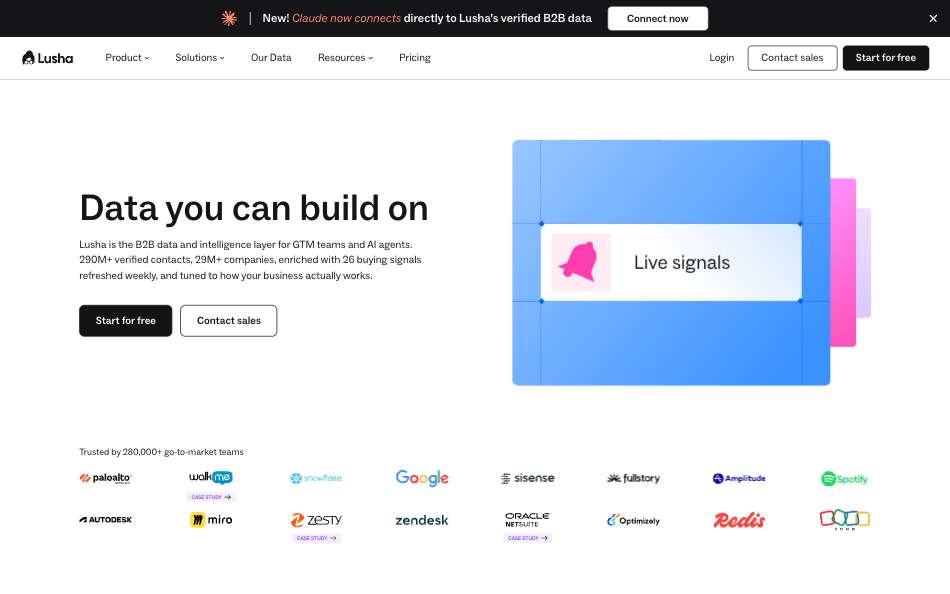
Lusha is a contact tool built around email and phone reveals in a browser extension and platform. It suits a small team that wants direct dials without a long contract.
An email costs 1 credit and a phone number costs 5. Pro is $69.90 a month for 600 credits, and Premium is $399.90 a month for 3,400 credits with 5 seats (Lusha pricing, September 2026). A bulk request adds 1 credit per 25 results.
Every plan gets an API key. Limits per key run from 40 requests a minute on Starter to 300 a minute on Premium (Lusha API guide, September 2026). The MCP server has 50 tools (Lusha MCP docs, September 2026).
Pros
- Direct-dial focus, with a free plan of 40 credits a month.
- Simple credit costs: 1 for an email, 5 for a phone.
- API and a 50-tool MCP server.
Cons
- The top public plan holds 10,000 credits a month, so there is no public price at 1M.
- Low API rate limits on cheap plans.
- Yearly credits reset at the end of the cycle.
Best for: a team of two to five that works a phone-first list.
Pricing: Free $0, Starter $49.90, Pro $69.90, Premium $399.90 a month, or $37.45, $52.45 and $299.95 billed yearly (Lusha pricing, September 2026).
6. ZoomInfo: best for enterprise sales teams
ZoomInfo is the enterprise suite. Platform plans are quoted by sales, and its pricing page blocked our fetch, so we cannot quote those prices here.
The self-serve route is GTM AI, a pay-as-you-go API and MCP server. Credits list from $0.45 each down to $0.25 at 100,000 credits, and the free tier gives 1,000 data credits with no card (GTM AI pricing, September 2026). Search is free, and a record is charged once per 12 months.
Rate limits run from 5 to 35 requests a second by package (GTM AI docs, September 2026). The MCP server works with Claude, ChatGPT and Cursor (ZoomInfo MCP docs, September 2026).
Pros
- Company, contact and intent records on one credit.
- Pay-as-you-go access with no contract on GTM AI.
- Free search, and no re-charge inside 12 months.
Cons
- The slider stops at 100,000 credits for $25,000, with no public price at 1M.
- Platform pricing is not public.
- Built for sales teams, not for a small agency pulling lists.
Best for: an agency that sells to enterprise accounts.
Pricing: pay as you go from $20 on GTM AI (GTM AI pricing, September 2026).
Comparison table
| Tool | Best for | Starting price | Cost at 1M records a month | API | MCP | Rate limit |
|---|---|---|---|---|---|---|
| LeadOcean | Client lists at volume | Free, then $97 a month | $497 a month (Agency) | Yes, REST | Yes, 13 tools | 200 a second on Agency |
| Apollo | Data plus sequences | $65 per seat a month | $24,750 a month list | Yes, every plan | Yes, any plan | 1,000 a minute on enrichment, 200 a minute on general |
| Clay | Enrichment workflows | $185 a month | No public price at 1M | Yes, every plan | Yes | No published number |
| Hunter | Cheap email pulls | $49 a month | $6,900 once | Yes | Yes | 15 a second per endpoint |
| Lusha | Mobile numbers | $49.90 a month | No public price at 1M | Yes, every plan | Yes, 50 tools | 40 to 300 a minute by plan |
| ZoomInfo | Enterprise teams | $20 pay as you go | No public price at 1M | Yes (GTM AI) | Yes | 5 to 35 a second by package |
How to choose
- You build lists for clients or pull more than 100,000 records a month: LeadOcean. A flat $497 beats any per-seat or per-credit price at that size.
- You want to find and email prospects yourself, in one app: Apollo. Pair it with LeadOcean if you hit its credit limits.
- You like building enrichment logic in a table: Clay, with LeadOcean as the first data source.
- You only need emails for known domains: Hunter. Its Data Platform is the cheapest public per-record price here.
- You work from a phone list with a small team: Lusha.
- You sell to enterprise accounts: ZoomInfo.
Verdict
LeadOcean wins for agencies that deliver lists, run agents or pull data at volume, because $497 a month does not change with records. Apollo wins for an owner who wants data and outreach in one app. Clay wins for workflow builders, Hunter for email-only pulls, Lusha for mobile numbers and ZoomInfo for enterprise targets. Most agencies end up with one data source and one sending tool, so choose the data source on cost at your real volume.
FAQ
What is the best B2B sales prospecting tool for an agency owner?
It depends on the job. For lists at volume, LeadOcean is the cheapest we found at $497 a month. For data and outreach in one app, Apollo is the simpler start.
How much does it cost to pull 1M records a month?
Apollo lists at $24,750 a month on monthly billing. Hunter sells 1M search credits for $6,900 once. LeadOcean Agency is $497 a month. Clay, Lusha and ZoomInfo have no public 1M price.
Do I need a developer to use these tools?
Not for Apollo, Clay or Lusha, which have apps. LeadOcean is built for API and MCP use, plus a CSV export page in the app, so a non-developer can export without code.
Can I use the data for client work?
On LeadOcean, the Agency plan covers your own and your clients' work. Check each other vendor's terms before you resell lists, since we did not verify them.
Does LeadOcean replace my sequencer?
No. It has no sequencer, dialer or CRM. Export the list or call the API, then send from the tool you already use. Read email_status first, because bounces are not refunded.
How fresh is the data?
LeadOcean refreshes its dataset monthly, and each record carries its own fetched_at date.
Size your agency prospect list free before you pay for a record
Free to start. No credit card. 1,000 records to spend whenever you like.
Get your free API key →