Intent data is a signal that shows which companies are researching a topic or a product right now, collected from publisher networks, review sites and your own web traffic. Sales and marketing teams use it to decide which accounts to contact first.
Most teams leave their first provider over price and access. Quotes are private, contracts run a year or more, and the API sits behind a package or a CSM. 6sense, for one, shows no price we could read and caps its API at 100 requests a minute (6sense API docs, October 2026).
This page ranks seven tools for people who work through an API or an agent. Six sell signals. The seventh, LeadOcean, sells the contacts behind them, and we say so in its section. For the basics, read what is intent data. Related swaps: ZoomInfo, Cognism and Dealfront alternatives.
TL;DR
| Tool | Best for | Starting price | Cost at 1M records a month |
|---|---|---|---|
| ZoomInfo | Intent and contacts in one pay-as-you-go API | GTM AI credits from $20, listed at $0.45 each | No public 1M price. Slider stops at 100,000 credits for $25,000 |
| Bombora | Raw account-level intent feeds | No public price. Vendr median $25,000 a year | No public 1M price |
| Demandbase | ABM teams that want intent plus advertising | No public price. Vendr median $68,591 a year | No public 1M price |
| 6sense | Buying stages and scoring inside a full ABM suite | No public price. Reported from $35,000 a year | No public 1M price |
| Dealfront (Leadfeeder) | Website visitor identification | Discover $113 a month billed monthly, $79 billed yearly | No public 1M price. Top tier is 5,500 credits a month |
| Cognism | Phone-verified mobiles with intent on Pro | No public price | No public 1M price |
| LeadOcean | The contact layer behind an intent signal | Free (1,000 records, one-off). Agency $497 a month | $497 a month flat. Fair use applies. No intent data |
"1M records" means 1M person or company records pulled in a month, one credit each where the vendor uses credits. Intent vendors rarely sell at that size, so most cells say there is no public price. We never multiply a rate out to 1M. Ask each vendor for a quote at your volume.
What we evaluated
- Signal source: where the intent comes from (a publisher co-op, review sites, your own site visitors) and what unit it arrives in.
- Price model: flat, credits, seats or contract, and whether any price is public.
- API access: which plan opens it and the published rate limit.
- MCP: whether an agent can query the vendor through a first-party server.
- Limits that bite: package gates, expiring credits, daily caps and contract terms.
We read each vendor's pricing page and docs in September and October 2026. We ran no same-input accuracy test. Intent signals are account-level and change daily, so a blind test would not give a fair result. We quote no quality numbers.
1. ZoomInfo: best for intent and contacts in one pay-as-you-go API
ZoomInfo ranks first for API buyers because it sells intent records on public pay-as-you-go credit prices, with no contract. Its newer product, GTM AI, sells an API and an MCP server on data credits. One credit enriches or exports one company, contact or intent record (GTM AI docs, September 2026).
List prices fall with purchase size. A 100-credit pack is $0.45 a credit and the $1,000 tier is $0.38. The slider stops at 100,000 credits for $25,000, or $0.25 a credit (GTM AI pricing, September 2026). Larger volumes go to Enterprise, so there is no public price at 1M. Search and lookup are free.
The free plan gives 1,000 data credits and 1,000 AI credits with no card, at 5 requests a second. Rate limits rise to 25 a second on Standard and 35 on Scaling (ZoomInfo rate limits, September 2026). The ZoomInfo platform plans are a different product. Vendr reports a median of $33,500 a year across 1,574 purchases (Vendr, September 2026).
Credits do not expire while the account is active. A record is charged once per 12 months, so re-enriching the same intent accounts inside that window costs nothing.
Pros
- Public credit prices from $20, with no contract on GTM AI.
- API, MCP server and CLI on the free plan.
- Intent records sit in the same credit meter as contacts.
- Re-enriching a record inside 12 months is free.
Cons
- Per-record pricing adds up fast at volume.
- No public price above 100,000 credits.
- No public price for the ZoomInfo platform plans.
Best for: teams that keep intent in the plan and want a metered API instead of a contract.
Pricing: GTM AI data credits from $0.45 each at 100 credits, down to $0.25 at 100,000 (GTM AI pricing, September 2026).
2. Bombora: best for raw account-level intent feeds
Bombora is where much of the intent market gets its signals. Its Company Surge product tracks which accounts research which topics, drawn from a Data Co-op of B2B publishers. Bombora says 86% of that data is shared exclusively with it (Bombora, October 2026).
It sells intent, not contacts. Personas add buying-group roles to Company Surge, but you still need another source for emails and phones (Bombora, October 2026). Bombora lists no price. Vendr reports a median of $25,000 a year across 35 purchases, from $13,000 to $80,450 (Vendr, February 2026).
The Intent API uses OAuth 2.0 bearer tokens and returns data in pages of up to 100 (Bombora developer portal, October 2026). Vendr says API access can add $5,000 to $20,000 or more a year. The Intent API overview states no rate limit.
For a developer, the useful part is the surface. The portal lists an Account List API, a Reference API, a Digital Audience API and a Webhooks API next to the Intent API (Bombora developer portal, October 2026). You define a signal, then pull the accounts that surge on it.
Pros
- A dedicated intent feed with its own API, webhooks and account-list API.
- Cheaper entry than a full ABM platform, by Vendr's median.
- Many other vendors build on Bombora data, so you can buy it at the source.
Cons
- No contact data. You pair it with a second tool.
- No first-party MCP server found. Bombora data reaches agents through Explorium's MCP (Bombora, October 2026).
- Annual contract, quote only, with API access reported as an extra fee.
Best for: teams that already own contact data and want the intent signal alone.
Pricing: No public price. Vendr median $25,000 a year (Vendr, February 2026).
3. Demandbase: best for ABM teams that want intent plus advertising
Demandbase is an ABM platform with account intent, buying groups and advertising in one product. Choose it if your marketing team runs programs against target accounts every week.
The price is a quote. The pricing page is a form, with no figures (Demandbase pricing, October 2026). Vendr reports a median of $68,591 a year across 187 purchases, with a range of $24,000 to $164,037 (Vendr, February 2026).
The developer side is stronger than most. The API suite covers B2B data, export, import, user admin, credit usage and intent (Demandbase API docs, October 2026). The MCP server has an Account-Level Intent tool and charges 1 credit per record returned (Demandbase credit docs, October 2026).
Demandbase also sells data. Its MCP tools search internal accounts and people, external companies and people, and net-new contacts. Each tool returns 5 records a page by default and up to 100. Set the limit yourself, because an agent may pick its own page size and spend credits.
Pros
- Intent, buying groups and advertising in one platform.
- First-party MCP server with an intent tool.
- MCP charges nothing when a query returns no data.
Cons
- Quote-only price and an annual contract.
- Export API allows 60 job submissions a day (Demandbase docs, October 2026).
- It is a platform, so you pay for modules you may not use.
Best for: marketing-led ABM teams that need intent and advertising together.
Pricing: No public price. Vendr median $68,591 a year (Vendr, February 2026).
4. 6sense: best for buying stages and scoring inside a full ABM suite
6sense is the platform most teams compare everything else against. It combines third-party intent, web visitor identification, buying stage, account scoring and advertising. If your pipeline runs on predicted buying stages, this is the product.
It prints no price we could read, because its pricing page sits behind a bot check (6sense pricing, October 2026). Docket reports the cheapest paid package from $35,000 a year (Docket, October 2026). Vendr reports a median of $62,440 a year, with contracts from $11,376 to $176,809 (Vendr, February 2026).
The API is gated by package. People Enrichment is an add-on, Lead Scoring needs the Advanced package, and your CSM turns APIs on. The limit is 100 requests a minute (6sense API docs, October 2026). Credits pay for contact data and do not roll over between periods (6sense credits, October 2026).
UserGems reports implementation costs of $10,000 to $50,000 or more and contract terms of 12 to 24 months (UserGems, October 2026). We found no first-party MCP server.
Pros
- Intent, buying stage, scoring and visitor identification in one suite.
- Credits cost nothing to re-enrich inside the 12-month maintenance period.
- A People Search API and Lead Scoring API that use no credits.
Cons
- No readable price and a reported median above $62,000 a year.
- API access depends on the package and a CSM.
- 100 requests a minute is a tight cap for agents.
- No first-party MCP server found.
Best for: enterprise ABM teams that run on buying stages and have a RevOps owner.
Pricing: No public price. Vendr median $62,440 a year (Vendr, February 2026).
5. Dealfront (Leadfeeder): best for website visitor identification
Dealfront trades as Leadfeeder. It reveals which companies visit your site, which is first-party intent: the signal comes from your own traffic, not a publisher network. It also lets you filter by intent signals and turn identified companies into named contacts (Leadfeeder pricing, September 2026).
Prices are public. Discover is $113 a month billed monthly, or $79 billed yearly. Activate is $527 billed monthly, or $369 yearly. Scale starts at $599 on yearly billing. Lite is free with 20 credits a month (Leadfeeder pricing, September 2026).
API and MCP access are on every paid plan, and the MCP server is in beta. The API allows 10 requests a second per key and 100,000 requests a month (Leadfeeder docs, September 2026). Email-only contact enrichment costs 0.2 credit, and email plus phone costs 1 (Leadfeeder help, September 2026).
Dealfront publishes no price per extra credit, so growth past the plan means asking support. It will not tell you who researches your category on other sites. For that you need a co-op feed such as Bombora.
Pros
- Published prices from $79 a month, with a free Lite plan.
- API and MCP server on every paid plan.
- Identifies visiting companies without a form fill.
Cons
- Top public tier is Scale at 5,500 credits a month.
- No published price per extra credit.
- Each API key caps at 100,000 requests a month.
- Sees only your own traffic, not wider market research.
Best for: marketers who want visitor identification and a public price.
Pricing: Discover $113 a month billed monthly, $79 billed yearly. Scale from $599 billed yearly (Leadfeeder pricing, September 2026).
6. Cognism: best for phone-verified mobiles with intent on Pro
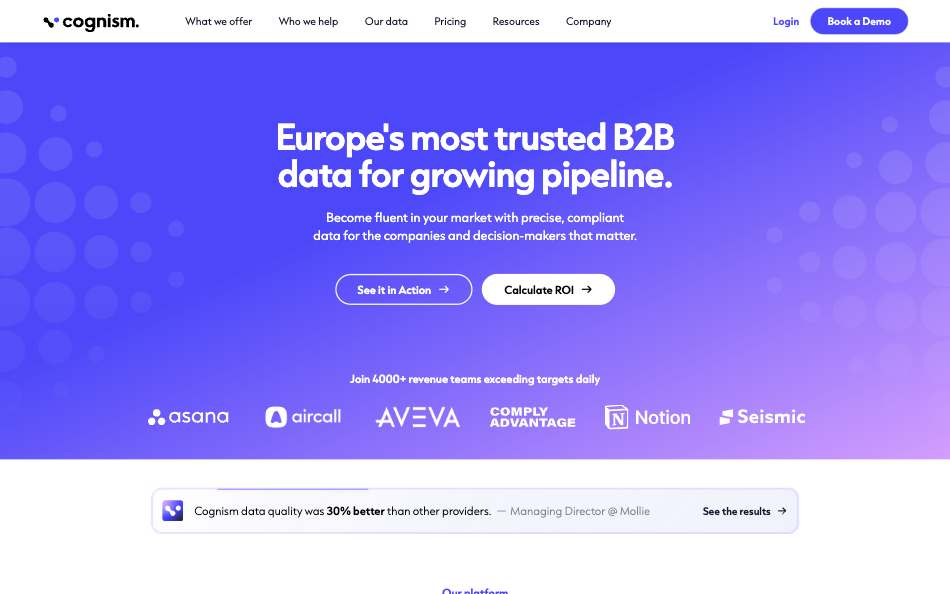
Cognism is a sales intelligence platform built around phone-verified contacts. It claims over 10M phone-verified contacts and cross-checks Do Not Call lists in 15 territories (Cognism, September 2026). If your reps cold call, that is the product.
Intent is on the Pro plan. It uses Bombora Company Surge, with up to 12 topics from over 11,000 (Cognism pricing, September 2026). That is a smaller feed than a direct Bombora contract, bundled with contacts. The page shows no dollar amounts, and each plan includes five seats.
The API allows 500 requests a minute per account, per operation (Cognism rate limits, September 2026). The MCP server has 15 tools that map onto the API and share its credits (Cognism docs, September 2026). API and MCP access need a package that includes them.
One credit reveals one contact, and viewing a contact you already revealed is free. Cognism publishes no credit price or per-seat allocation, so you cannot cost a 1M job without a quote.
Pros
- Phone-verified contacts, with Do Not Call checks in 15 territories.
- Intent from Bombora included on Pro.
- First-party MCP server with the same capabilities as the API.
Cons
- No public price, so you negotiate before you can size a job.
- Credits and seats gate every reveal.
- Intent is capped at 12 topics.
Best for: outbound teams that call mobiles and want light intent included.
Pricing: No public price. Standard and Pro plans, five seats each, quote only (Cognism pricing, September 2026).
7. LeadOcean: best for the contact layer behind an intent signal
LeadOcean has no intent data, and we rank it last for that reason. It does not detect who is researching your category. It answers the next question: once a signal names an account, who works there and how do you reach them?
It is one dataset behind one REST API and one MCP server: 693M people, 366M with an email, 166M with a phone number, and 67M companies. You search with 50 people filters and 34 company filters, and counts are free. Funding and technology filters give you triggers, but they are firmographic, not behavioral.
Agency is $497 a month, flat, with 200 requests per second per account. There are no credits and no overage invoice. A very large month is paced down until the reset, not cut off. The split works: a signal source picks the accounts, and LeadOcean returns the people.
Enrichment is POST /v1/people/enrich, phones are GET /v2/people/phone, and exports run through POST /v1/exports. The MCP server at https://api.leadocean.io/mcp signs in with OAuth 2.1 and exposes 13 tools. The app has an Exports page with a filter builder, column picker, price preview and CSV download (LeadOcean docs, September 2026).
Pros
- Flat $497 a month on Agency, with a fair-use pace instead of a credit meter.
- REST and MCP on every plan, including Free, with no CSM step.
- Email status on every record, from
verifiedtospam_trap. - Free counts size a list before you spend a record.
Cons
- No intent data, scoring or website visitor identification.
- No rep workspace: no sequencer, dialer, CRM or Chrome extension.
- One dataset, so no waterfall across vendors.
Best for: engineers, RevOps and agents that pull people and company data at volume for a fixed bill.
Pricing: Free is 1,000 records, one-off, no card. Agency is $497 a month, flat (LeadOcean pricing, October 2026).
Comparison table
| Tool | Best for | Starting price | Cost at 1M records a month | API | MCP | Rate limit |
|---|---|---|---|---|---|---|
| ZoomInfo | Intent and contacts, pay as you go | GTM AI credits from $20 | No public 1M price | GTM AI API on every plan | Yes, through GTM AI | 5 a second Builder, 25 Standard, 35 Scaling |
| Bombora | Raw intent feeds | No public price | No public 1M price | Intent API, OAuth 2.0. Extra fee reported | No first-party server found | Not stated in the Intent API overview |
| Demandbase | ABM plus advertising | No public price | No public 1M price | API suite, including an Intent API | Yes. Account-Level Intent tool | Export API: 60 job submissions a day |
| 6sense | Buying stages and scoring | No public price | No public 1M price | Gated by package and CSM | No first-party server found | 100 a minute |
| Dealfront (Leadfeeder) | Visitor identification | Discover $113 a month, $79 yearly | No public 1M price | On every paid plan | Yes, beta | 10 a second per key, 100,000 a month |
| Cognism | Phone-verified mobiles | No public price | No public 1M price | On packages that include it | Yes. 15 tools | 500 a minute per account, per operation |
| LeadOcean | Contact layer, no intent | Free. Agency $497 a month | $497 flat. Fair use applies | REST on every plan | Yes. OAuth 2.1, 13 tools | 5 a second on Free, 200 on Agency, per account |
Sources are linked in each tool section, checked in September and October 2026. Vendors change plans often, so confirm on the pricing page before you buy.
How to choose
- You want intent and contacts in one metered API, with a public price: ZoomInfo through GTM AI.
- You already own contact data and want the signal alone: Bombora.
- Marketing runs ABM programs and ads against target accounts: Demandbase.
- Your pipeline runs on predicted buying stages and you can fund a full suite: 6sense.
- You want to know which companies visit your site, at a public price: Dealfront (Leadfeeder).
- Your reps call mobiles and want light intent included: Cognism, after you get a quote.
- You have the signal and need the people, emails and phones in code or in an agent: LeadOcean.
- You are weighing contact databases rather than signals: read best B2B databases, or best B2B data providers in the UK for European coverage.
Verdict
ZoomInfo wins for API buyers who want intent and contacts under one public price list. Bombora wins for the raw feed, Demandbase for marketing-led ABM, and 6sense for teams that live on buying stages and can pay for the suite. Dealfront wins for visitor identification at a published price, and Cognism for phone-verified mobiles with light intent. LeadOcean sells no intent. Use it as the contact layer: pick accounts with a signal source, then pull the people for a flat fee. Start on the free plan and run the same lookups on your own accounts.
FAQ
What is the best intent data provider?
It depends on the signal you need. Bombora is the raw account-level feed, ZoomInfo is the easiest to buy and call from code, and 6sense or Demandbase suit full ABM programs. For visitor-level intent, Dealfront is the one with a public price.
How much does intent data cost?
Most providers publish nothing. Vendr medians are $25,000 a year for Bombora, $62,440 for 6sense and $68,591 for Demandbase (Vendr, February 2026). ZoomInfo's GTM AI is the exception, with credits from $0.45 each (GTM AI pricing, September 2026).
Which intent data provider has an API?
All of them, with conditions. ZoomInfo and Dealfront include the API on paid plans. Bombora reportedly charges extra, and 6sense gates it by package and a CSM.
Which intent data provider has an MCP server?
ZoomInfo, Demandbase, Cognism and Dealfront do. Dealfront's is in beta. We found no first-party server from Bombora or 6sense, though Explorium's MCP carries Bombora data.
Does LeadOcean sell intent data?
No. LeadOcean returns people and company records: 693M people and 67M companies. Pair it with an intent source, then enrich the accounts the signal names.
Do I need a credit card to try LeadOcean?
No. The free plan needs no card. It gives you 1,000 records, one-off, with the same API and MCP server as Agency. See pricing.
Related: what is intent data, best B2B databases, best B2B data providers in the UK, pricing.
Found the accounts with intent. Now get the people and emails at them for a flat fee.
Free to start. No credit card. 1,000 records to spend whenever you like.
Get your free API key →