Teams leave Harmonic when they need startup and company data in code and cannot price it first. Harmonic sells Console, API access and Bulk data, and the pricing page shows "Get pricing" on each, with no dollar figure (Harmonic pricing, September 2026). Access starts with a demo.
Three limits push API buyers out. Funding rounds and investor data are a paid add-on, not part of the API plan (Harmonic API docs, September 2026). Most endpoints allow 10 requests per second. And an MCP login on a team with no API plan gets 100 requests a day per user, with no deal data (Harmonic MCP guide, September 2026).
Harmonic is still the sharpest tool for finding startups before a round is announced. This page ranks six alternatives for readers who pull company data through an API, an agent or at volume. Each section says what you get and what is missing.
TL;DR
| Tool | Best for | Starting price | Cost at 1M records a month |
|---|---|---|---|
| LeadOcean | Company and contact data by API, agent or export | Free (1,000 records, one-off). Pro $499 a month | $499 a month flat. Fair use applies |
| CompanyEnrich | Funding rounds by API at a printed price | Starter $49 a month for 5,000 credits | No public 1M price. Top tier Scale: $549 a month for 500,000 credits |
| Coresignal | Bulk company files and job postings | Mini $49 a month for 2,500 credits | No public 1M price. Top tier Elite: $5,000 a month for 10,000,000 credits, or 1,000,000 Base company records |
| Crustdata | Live company data and signals in agents | No public price list | No public 1M price. 2,000,000 credits at 2 per company enrich, no public dollar price per credit |
| People Data Labs | Licensed company datasets | Company Pro from $100 a month for 1,000 records | No public 1M price. Enterprise is quote only |
| Crunchbase | Deal history and investor profiles | Free trial. No dollar figure on the pricing page | No public 1M price. API is by licence |
"1M records" means 1M company records returned or enriched, one record each. Where a vendor sells no plan at 1M, the cell shows its top public tier or the credit count. We never multiply a rate out to a price. Enterprise quotes are usually lower than list.
What we evaluated
- API access: the plan that opens it, and whether a key is self-serve.
- MCP: whether an agent can pull company records or only read documentation.
- Price model: flat or credits, whether the price is public, and what 1M company records cost.
- Startup and funding data: stated coverage, funding fields and what is missing next to Harmonic.
- Limits that bite: rate limits, plan gates, expiring credits, fair use.
We ran no accuracy test, so we quote no quality numbers. Coverage figures are each vendor's own claims. Prices are list prices checked in September 2026, and enterprise quotes can differ.
1. LeadOcean: best for company and contact data at volume
LeadOcean holds 63M companies and 693M people, 366M of them with an email. The filter set includes 23 funding types, 534 industries and 105 technology categories. Sizing counts are free, so you check a list before you spend a record. Each company or person returned counts as one record.
Company calls are POST /v1/companies/enrich, /v1/companies/search and GET /v1/companies/{domain}/people. The last one returns the people at a company, up to 10,000 rows. Exports run through POST /v1/exports, up to 50,000 rows per request. The app has an Exports page with a filter builder, a column picker, the record price before you start and a CSV download. It has no rep workspace, sequencer or CRM.
Pro is $499 a month with no credits and no overage invoice. It includes 5 API keys and 100 requests per second per key, ten times Harmonic's limit on most endpoints. The MCP server at https://api.leadocean.io/mcp signs in with OAuth 2.1 and exposes 12 tools, including get_company and search_companies. LeadOcean is not a startup database. Funding filters narrow a company list, but there are no stealth-company records, hiring signals, network mapping or investor profiles. Pick it when the job is a list, an enrichment or an agent query.
Pros
- Flat $499 a month at any volume, no credits.
- REST and MCP on every plan, including Free.
- Free counts, and the same key returns the people at each company.
- 100 requests per second per key.
Cons
- No startup signals, investor profiles or deal history.
- No weekly warehouse feed of the whole dataset.
- A very large month is paced down past the fair-usage line, not cut off.
Best for: engineers, RevOps and agents that need company and contact data at volume and a fixed bill.
Pricing: Free is 1,000 records, one-off, no card. Pro is $499 a month, flat (LeadOcean pricing, September 2026).
2. CompanyEnrich: best for funding rounds by API at a printed price
CompanyEnrich is the closest match to Harmonic's funding fields that has a public price. Starter is $49 a month for 5,000 credits, Pro is $149 for 50,000 and Scale is $549 for 500,000 (CompanyEnrich pricing, September 2026). Every plan includes full API access. A company enrichment costs 1 credit and a company search 1 credit per company.
It claims 33M+ companies and a separate Company Funding API. The vendor says that API covers about 364K funded companies and 670K rounds, with full round history and investors. New rounds appear within about 15 days of announcement (CompanyEnrich docs index, September 2026). Harmonic sells the same kind of data as an add-on with no price attached.
The MCP server exposes all its APIs as tools (CompanyEnrich docs index, October 2026), so an agent can enrich a company or run a lookalike search without glue code. Rate limits scale with the plan: 60 requests a minute on Starter, 120 on Pro and 600 on Scale. Extra credits are sold at a price the site does not print, so 1M records has no public price.
Pros
- Every plan price and credit cost is public.
- A funding API with round history and investors.
- MCP server, and lookalike search for account lists.
- Credits roll over on Pro and Scale.
Cons
- Extra credits are unpublished, so you cannot price 1M from the site.
- 33M+ companies is a smaller set than LeadOcean's 63M.
- 600 requests a minute at the top tier, the same as Harmonic's 10 a second, and 60 a minute on Starter.
Best for: teams that want funding and firmographics by API and a price they can read.
Pricing: Starter $49, Pro $149, Scale $549 a month. Annual plans exist but no figure is published (CompanyEnrich pricing, September 2026).
3. Coresignal: best for bulk company files and job postings
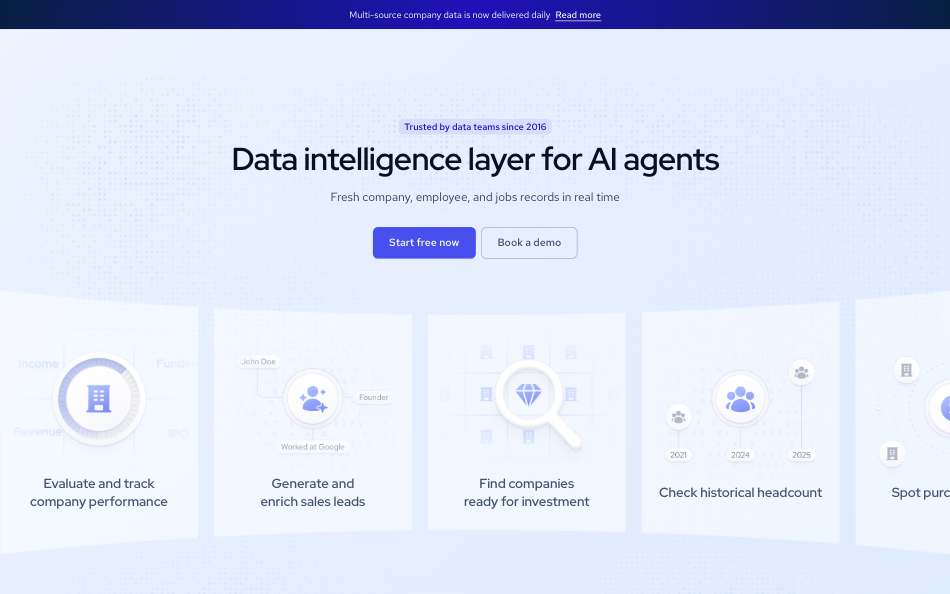
Coresignal sells company, employee and job data on credits. It lists 70M+ company records and 482M+ job postings (Coresignal, September 2026). A Base company record costs 10 credits and a Multi-source company record 20 (Coresignal docs, September 2026).
Hiring is a signal Harmonic sells, and job postings are the closest thing Coresignal has to it. Funding is thinner. The Multi-source company data dictionary lists the last funding round and its investors (Coresignal docs, September 2026). That is one round, not a history. Plans run from Mini at $49 a month for 2,500 credits to Elite at $5,000 for 10,000,000 (Coresignal pricing, September 2026).
Rate limits climb with the plan: 5 requests a second up to Starter, 10 on Pro and 100 or more on Elite (Coresignal docs, September 2026). Pro matches Harmonic's limit and Elite beats it. The MCP server uses OAuth 2.1 and exposes 5 tools (Coresignal docs, September 2026).
Pros
- Company records, employee records and job postings in one vendor.
- Last funding round and investors on Multi-source records.
- Flat-file datasets from $1,000 a month.
- A public price list that reaches 10,000,000 credits.
- MCP server that returns records.
Cons
- Every record costs credits, and Multi-source doubles the price.
- Small plans are limited to 5 requests a second.
- One funding round per company, not a history.
Best for: teams that want job postings or bulk company files and accept a credit meter.
Pricing: Mini $49 a month up to Elite at $5,000 a month. Billed yearly is 10% lower (Coresignal pricing, September 2026).
4. Crustdata: best for live company data and signals in agents
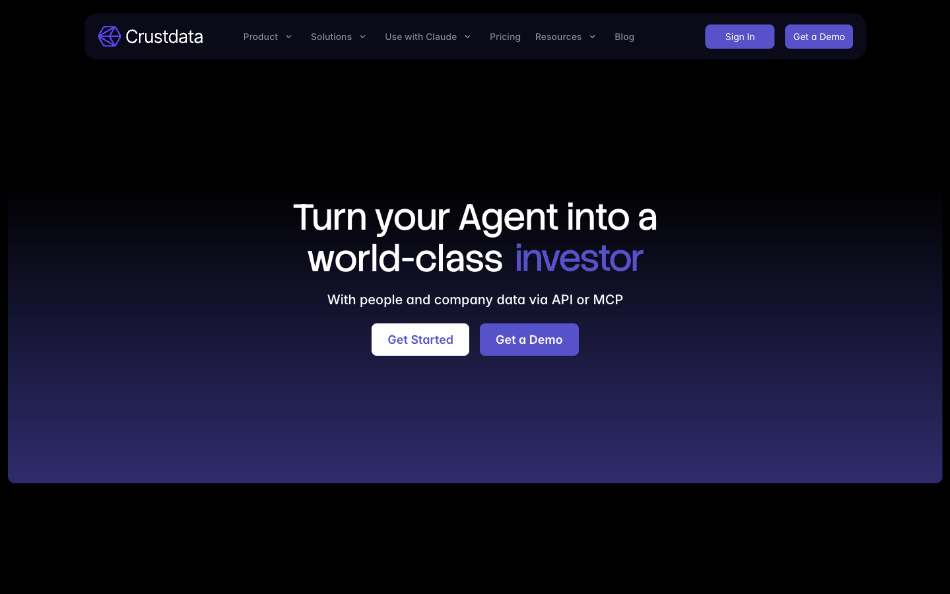
Crustdata sells real-time company and people data by API. The pitch is fresh data and change signals rather than a static file, which is close to what Harmonic sells for startups. Company search is 0.03 credits per result. The funding field group adds 0.2 credits per result to filter on it and another 0.2 to return it. Company enrichment is 2 to 4 credits, and company identify is free (Crustdata docs, September 2026).
Pricing is credit based and the pricing page shows no plan names or dollar price per credit (Crustdata pricing, September 2026). The homepage gives two different company counts, so this page quotes none (Crustdata, September 2026). That is the same problem as Harmonic: you cannot price a month before talking to someone.
Default limits are 15 requests a minute on company enrich and 30 on search (Crustdata docs, September 2026). The hosted MCP server takes OAuth for interactive clients and an API key for code (Crustdata docs, September 2026).
Pros
- Cheap search at 0.03 credits a result, so you narrow before you enrich.
- Funding data available as a search and response field.
- MCP server that returns records, with a key for code.
Cons
- No public dollar price, so 1M records cannot be priced from the site.
- 15 requests a minute on company enrich by default.
- Credit expiry is 12 months in the docs, but a July 2026 Crustdata blog post says 6 months (docs, blog, both September 2026).
Best for: AI SDR and signal workflows that need fresh company data more than volume.
Pricing: Credit based, no public price list (Crustdata docs, September 2026).
5. People Data Labs: best for licensed company datasets
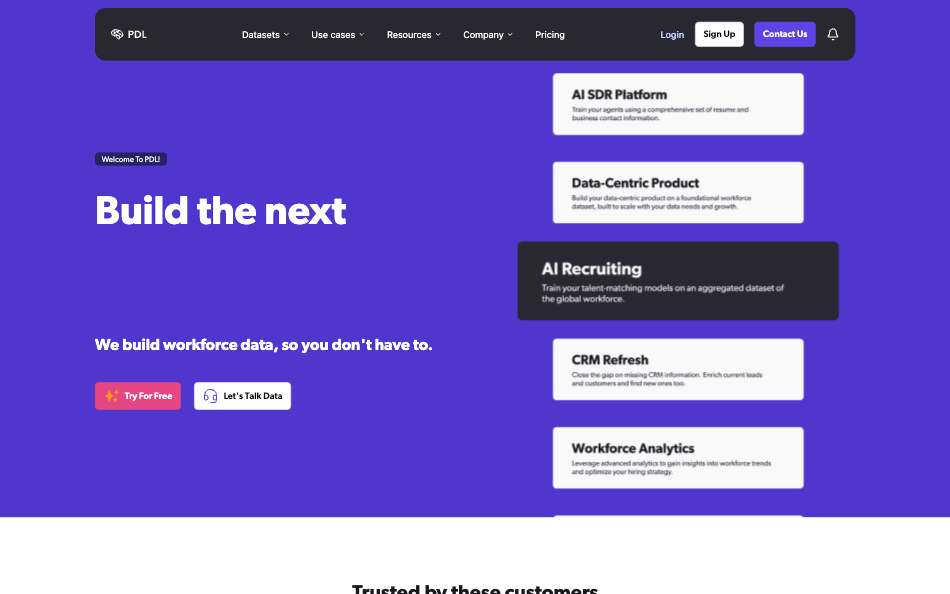
People Data Labs (PDL) sells company records by API and as licensed files. Company Pro starts at $100 a month for 1,000 records, or $960 a year billed yearly. Free gives up to 100 records a month with contact data hidden (PDL company pricing, September 2026).
PDL lists 76,606,079 company records (PDL docs, September 2026). Its stats page shows funding details on 318,398 of them, about 0.4% of the set. Funding is a field here, not a focus. If you need round histories, read the CompanyEnrich section above.
Above roughly 400,000 company profiles a year PDL advises Enterprise and sales (PDL blog, September 2026). Company Enrichment allows 1,000 requests a minute on paid plans, and Company Search 10 a minute (PDL docs, September 2026). The docs index lists no official MCP server (PDL docs, September 2026).
Pros
- 76.6M company records, a count PDL publishes in its docs.
- Enterprise offers API or data licence feeds, like Harmonic's bulk plan.
- A published Pro price from $100 a month.
Cons
- Funding detail is thin.
- Company Search is 10 requests a minute by default.
- No official MCP server.
- Above about 400,000 companies a year you are in a sales process.
Best for: data teams that want company files licensed into their own storage.
Pricing: Free up to 100 records a month. Company Pro from $100 a month for 1,000 records (PDL company pricing, September 2026).
6. Crunchbase: best for deal history and investor profiles
Crunchbase is the alternative if you leave Harmonic for its funding depth, not its API. Its pricing page claims 4M+ private companies and shows a free trial but no dollar figure (Crunchbase pricing, September 2026). You cannot budget a year from that page.
The API is the catch. Full access needs an Enterprise or Applications licence, so there is no self-serve key, and calls are limited to 200 a minute (Crunchbase API docs, September 2026). The packages are Fundamentals, Insights and Predictions. Fundamentals covers funding stages, round history, valuations and investor details (Crunchbase API packages, September 2026).
MCP is bought separately, and each user needs a Crunchbase Business seat (Crunchbase MCP docs, September 2026). Shared automation needs a conversation with the account team. For a deeper read, see Crunchbase alternatives.
Pros
- Round history, valuations and investor details in the API.
- Predictions on funding, growth and exits.
- MCP server, with seats managed per user.
Cons
- No self-serve API key. Full access is a licence.
- 200 calls a minute.
- MCP is a separate purchase and needs a Business seat per user.
Best for: investors and analysts who want deal history and predictions, with a licence budget.
Pricing: No dollar figure on the pricing page. The API is by licence (Crunchbase pricing, September 2026).
Comparison table
| Tool | Best for | Starting price | Cost at 1M records a month | API | MCP | Rate limit |
|---|---|---|---|---|---|---|
| LeadOcean | Company and contact data at volume | Free. Pro $499 a month | $499 flat. Fair use applies | REST on every plan | Yes. OAuth 2.1, 12 tools | 100 requests per second per key |
| CompanyEnrich | Funding rounds at a printed price | Starter $49 a month | No public 1M price. Scale $549 for 500,000 credits | REST on every plan | Yes | 60, 120 or 600 a minute by plan |
| Coresignal | Bulk files, job postings | Mini $49 a month | No public 1M price. Elite $5,000 for 10,000,000 credits | REST | Yes. OAuth 2.1, 5 tools | 5 to 100+ per second by plan |
| Crustdata | Live data for agents | No public price list | No public 1M price. 2,000,000 credits | REST | Yes. OAuth or key | 15 a minute enrich, 30 search |
| People Data Labs | Licensed company files | Company Pro $100 a month | No public 1M price | REST. Free hides contact data | No official server | Enrich 1,000 a minute paid. Search 10 a minute |
| Crunchbase | Deal history, predictions | Free trial. No dollar figure | No public 1M price. API by licence | REST on a licence | Yes. Separate purchase | 200 calls a minute |
The 1M column is plan or credit arithmetic on company records. Coresignal's Elite plan holds 10,000,000 credits, which is 1,000,000 Base company records at 10 credits. CompanyEnrich needs 1,000,000 credits and its largest plan holds 500,000. Crustdata needs 2,000,000 credits and prints no dollar price per credit. For comparison, Harmonic allows 10 requests per second and it publishes no 1M price.
How to choose
- You pull company data in code or with an agent, at volume: LeadOcean. One flat price, REST and MCP on every plan, 100 requests per second.
- You want funding rounds by API with a printed price: CompanyEnrich.
- You need job postings next to company records: Coresignal.
- You need live signals inside an agent: Crustdata.
- You need company files licensed into your warehouse: People Data Labs or Coresignal.
- You need deal history, valuations and predictions: Crunchbase, with a licence.
- You invest in startups and want sourcing, Scout agents and network mapping: stay on Harmonic. See Harmonic pricing first.
- You need technology data: read Wappalyzer alternatives.
- You want a contact finder inside LinkedIn: read Surfe alternatives or Skrapp alternatives.
Verdict
LeadOcean wins for API, agent and volume buyers: a flat price, company and contact data on one key, and an MCP server that returns records. CompanyEnrich is the runner-up and the best pick for funding data with a public price. Coresignal wins for job postings and bulk files, Crustdata for live signals, PDL for licensed datasets and Crunchbase for deal history. Keep Harmonic if you invest in startups and need sourcing signals in an app. Otherwise start on the free plan.
FAQ
Why do teams leave Harmonic?
Price opacity and API limits. Every plan is a quote after a demo, and funding and investor data are paid add-ons (Harmonic pricing, September 2026). Most API endpoints allow 10 requests per second (Harmonic API docs, September 2026).
Is there a free Harmonic alternative?
Five have a free tier or trial. LeadOcean gives 1,000 records one-off with no card. CompanyEnrich gives a 500-credit trial. PDL Free allows up to 100 records a month with contact data hidden. Coresignal's trial is 2,000 credits valid for 7 days (Coresignal docs, September 2026). Crunchbase offers a free trial. Harmonic has no free plan.
Which Harmonic alternative has funding data by API?
CompanyEnrich has a Company Funding API with round history, by its own description. Crunchbase's Fundamentals package covers round history and investors. Coresignal returns the last round and its investors, and Crustdata offers a funding field group in search. LeadOcean filters companies by funding type but has no round histories.
What is the cheapest Harmonic alternative at volume?
At 1M records a month, LeadOcean is the only one with a public flat price, $499. Coresignal has no public 1M price, and its Elite plan at $5,000 a month holds 10,000,000 credits. CompanyEnrich, PDL, Crustdata, Crunchbase and Harmonic publish no 1M price.
Which alternative has an MCP server that returns data?
LeadOcean, CompanyEnrich, Coresignal, Crustdata and Crunchbase all do, and so does Harmonic. PDL lists no official MCP server in its docs index. Crunchbase's needs a separate purchase and a Business seat per user.
Can LeadOcean replace Harmonic?
For company lists and contacts pulled in code, yes. For startup discovery, stealth founders, hiring signals and investor data, no. LeadOcean has 63M companies and 693M people, but no startup-specific signals. See pricing to try it with 1,000 records and no card.
Related: Harmonic pricing, Crunchbase alternatives, Wappalyzer alternatives, Surfe alternatives, Skrapp alternatives, pricing.
Get a company data price you can read before a demo. Pull your first 1,000 records free.
Free to start. No credit card. 1,000 records to spend whenever you like.
Get your free API key →