A funding data provider sells records of who raised money: the round type, the amount, the date and the investors. Sales teams use it to time outreach to freshly funded companies. Investors use it to source deals, and engineers and agent builders pull it by API to enrich accounts.
Most of the category is built for analysts, not pipelines. Crunchbase sells seats with export caps, Harmonic sells by quote, and several vendors bill in credits with no dollar price. This page ranks seven sources on funding depth, API and MCP access, rate limits and list price, checked in September 2026.
LeadOcean is first for API, agent and volume buyers, with a shallower funding record than the specialists. Compare rivals one by one: Crustdata, Apollo, People Data Labs and Coresignal. For wider lists, see best B2B databases and best B2B data providers.
TL;DR
| Tool | Best for | Starting price | Cost at 1M records a month |
|---|---|---|---|
| LeadOcean | API, agent and volume buyers who filter contacts by funding | Free (1,000 records, one-off), Solo $97 a month | $497 a month flat (Agency), fair-use pace applies |
| Crunchbase | Round-by-round history and investor research | Pro $99 a month ($49 billed yearly, first year) | No public 1M price |
| Harmonic | Startup sourcing with funding and investor data | Quote only | No public 1M price |
| Crustdata | Funding fields plus change watchers | No public price list | No public 1M price (2,000,000 credits at 2 per company) |
| Apollo | Teams that already work in Apollo | Free, Basic $65 per seat a month ($49 billed yearly) | $24,750 a month on monthly billing, $19,600 billed yearly |
| People Data Labs | Licensed company datasets with funding events | Company Pro $100 a month for 1,000 records ($960 billed yearly) | No public 1M price, Enterprise quote above 400,000 profiles a year |
| Coresignal | Funding rounds next to job postings | Mini $49 a month for 2,500 credits | No public 1M price (10,000,000 credits is the whole Elite plan) |
"1M records" means 1M company records returned or enriched, at list price. Where a vendor prints no price at that size, we say so and do not multiply a rate out.
What we evaluated
We asked every tool the same five questions, and we read each one's own docs for the answer. We ran no accuracy test, so this page quotes no match rates.
- Funding depth: whether you get every round with its date, amount and investors, or only the last round and a total.
- Filters: whether you can search for companies by round type, amount or date, not only look one up by domain.
- API and MCP: whether the funding data is reachable by REST and by an agent, and how that sign-in works.
- Rate limit: the default per second or per minute, since a funded-company sweep is a bulk job.
- Price at volume: flat, credits, seats or quote, and the cost of 1M company records.
1. LeadOcean: best for API, agent and volume buyers
LeadOcean holds 67M companies and 693M people. Funding is a set of filters on both. The filters are fundingType (23 round types, from Pre seed to Post IPO equity), minFunding and maxFunding in USD, and minLastFundingYear and maxLastFundingYear. investors matches lead investor keywords (LeadOcean filter reference, October 2026).
The useful part is the join. On people search, the funding filters match through the employer, so one call returns VPs at companies that closed a Series A after 2024. On people search they apply when the matched companies number 50,000 or fewer. Records with no funding value on file are never returned.
Agency is $497 a month flat, with 200 requests a second and no credits. The MCP server at https://api.leadocean.io/mcp signs in with OAuth 2.1 and has 13 tools, including leadocean_search_companies and leadocean_search_leads (LeadOcean docs, October 2026).
Pros
- Funding, company and contact filters in one query, so a funded-company list comes back with the people to contact.
- Flat $497 a month on Agency, with a fair-use pace instead of a credit meter or overage invoice.
- A person we hold nothing for is a free 404. Counts and filter lists are free.
- REST and MCP on every plan, Free included.
Cons
- Last round only. There is no round-by-round history, no valuation and no investor profile.
- The free people count rejects funding filters. Size a list without them, then add funding at search time.
- No predictions, no acquisition or IPO feed and no deal alerts.
- Free allows 5 requests a second and does not include bulk CSV export.
Best for: engineers, RevOps teams and agents that need funding as a filter on contacts, at volume and for a fixed bill.
Pricing: Free is 1,000 records, one-off, no card. Solo is $97 a month, Agency $497 and Platform $1,997 (LeadOcean pricing, October 2026).
2. Crunchbase: best for round-by-round history and investor research
Crunchbase is the default source for startup funding history. Its API covers company, funding, people, Insights and Predictions data. Predictions are forecasts of funding, acquisition, IPO, growth and closure (Crunchbase Data docs, September 2026). The Fundamentals package can be licensed whole or as Core Financials (Crunchbase API packages, September 2026).
The cost is access. Pro is $99 a month, or $49 a month billed yearly in the first year, for one user with 2,000 export rows a month and base MCP use. Business starts at $199 a month billed yearly, through sales, with higher MCP use and CRM integrations (Crunchbase pricing, October 2026).
The full API needs an Enterprise or Applications licence, priced by quote, at 200 calls a minute (Crunchbase API docs, September 2026). Scaled API access and enterprise MCP sit in Custom Data Solutions, also by quote (Crunchbase pricing, October 2026).
Pros
- The deepest funding history on this list, plus investor and prediction data.
- Cheapest way to research a few thousand companies, on a yearly Pro seat.
- MCP use included from Pro, with more on Business.
Cons
- No self-serve API key. API access is a quoted licence.
- Pro exports stop at 2,000 rows a month.
- MCP use on Pro is a base allowance, and more needs Business.
- No public price at 1M records.
Best for: analysts, investors and sales teams that need round history and investor names, at research volumes.
Pricing: Pro $99 a month, or $49 a month billed yearly in the first year. Business from $199 a month billed yearly. API by quote (Crunchbase pricing, October 2026).
3. Harmonic: best for startup sourcing
Harmonic is a startup database for investors and teams that sell to startups. Its pricing page lists 40 million companies, 200 million people and 250 thousand investors (Harmonic pricing, September 2026). Detailed funding rounds and investor data are a paid add-on on top of the API plan (Harmonic API docs, September 2026).
There is no public price and no free plan. Console, API access and Bulk data each show a "Get pricing" button. API access has REST, GraphQL and an MCP server at https://mcp.api.harmonic.ai/, with 10 requests a second on most endpoints (Harmonic MCP guide, September 2026).
Bulk data is a weekly delivery to S3, BigQuery or Snowflake (Harmonic bulk data overview, September 2026). At 1M records that is the realistic route, and it is also a quote.
Pros
- Built for startups: founders, investors and funding in one product.
- REST, GraphQL and a hosted MCP server.
- Warehouse delivery for the whole dataset.
Cons
- No price before a demo, and no free plan.
- Funding rounds and investor data cost extra.
- 10 requests a second on most endpoints.
- Weak fit for general B2B contacts outside startups.
Best for: VC teams and GTM teams that sell to startups and can budget a quote.
Pricing: Quote only for Console, API access and Bulk data (Harmonic pricing, September 2026).
4. Crustdata: best for funding fields plus change watchers
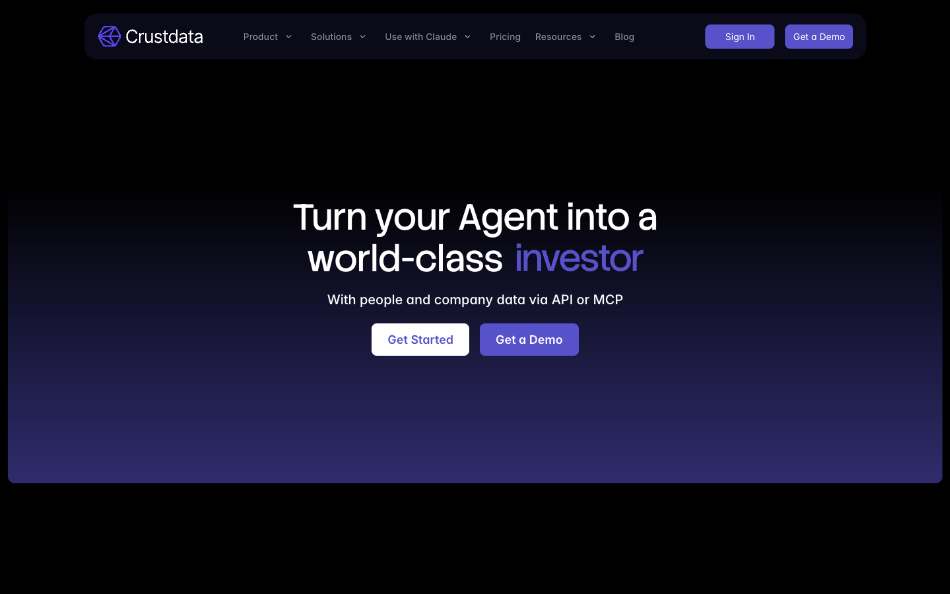
Crustdata's company enrich API returns a profile with headcount, funding, industry and hiring. You request the funding section explicitly through the fields parameter. Company search filters by industry, funding and headcount (Crustdata docs, September 2026).
Company enrich costs 2 credits per record, or 4 with technographics. A company watcher is 5 credits per changed company on a 30-day schedule (Crustdata pricing docs, September 2026). The pricing page lists no plans or dollar price per credit (Crustdata pricing, September 2026).
Default limits are 15 requests a minute on company enrich, with 25 companies per request, and 30 on search (Crustdata rate limits, September 2026). The hosted MCP server signs in with OAuth, or takes an API key as a bearer token (Crustdata MCP docs, September 2026).
Pros
- Funding comes with headcount, hiring and company profile in one enrich call.
- Change watchers alert you when a company record changes.
- Hosted MCP server.
Cons
- No public dollar price per credit, so 1M records (2,000,000 credits) has no dollar price.
- Low default rate limits.
- Purchased credits expire.
Best for: AI SDR and signal workflows that want funding changes pushed to them.
Pricing: Credit based, no public price list. One Crustdata blog post reports a lowest tier of $95 a month (Crustdata blog, September 2026).
5. Apollo: best for teams that already work in Apollo
Apollo's organization search filters on latest round amount, total funding and latest round date (Apollo API docs, September 2026). Organization search costs 1 credit per page of up to 100 results, and organization enrichment costs 1 credit per company (Apollo API pricing, September 2026).
Plans are per seat. Free is $0, and Basic is $65 a month per seat, or $49 billed yearly. Credits are pooled, expire each billing cycle and do not roll over (Apollo pricing, September 2026). Every plan includes API access. The MCP server at https://mcp.apollo.io/mcp is open to any plan (Apollo MCP docs, September 2026).
Search endpoints allow 200 requests a minute on paid plans. Enrichment endpoints allow 1,000 a minute (Apollo rate limits, September 2026).
Pros
- Funding filters on search, at 1 credit per page of 100.
- API and MCP on every plan, Free included.
- Contacts and sequencing in the same product.
Cons
- Only last-round and total filters. Round history is thinner than Crunchbase.
- Seat pricing makes 1M records expensive. List price is $24,750 a month on monthly billing.
- Credits expire each cycle.
Best for: sales teams that prospect and send from Apollo and want funding as a filter.
Pricing: Basic $65 per seat a month, $49 billed yearly. Professional $99, or $79 billed yearly (Apollo pricing, September 2026).
6. People Data Labs: best for licensed company datasets
PDL company records carry funding_stages, total_funding_raised, last_funding_date and a funding_details list of events (PDL company schema, September 2026). That gives you event-level history, not only a last round.
Company Pro starts at $100 a month for 1,000 records, or $960 billed yearly. PDL advises Enterprise above 400,000 company profiles a year and publishes no price at 1M (PDL company pricing, September 2026).
Company enrichment allows 1,000 requests a minute on paid plans and 10 on Free. Company search allows 10 a minute (PDL usage limits, September 2026). PDL's docs index lists no official MCP server (PDL docs, September 2026).
Pros
- Event-level funding data in the company schema.
- 1,000 enrichment requests a minute on paid plans.
- Dataset licences for your own warehouse.
Cons
- $0.10 a company at the entry rate ($100 for 1,000 records).
- Company search is capped at 10 requests a minute.
- No official MCP server.
- No public price at 1M.
Best for: data teams that license files or enrich a few hundred thousand companies a year.
Pricing: Company Pro $100 a month, $960 billed yearly. Enterprise custom (PDL company pricing, September 2026).
7. Coresignal: best for funding rounds next to job postings
Coresignal's Base dictionary lists funding rounds. The Multi-source dictionary adds last-round details (Coresignal Base dictionary, September 2026; Multi-source dictionary, September 2026). Job postings sit next to them on the same credits.
A Base company record costs 10 credits and a Multi-source record 20. Search by filter is free (Coresignal docs, September 2026). Mini is $49 a month for 2,500 credits, which is 250 Base records. Elite is $5,000 a month for 10,000,000 credits (Coresignal pricing, September 2026).
That makes 1M Base records exactly one Elite plan, a figure derived from list prices, not a published 1M price. Rate limits run from 5 requests a second on Free, Mini and Starter to 100 on Scale. The MCP server has 5 tools and signs in with OAuth 2.1 (Coresignal MCP docs, September 2026).
Pros
- Funding rounds, job postings and headcount signals in one vendor.
- Free search by filter.
- MCP server with OAuth 2.1.
Cons
- 10 to 20 credits a record, so entry plans buy few records.
- Entry plans are capped at 5 requests a second.
- The free trial is 2,000 credits for 7 days and does not carry to a paid plan.
Best for: teams that track hiring and funding together and want records in credits they can plan.
Pricing: Mini $49, Starter $199, Pro $499 and Growth $1,000 a month and up (Coresignal pricing, September 2026).
Comparison table
| Tool | Best for | Starting price | Cost at 1M records a month | API | MCP | Rate limit |
|---|---|---|---|---|---|---|
| LeadOcean | API, agent and volume buyers | Free, Solo $97 a month | $497 a month flat (Agency) | Yes | Yes, 13 tools | 5 to 10,000 a second by plan |
| Crunchbase | Round history and investors | Pro $99 a month ($49 billed yearly, first year) | No public 1M price | Quote-only licence | Yes, base use on Pro | 200 a minute |
| Harmonic | Startup sourcing | Quote only | No public 1M price | Yes, REST and GraphQL | Yes | 10 a second on most endpoints |
| Crustdata | Funding plus watchers | No public price list | No public 1M price | Yes | Yes | 15 a minute enrich, 30 search |
| Apollo | Apollo users | Basic $65 per seat a month ($49 yearly) | $24,750 monthly, $19,600 billed yearly | Yes | Yes | 200 a minute search, 1,000 enrich |
| People Data Labs | Licensed datasets | Company Pro $100 a month ($960 yearly) | No public 1M price | Yes | No official server | 1,000 a minute enrich, 10 search |
| Coresignal | Funding plus jobs | Mini $49 a month | No public 1M price | Yes | Yes, 5 tools | 5 a second entry, 100 Scale |
Sources are in each section above, checked in September 2026 (October 2026 for LeadOcean).
How to choose
- You need every round, valuation context and investor names: Crunchbase. Harmonic if your focus is startups only.
- You pull funded companies and their contacts by API: LeadOcean. One query returns both, at a flat price.
- You build an agent that asks for funded companies: LeadOcean or Apollo. Both have MCP on every plan. Crunchbase includes base MCP use from Pro.
- You want event-level funding in your own warehouse: People Data Labs datasets, or Harmonic Bulk data by quote.
- You already prospect in Apollo: use its funding filters before you buy anything else.
- You track hiring and funding together: Coresignal.
- You need pushed alerts on changes: Crustdata watchers.
- You need 1M records a month and a price today: LeadOcean ($497) or Apollo ($24,750 at list). The rest quote.
Verdict
For funding history and investor research, Crunchbase is the best source, and Harmonic is the pick for startup sourcing if you can budget a quote. For API, agent and volume buyers who want funding as a filter, LeadOcean is first. The price is flat and the MCP server is on every plan. Choose People Data Labs for licensed event-level data, Coresignal for funding beside job postings, Crustdata for change watchers and Apollo if you already live in it. LeadOcean holds the last round only, so if you need the full round list, pair it with a Crunchbase seat.
FAQ
What is the best funding data provider?
It depends on depth. Crunchbase has the deepest round history. LeadOcean is the better fit when you pull funded companies and their contacts by API at volume, on a flat $497 a month.
Which funding data provider has an API?
All seven do. Crunchbase's API needs an Enterprise or Applications licence by quote (Crunchbase API docs, September 2026). LeadOcean, Apollo, PDL, Coresignal and Crustdata offer keys on self-serve plans.
Which funding data tools have an MCP server?
Six of the seven. People Data Labs has no official server in its docs index (PDL docs, September 2026). LeadOcean's has 13 tools and signs in with OAuth 2.1.
Can I filter by funding round type?
Yes, on LeadOcean, with fundingType (23 round types), plus amount and last-round year. Apollo filters on latest round amount, total funding and date. Crunchbase and Harmonic also hold round data, behind paid seats or quotes.
How much does 1M company records with funding data cost?
Only two vendors give a price. LeadOcean Agency is $497 a month flat. Apollo is $24,750 a month at list on monthly billing, from 250 Professional seats. The rest publish no price at 1M.
Is LeadOcean's funding data as deep as Crunchbase?
No. LeadOcean filters on the last round type, total raised, last-round year and lead investor. Crunchbase carries round-by-round history, investors and predictions.
Find funded companies and the people to contact, by API or agent. Start free with 1,000 records.
Free to start. No credit card. 1,000 records to spend whenever you like.
Get your free API key →