CRM data enrichment fills the empty and stale fields on your contact and account records (work email, phone, title, company size, industry) from an outside database. RevOps and engineers who own the CRM need it, because reps do not fix their own records.
The best way depends on how you pull the data. Through an API, an agent or in bulk, pick a flat-price data API. Inside a sales app, pick a suite.
Teams leave their first tool for the same reasons. Apollo bills per seat with credits that expire. Clay and FullEnrich stop at a public tier. ZoomInfo and People Data Labs quote volume by sales. This page ranks seven options and prices each one at 1M records a month.
TL;DR
| Tool | Best for | Starting price | Cost at 1M records a month |
|---|---|---|---|
| LeadOcean | Teams that enrich through an API, an agent or in bulk | Free ($0, 1,000 records for life), then Solo $97 a month | $497 a month (Agency, fair-use pace) |
| Apollo | Reps who want enrichment and outreach in one app | Basic $65 per seat a month ($49 billed yearly) | About $24,750 a month at list price, 250 seats (arithmetic) |
| FullEnrich | Waterfall email and mobile enrichment into HubSpot | Pro $29 a month for 500 credits ($26 billed yearly) | No public 1M price |
| Clay | Ops teams that build enrichment workflows in tables | Launch $185 a month ($167 billed yearly) | No public 1M price |
| ZoomInfo | Enterprise teams that want intent data and a full suite | GTM AI credits from $20, pay as you go | No public 1M price |
| People Data Labs | Engineers who build enrichment into a product | Pro $98 a month for 350 credits ($78 billed yearly) | No public 1M price |
| Crustdata | Teams that watch accounts and people for changes | No public dollar price | No public 1M price |
What we evaluated
- How you pull the data. REST API, MCP server, bulk CSV, or a native CRM sync. Each fits a different team.
- Price at volume. The monthly list price first, the billed-yearly figure after it, and what 1M records a month costs. A tool with no public 1M price says so.
- Rate limits. How many requests a key can make, and whether the limit is per second, per minute or per day.
- Write-back effort. Whether the tool writes to your CRM for you or hands you rows to load.
- Coverage and misses. Dataset size from the vendor's own page, and whether a miss is billed.
We did not run a head-to-head match-rate test, so this page makes no claim about whose emails are most accurate. Every figure comes from a vendor page read in September 2026. The test you can run yourself is at the end.
1. LeadOcean: best for teams that enrich through an API or an agent
LeadOcean is a data API with a hosted MCP server. It holds 693M people (366M with an email, 166M with a phone) and 67M companies. You call POST /v1/people/enrich with a LinkedIn URL, an email, a phone or a person ID, and you get the profile back.
It is a data layer, not a sales app: no rep workspace, sequencer, dialer, CRM or Chrome extension. Your script, workflow tool or agent writes the result into the CRM. For a bulk refresh, the app at app.leadocean.io has an Exports page with a filter builder, a column picker and a price preview.
Pricing is flat. Free gives 1,000 records for life with no card. Solo is $97 a month, Agency $497 and Platform $1,997. Paid plans have a fair-use pace, not credits, so nothing expires. Agency allows 200 requests a second and 1M enrichments a day.
Pros
- 13 MCP tools, including free company sizing with
leadocean_count_companiesandGET /v1/companies/count. - Person enrich returns career history: past roles, education, certifications and awards.
- Misses are free. A person we hold nothing for is a 404 and costs nothing.
- One search pages to 10,000 rows, and an export request returns up to 50,000 rows.
Cons
- No native CRM sync. You write the load step yourself or use a workflow tool.
- Bulk CSV export is not on Free.
- No intent data, org charts or rep workspace.
Best for: RevOps engineers, agencies and product teams that enrich at volume through code or an agent. Pricing: Free $0, Solo $97, Agency $497, Platform $1,997 a month (LeadOcean pricing, October 2026). See the enrich docs, October 2026.
2. Apollo: best for reps who live in one app
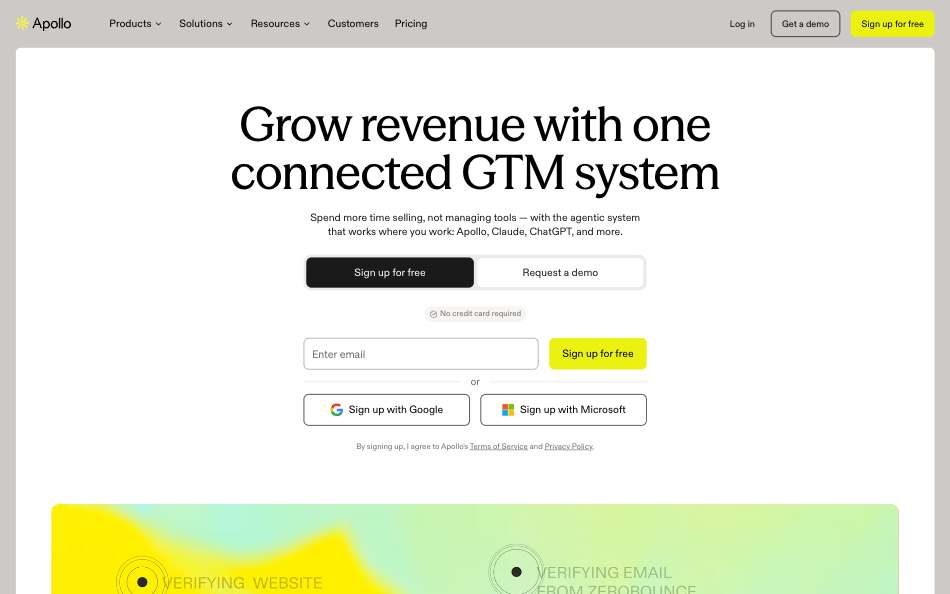
Apollo is an all-in-one sales platform with a contact database, sequences, a dialer and a rep workspace. Enrichment sits inside that app, so a rep can fix a record without leaving it. Every plan includes API access, and the official MCP server at mcp.apollo.io/mcp works on any plan (Apollo MCP docs, September 2026).
Basic is $65 per seat a month ($49 billed yearly) with 2,500 credits. Professional is $99 ($79 yearly) with 4,000. Organization is $149 ($119 yearly) with 6,000 and a three-seat minimum (Apollo pricing, September 2026). Credits are pooled and expire each billing cycle.
An email costs 1 credit and a phone number costs 8. API enrichment runs 1 to 9 credits per person (Apollo API pricing, September 2026). That is where the 1M figure comes from: 1M work-email lookups need 1M credits, which is 250 Professional seats at $99, or about $24,750 a month at list price. On yearly billing, 400 Basic seats at $49 come to $19,600 a month. This is list arithmetic, not a quote, and Apollo does not say whether that many seats is self-serve.
Pros
- Enrichment, outreach and calling in one tool.
- Official MCP server on every plan.
- Enrichment endpoints allow 1,000 requests a minute on paid plans (Apollo rate limits, September 2026).
Cons
- Seats gate credits, so a pipeline no rep opens still pays per seat.
- Credits expire each cycle, including purchased add-on credits.
- Selection per action is capped at 10,000 on Organization.
Best for: sales teams that want enrichment and outreach in one login. Pricing: Basic $65 per seat a month, $49 billed yearly (Apollo pricing, September 2026).
3. FullEnrich: best for waterfall email and mobile into HubSpot
FullEnrich runs a waterfall across 25+ data sources and verifies the result. Its pricing page lists 800M people and 50M companies for search. The API, MCP, search and bulk CSV are on every plan, and users are unlimited. HubSpot is the native CRM integration; Zapier, Make, n8n and Clay are listed (FullEnrich pricing, September 2026).
Credits are the unit. A work email costs 1 credit, a personal email 3 and a mobile 10. A miss or a landline costs 0 (FullEnrich credit docs, September 2026). Pro starts at $29 a month for 500 credits and climbs to $3,500 a month for 100,000 credits. Above that the page says contact sales.
The rate limit is 60 API calls a minute, with up to 100 contacts per bulk request (FullEnrich volume docs, September 2026).
Pros
- Misses cost 0 credits.
- Unused credits roll over 3 months on monthly plans and 12 on annual.
- Native HubSpot integration plus Zapier, Make and n8n.
Cons
- The top public monthly tier covers 100,000 credits, a tenth of 1M.
- Mobiles cost 10 credits each.
- 60 calls a minute limits real-time enrichment.
Best for: HubSpot teams that want waterfall enrichment of work emails and mobiles. Pricing: Pro $29 a month for 500 credits, $26 a month billed yearly (FullEnrich pricing, September 2026).
4. Clay: best for ops teams that build enrichment workflows
Clay is a workflow spreadsheet that resells many data providers on credits. You build a table, add enrichment columns and push the result to your CRM. Clay's developer platform, with a Public API and a CLI, is on every plan, including Free (Clay API docs, September 2026).
Pricing is two meters. Launch starts at $185 a month ($167 billed yearly) with 15,000 Actions and 2,500 Data Credits. Growth starts at $495 a month ($446 billed yearly) with 40,000 Actions and 6,000 Data Credits (Clay pricing, September 2026). Clay's own doc says a fully enriched record typically costs 6 to 20 Data Credits, plus one Action per enrichment (Clay docs, September 2026).
Volume is the weak point. The largest self-serve tiers are 200,000 Actions and 50,000 Data Credits a month, and Actions cannot be bought as top-ups. A million enrichments needs 1M Actions, so 1M a month is an Enterprise quote.
Pros
- Fallbacks across many providers in one table.
- CRM auto-sync on Growth and Enterprise.
- An enrichment that returns no result is charged no credits and no Actions.
Cons
- Two meters (Actions and Data Credits) make cost hard to forecast.
- No self-serve tier reaches 1M lookups a month.
- The HTTP API column needs Growth.
Best for: RevOps teams that want a visual workflow with fallbacks and CRM sync. Pricing: Launch $185 a month, $167 billed yearly (Clay pricing, September 2026).
5. ZoomInfo: best for enterprise teams that want a full suite
ZoomInfo is an enterprise sales suite that integrates with CRM and automation tools (ZoomInfo pricing, October 2026). Its newer GTM AI product sells data credits pay as you go, from $20, with no contract and no seat fee. A credit enriches or exports one record, charged once per 12 months (GTM AI credit docs, September 2026).
List price per credit falls with purchase size, from $0.45 at 100 credits to $0.25 on the largest published pack of 100,000 credits for $25,000 (GTM AI pricing, September 2026). Past that it is Enterprise by quote. The full platform shows no dollar price. Its pricing page is a quote form, and packages are built from licenses and monthly credits (ZoomInfo pricing, October 2026).
Rate limits by package are 5 requests a second on Builder, 25 on Standard and 35 on Scaling (GTM AI rate limits, September 2026). Batch enrichment takes at most 25 contacts per call. The official MCP server needs a GTM AI account or a ZoomInfo subscription with data credits.
Pros
- Native CRM integrations and a rep-facing application.
- Search and lookup are free; you pay to enrich or export.
- Re-enriching a record inside 12 months is free.
Cons
- No public price at 1M records.
- Batch enrichment is capped at 25 records per call.
- Platform plans are negotiated contracts.
Best for: enterprise sales teams that need intent data, org charts and one suite. Pricing: GTM AI credits from $20, pay as you go (GTM AI pricing, September 2026).
6. People Data Labs: best for engineers who build enrichment into a product
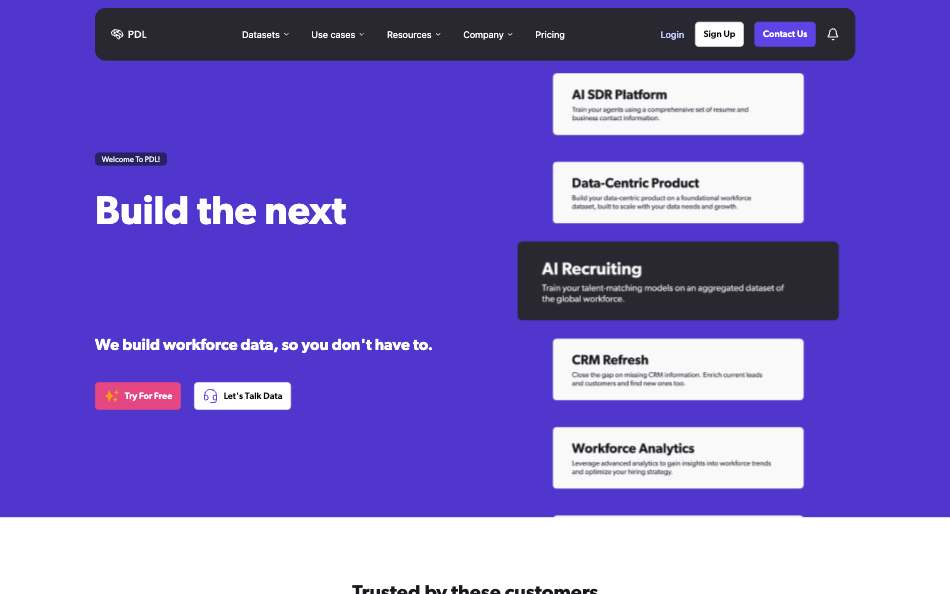
People Data Labs sells person and company data by API. It reports 2.47B person profiles (592M with an email, 470M with a mobile) and 76M companies (PDL dataset docs, September 2026).
Person data on Pro starts at $98 a month for 350 credits, which is $0.28 a credit, or $940 a year billed yearly (PDL pricing, September 2026). One credit is used per successful match, and a 404 is not billed. PDL says Pro profiles cost about $0.20 to $0.28 each. Self-serve Pro is meant for under about 100,000 profiles a year; above that PDL points buyers to Enterprise.
Person Enrichment allows 1,000 requests a minute on paid plans, but Person Search allows 10 a minute by default (PDL usage limits, September 2026). There is no official PDL MCP server; only community ones exist.
Pros
- Large published dataset with per-field counts.
- Bulk enrichment of up to 100 persons per request.
- Requests that return nothing (404) are not billed.
Cons
- No official MCP server.
- Person Search is limited to 10 requests a minute by default.
- No public price at 1M; self-serve is meant for under 100,000 profiles a year.
Best for: engineers who embed person and company enrichment in their own product. Pricing: Pro $98 a month for 350 credits, $78 a month billed yearly (PDL pricing, September 2026).
7. Crustdata: best for teams that watch accounts and people for changes
Crustdata is a credit-based data API with search, enrichment and watchers that flag when a person or company changes. It runs a hosted MCP server at install.crustdata.com/mcp with OAuth for interactive clients and an API key for code (Crustdata MCP docs, September 2026). It suits keeping a CRM current, not only filling it once.
The pricing page lists no plan names, dollar prices or price per credit (Crustdata pricing, September 2026). The docs give credits per call: a work email through /person/enrich is 2 credits, and the cheaper contact endpoint needs an enterprise plan. A person watcher is 5 credits per changed person at the 30-day SLA (Crustdata docs, September 2026).
Default limits are low: 15 requests a minute on person and company enrich, 30 on search (Crustdata rate limits, September 2026).
Pros
- Watchers track changes after the first enrichment.
- Hosted MCP server.
- Batch person enrich takes up to 10,000 identifiers a job.
Cons
- No public dollar price, so you cannot budget from the website.
- 15 requests a minute on person enrich by default.
- The best email endpoint is enterprise only; self-serve keys get a 403.
Best for: teams that need change alerts on accounts and people, and will ask sales for a price. Pricing: No public dollar price (Crustdata pricing, September 2026).
Comparison table
| Tool | Best for | Starting price | Cost at 1M records a month | API | MCP | Rate limit |
|---|---|---|---|---|---|---|
| LeadOcean | API, agent and bulk enrichment | Free, then Solo $97 a month | $497 a month (Agency) | Yes, REST | Yes, 13 tools | 5 a second Free, 50 Solo, 200 Agency |
| Apollo | Reps in one app | Basic $65 per seat a month | About $24,750 a month, list arithmetic | Yes, every plan | Yes, every plan | Enrichment 1,000 a minute on paid plans |
| FullEnrich | Waterfall into HubSpot | Pro $29 a month | No public 1M price | Yes, every plan | Yes | 60 calls a minute |
| Clay | Table workflows | Launch $185 a month | No public 1M price | Yes, every plan | Yes | Not published |
| ZoomInfo | Enterprise suite | GTM AI from $20 | No public 1M price | Yes | Yes | 5 to 35 a second by package |
| People Data Labs | Embedding in a product | Pro $98 a month | No public 1M price | Yes | No official server | Enrich 1,000 a minute, search 10 a minute |
| Crustdata | Change watchers | No public dollar price | No public 1M price | Yes | Yes | 15 a minute on person enrich |
How to choose
- Your reps work in one app. Choose Apollo, or ZoomInfo for an enterprise team.
- You enrich through code, an agent or a script. Choose LeadOcean. One flat price, 200 requests a second on Agency, and an MCP server.
- You use HubSpot. Choose FullEnrich: misses are free and the integration is native.
- Ops builds the workflow. Choose Clay, and call LeadOcean from an HTTP column for bulk lookups.
- You build enrichment into a product. Choose People Data Labs, or LeadOcean for an MCP server and a flat bill.
- You need alerts when a contact changes jobs. Choose Crustdata, and expect to ask for a quote.
Verdict
For teams that enrich a CRM through an API, an agent or at volume, LeadOcean is the best choice: one flat price, free misses and an MCP server, at $497 a month for 1M records. For reps who want enrichment next to their sequences and calls, Apollo is the pick, and ZoomInfo is the pick for enterprises that want a full suite. FullEnrich wins for HubSpot teams that care about find rate, Clay wins for table-based workflows, and People Data Labs wins for embedding data in a product. Crustdata is for change tracking. You can also run two: a suite for reps and a data API for the pipeline.
How to test on your own CRM
Pull 25 contacts with a LinkedIn URL from your CRM, enrich each, and compare the fields to what the CRM holds. The free plan covers it. The values below are placeholders.
curl -X POST https://api.leadocean.io/v1/people/enrich \
  -H "x-api-key: $LEADOCEAN_API_KEY" \
  -H "Content-Type: application/json" \
  -d '{"linkedin_url": "https://www.linkedin.com/in/jane-doe-example", "reveal_email": true}'
To size a company list first, call GET /v1/companies/count. It is free and returns an exact total with breakdowns by industry, headcount band and country. For what each field adds, see what CRM enrichment adds to your sales data.
FAQ
What is the best way to enrich CRM data?
Pick by how you pull the data. A data API with a flat price is best for code, agents and volume. A sales suite is best when reps enrich inside the app. You can run both.
How much does it cost to enrich 1M CRM records?
It ranges from $497 a month on LeadOcean Agency to about $24,750 a month on Apollo at list price. The other five publish no 1M price, and their top public tiers stop well short of that volume.
Should I enrich in real time or in batches?
Use real time for new leads and batches for the existing database. Check the rate limit first: FullEnrich allows 60 calls a minute, Crustdata 15 and LeadOcean Agency 200 a second.
Can I enrich my CRM without a native integration?
Yes. Export a CSV from the CRM, enrich it through an API, and import the result. LeadOcean has no native CRM sync, so this is the route.
Does LeadOcean refund bounced emails?
No. There is no refund or credit-back for bounced emails, so read email_status before sending. Misses are free: a person we hold nothing for is a 404 and costs nothing. See pricing for the plans, and our guide to sales data providers and firmographic data providers.
Enrich 25 of your own CRM contacts free
Free to start. No credit card. 1,000 records to spend whenever you like.
Get your free API key →