People leave PhantomBuster when the list matters more than the scraper. It runs automations through your own accounts, so you build every list yourself. The work is metered in hours and slots. Start allows 20 hours of execution a month on 5 slots, and Scale allows 300 hours on 50 slots. When hours run out, automations pause until the reset (PhantomBuster pricing, September 2026).
The vendor says it does not sell or provide pre-built databases. Its API launches and aborts agents and reads their output, so code still drives a scraper, not a dataset (PhantomBuster API docs, September 2026). An email attempt costs one credit even when nothing is found (PhantomBuster blog, July 2026).
This page ranks six alternatives for API and volume buyers. LeadOcean is first because it is a stored dataset at one flat price. If you use PhantomBuster mainly to send LinkedIn messages, none of these replace that. For plan detail, read PhantomBuster pricing.
TL;DR
| Tool | Best for | Starting price | Cost at 1M records a month |
|---|---|---|---|
| LeadOcean | API, agent and volume buyers | Free (1,000 records, one-off). Pro $499 a month | $499 a month flat. Fair use applies |
| Apify | Developers who want to keep scraping | Free with $5 of usage. Starter $19 a month | No public 1M price. Each Actor sets its own price |
| Apollo | Reps who want data, sequences and an extension in one seat | Free, 75 credits a month. Basic $65 per seat a month ($49 billed yearly) | $24,750 a month on monthly billing, or $19,600 a month billed yearly |
| Prospeo | Reps who want an extension and pay per email | Free, 100 credits a month. Starter $49 per user a month ($37 billed yearly) | About $14,456 a month, or $11,223 billed once yearly |
| Clay | Teams that build enrichment workflows in tables | Free. Launch $185 a month ($167 billed yearly) | No public 1M price. Top public tier is $2,975 a month |
| Evaboot | Teams that export Sales Navigator searches | $29 a month for 400 credits, plus a Sales Navigator seat | No public 1M price |
"1M records" here means 1M work-email lookups that return a result. Figures are list-price arithmetic. Where a vendor sells no plan at that volume, the cell says so. Enterprise quotes differ, so ask each vendor at your volume.
For reference, PhantomBuster has no public price at 1M either. Its top plan is Scale at $439 a month on monthly billing ($352 billed yearly), with 10,000 email credits a month (PhantomBuster pricing, September 2026).
What we evaluated
- API access: which plan opens it, what a call returns, and the default rate limit.
- MCP: whether an agent can reach the tool through a hosted server, and how it signs in.
- Price model: flat, credits, seats or compute, and what 1M records a month costs at list price.
- Data source: a stored database, a live scraper or an export of your own LinkedIn search.
- Limits that bite: daily caps, seat requirements, plan gates and fair-use clauses.
We read each vendor's pricing page and docs in September 2026. We ran no find-rate or accuracy test for this page, so we quote no quality numbers. PhantomBuster markets live data over stored databases. We did not test freshness on either side.
1. LeadOcean: best for API, agent and volume buyers
LeadOcean is one dataset behind one REST API and one MCP server. It holds 693M people, 366M with an email and 166M with a phone number, plus 63M companies. You search with 50 people filters and 34 company filters. Counts are free. Enrichment is POST /v1/people/enrich, phones are GET /v2/people/phone, and exports run up to 50,000 rows per request.
It replaces the scraping step, not the outreach step. You ask for people by title, country or company and get records back, with no accounts to log in and no hours to budget. The dataset is refreshed monthly, and each record carries its own fetched_at date. PhantomBuster's live pull will be fresher on a single profile.
curl -X POST "https://api.leadocean.io/v1/people/enrich" \
  -H "x-api-key: $LEADOCEAN_API_KEY" \
  -H "content-type: application/json" \
  -d '{"linkedin_url":"https://www.linkedin.com/in/jane-doe","reveal_email":true}'
The price does not move with volume. Pro is $499 a month with unlimited searches, enrichments and lookups, 5 API keys and 100 requests per second per key. There are no credits and no overage invoice. A very large month is paced down to one request a minute until the reset, not cut off. The MCP server at https://api.leadocean.io/mcp signs in with OAuth 2.1 and exposes 12 tools, from search_leads to find_phone and export_leads.
Pros
- Flat $499 a month at any volume, with no credit meter and no seats.
- REST and MCP on every plan, including Free.
- Email status on every record, from
verifiedtospam_trap. - Free counts, and a miss on
POST /v1/people/enrichis a free 404.
Cons
- A stored dataset, not a live scrape. Read
fetched_atbefore you rely on a job title. - No LinkedIn messaging, no Chrome extension and no sequencer. The app has an Exports page with a filter builder and CSV download.
- A v2 contact lookup that finds nothing still costs one record.
Best for: engineers, RevOps and agents that need volume and a fixed bill.
Pricing: Free is 1,000 records, one-off, no card. Pro is $499 a month, flat (LeadOcean pricing, September 2026).
2. Apify: best for developers who want to keep scraping
Apify is the closest like-for-like swap if you still want to scrape. It is a marketplace of ready-made scrapers called Actors, and its homepage lists more than 78,000 (Apify, September 2026). You run an Actor from code or an agent and read the result as a dataset. You can also write your own in JavaScript or Python.
Pricing has two parts. A plan carries a monthly amount of prepaid usage, and each Actor charges either per event or per platform usage. Free is $0 with $5 of usage at $0.2 per compute unit. Starter is $19 a month with $19 of usage. Scale is $199 a month at $0.16 per compute unit, and Business is $999 at $0.13. Annual billing is 10% off. Unused usage does not roll over, and paid plans bill overage on the next invoice (Apify pricing, September 2026).
The API is a plain REST API with a Bearer token. The global limit is 250,000 requests a minute per user, and the default per-resource limit is 60 requests a second (Apify API docs, September 2026). The hosted MCP server at https://mcp.apify.com signs in with OAuth or a token and lets an agent find and run Actors (Apify MCP docs, September 2026).
Pros
- Your own code, a schedule and an API for every run, with no per-seat fee.
- A hosted MCP server, so an agent can find and run scrapers.
- Plans from $0, and compute is cheaper on higher tiers.
Cons
- It returns what a page shows. It is not a contact database, so emails and phones need another step.
- Cost depends on the Actor and how long it runs. Apify's own advice is to do a test run and read your usage.
- You still own the scraping and its upkeep, which is the PhantomBuster problem in a different place.
Best for: developers who want programmatic scraping with pay-for-usage pricing.
Pricing: Free $0, Starter $19, Scale $199 and Business $999 a month, plus Actor pricing. Billed annually is 10% off (Apify pricing, September 2026).
3. Apollo: best for reps who want data, sequences and an extension in one seat
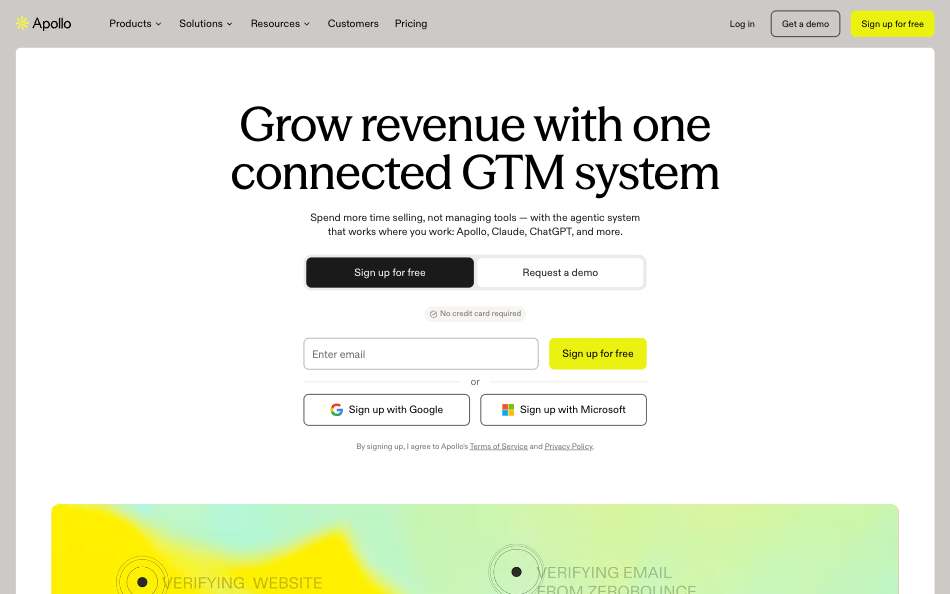
Apollo is a sales workspace built around a contact database. Its pricing page says 240M contacts and 30M companies, with a Chrome extension, sequences and a dialer in the same seat (Apollo pricing, September 2026). For a PhantomBuster user, it replaces the lookup and the outreach in one product. For a full comparison, see LeadOcean vs Apollo.
Pricing is per seat. Billed monthly, Basic is $65, Professional is $99 and Organization is $149, and Organization needs 3 seats. Billed yearly they are $49, $79 and $119. Credits are pooled by the team and expire each cycle. An email costs 1 credit and a phone number costs 8. People enrichment by API runs 1 to 9 credits (Apollo API pricing, September 2026).
Every plan includes API access, Free too. Enrichment endpoints allow 1,000 requests a minute on paid plans, and other endpoints allow 200 a minute on Basic and Professional (Apollo rate limits, September 2026). The MCP server at https://mcp.apollo.io/mcp works on any plan and spends the same credits (Apollo MCP docs, September 2026).
Pros
- Data, a Chrome extension, sequences and a dialer in one account.
- API and MCP on every plan, including Free.
- A free plan to test with, and no scraping to run.
Cons
- Per-seat pricing plus credits, so cost grows with both headcount and volume.
- Credits expire each cycle, and the price of extra credits is not published.
- At 1M emails a month the seat count becomes the bill, and Apollo prints no plan for that volume.
Best for: sales teams that want one workspace for data and outreach.
Pricing: Free with 75 credits a month. Basic $65, Professional $99 and Organization $149 per seat a month, or $49, $79 and $119 billed yearly (Apollo pricing, September 2026).
4. Prospeo: best for reps who want an extension and pay per email
Prospeo is an email and mobile finder with a Chrome extension, a REST API and an MCP server. Its API docs say 200M+ contacts. The extension works on any website and on social networks, which makes it the nearest thing here to PhantomBuster's browser habit (Prospeo, September 2026).
Plans are per user. Billed monthly, Starter is $49 for 2,000 credits, Growth is $99 for 5,000 and Pro is $249 for 15,000. Billed yearly they are $37, $74 and $187 a month. A verified email costs 1 credit, a mobile costs 10 and a company costs 1. A search that returns results costs 1 credit for up to 25 people, with no contact data attached (Prospeo help center, September 2026). Unused credits expire.
Enrichment allows 2,000 requests a day on Starter, 5,000 on Growth and 500,000 on the top plan, at 5 to 30 requests a second (Prospeo rate limits, September 2026). The hosted MCP server has 8 tools (Prospeo MCP docs, September 2026). No single plan reaches 1M credits.
Pros
- A Chrome extension on every plan, so reps keep their habit.
- A credit is spent only when a result comes back.
- Hosted MCP server with OAuth or an API key.
Cons
- Per-user pricing plus credits, so both grow with the team.
- Daily enrichment caps of 2,000 and 5,000 on the lower plans.
- Search returns 25 results per call with no emails, so you pay twice to get a contact.
Best for: small teams that want an extension and pay-as-you-go emails.
Pricing: Free with 100 credits a month. Starter $49, Growth $99 and Pro $249 per user a month, or $37, $74 and $187 billed yearly (Prospeo pricing, September 2026).
5. Clay: best for teams that build enrichment workflows in tables
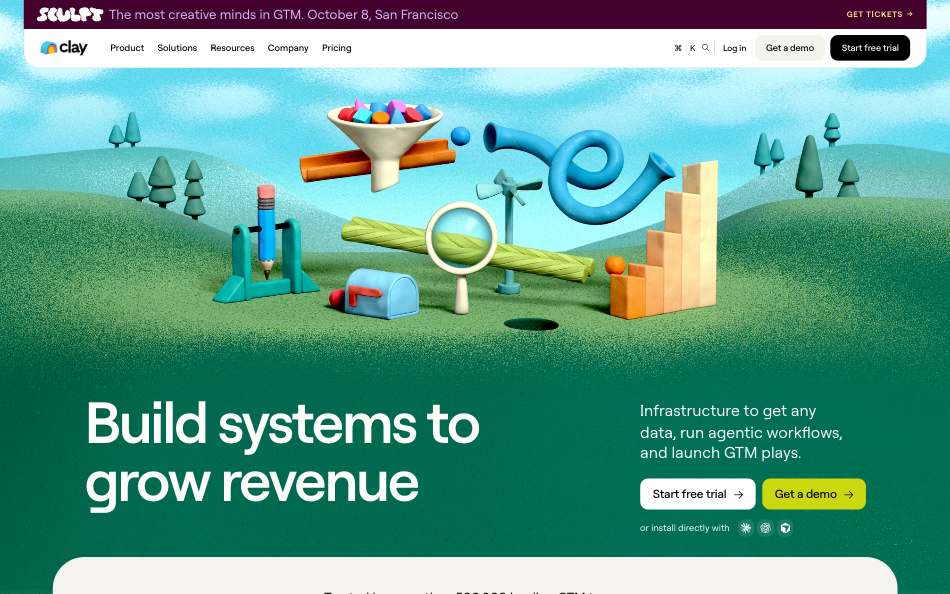
Clay is a table where each column calls a data provider or a model. Its site sells one contract for 200+ data and AI vendors, with waterfalls and an AI research agent called Claygent (Clay, September 2026). It is the nearest match to PhantomBuster's chained workflows, with data sources instead of scrapers.
Clay prices by Actions and Data Credits. Launch starts at $185 a month, or $167 billed yearly. Growth starts at $495 a month, or $446 billed yearly. Free is $0 with 100 Data Credits a month. Clay's own doc says a fully enriched record costs 6 to 20 Data Credits, plus an Action per enrichment (Clay pricing, September 2026; Clay docs, September 2026). A lookup with no result is not charged.
The Public API and CLI are on every plan, including Free. The HTTP API column that calls other APIs starts on Growth. The Public API has a per-workspace rate limit and publishes no number (Clay docs, September 2026; Clay developer docs, September 2026). Clay lists an MCP server for reps (Clay MCP, September 2026). The biggest self-serve tier is 200,000 Actions and 50,000 Data Credits a month. Above that it is an Enterprise quote.
Pros
- Waterfalls across many providers, with a table interface for non-coders.
- No charge for a lookup that returns nothing.
- Public API and CLI on every plan, and an MCP server for reps.
Cons
- Two meters, Actions and Data Credits, and a record can use 6 to 20 credits.
- No public price at 1M. The self-serve ceiling is 200,000 Actions a month.
- Tables cap at 50,000 rows on Launch and Growth, and the API publishes no rate limit.
Best for: GTM engineers who build enrichment and scoring workflows in a table.
Pricing: Free $0. Launch from $185 a month ($167 billed yearly) and Growth from $495 ($446 billed yearly). Enterprise is custom (Clay pricing, September 2026).
6. Evaboot: best for teams that export Sales Navigator searches
Evaboot turns a LinkedIn Sales Navigator search into a clean file with emails attached. It is the swap for people who used PhantomBuster mainly to scrape Sales Navigator lists. It needs a Sales Navigator seat, because it exports the results of your own searches.
Plans are credit-based, with one credit per lead. 400 credits cost $29 a month, 1,000 cost $49 and 3,000 cost $99. Larger volumes are Enterprise, contact sales (Evaboot pricing, September 2026). The page shows no yearly figure. A Sales Navigator Core seat starts at US$119.99 a month on top (LinkedIn, September 2026). A lead with no email still costs a credit, and there are no phone numbers.
The API and MCP are on every plan. The JSON API extracts a Sales Navigator search, finds and validates emails and sends webhooks. The hosted MCP server is at https://mcp.evaboot.com/mcp (Evaboot docs, September 2026; Evaboot MCP docs, September 2026). Exports are capped at 2,500 leads per 24 hours per Sales Navigator account (Evaboot help, September 2026).
Pros
- A clean Sales Navigator export with email finding and verification included.
- Unlimited seats on a shared credit balance, and credits roll over while you subscribe.
- API, webhooks and a hosted MCP server on every plan.
Cons
- A Sales Navigator seat is required, which can cost more than the credits themselves.
- A 2,500-lead daily cap per seat turns volume into a seat count.
- No phone numbers, and a lead with no email still costs a credit.
Best for: teams that already pay for Sales Navigator and want its searches as files.
Pricing: $29, $49 and $99 a month for 400, 1,000 and 3,000 credits. Enterprise is custom (Evaboot pricing, September 2026).
Comparison table
| Tool | Best for | Starting price | Cost at 1M records a month | API | MCP | Rate limit |
|---|---|---|---|---|---|---|
| LeadOcean | API, agent and volume buyers | Free. Pro $499 a month | $499 flat. Fair use applies | REST on every plan | Yes. OAuth 2.1, 12 tools | 100 requests per second per key |
| Apify | Developers who keep scraping | Free. Starter $19 a month | No public 1M price | REST on every plan. Bearer token | Yes. OAuth or token | 60 a second per resource. 250,000 a minute global |
| Apollo | Data, sequences and extension in one seat | Free. Basic $65 per seat a month ($49 billed yearly) | $24,750 a month, or $19,600 billed yearly | REST on every plan | Yes. Any plan | 200 a minute general. 1,000 a minute enrichment on paid plans |
| Prospeo | Extension and pay per email | Free. Starter $49 per user a month ($37 billed yearly) | About $14,456 a month, or $11,223 billed once yearly | REST on paid plans | Yes. 8 tools | 5 to 30 a second, 2,000 to 500,000 a day |
| Clay | Enrichment workflows in tables | Free. Launch $185 a month ($167 billed yearly) | No public 1M price | Public API and CLI on every plan | Yes. For reps | Per workspace. No number published |
| Evaboot | Sales Navigator exports | $29 a month, plus a Sales Navigator seat | No public 1M price | REST on every plan | Yes. OAuth or key | 2,500 leads per 24 hours per seat |
Sources are linked in each tool section, all checked in September 2026. Vendors change plans often, so confirm on the pricing page before you buy. The 1M column is list-price arithmetic on email lookups. Apollo's figures buy 1M credits through seats: 250 Professional seats at $99 on monthly billing, or 400 Basic seats at $49 billed yearly (Apollo pricing, September 2026). Add-on credits have no public price. Prospeo's cheapest public path on monthly billing is 44 top-plan seats at $249 plus the 350,000-credit add-on at $3,500. Billed yearly it is 3 of those seats plus the 500,000-credit add-on at $4,500, paid once (Prospeo pricing, September 2026). Clay's highest public tier is 200,000 Actions and 50,000 Data Credits, $2,975 a month billed monthly (Clay pricing, September 2026). Apify and Evaboot publish no price at this volume, and we do not multiply a rate out to 1M.
How to choose
- You pull people and companies in code or with an agent, at volume: LeadOcean. One flat price, REST and MCP on every plan, 100 requests per second.
- You still need to scrape a page that no database covers: Apify, and budget for a test run per Actor.
- Your reps want data, sequences and an extension in one seat: Apollo.
- Your reps live in LinkedIn and want an extension that reveals emails: Prospeo.
- You build enrichment and scoring workflows in a table: Clay, and watch the two meters.
- Your list lives in Sales Navigator: Evaboot, with a Sales Navigator seat.
- You send LinkedIn connection requests and messages: keep PhantomBuster for that, and pull the list from LeadOcean.
Verdict
LeadOcean wins for API, agent and volume buyers. It is a stored dataset with a flat price, emails and phones in one plan, and an MCP server that returns records. Apify wins for developers who must keep scraping. Apollo wins for reps who want data and sequences in one seat, Prospeo for an extension with pay-per-email credits, Clay for table workflows and Evaboot for Sales Navigator exports. Stay on PhantomBuster if outreach automation is the job. Otherwise start on the free plan and compare the same lookups.
FAQ
Why do teams leave PhantomBuster?
The list has to be built by scraping. PhantomBuster runs through your own accounts, meters work in hours and slots, and does not provide pre-built databases (PhantomBuster pricing, September 2026). Teams that only need contact data often move to a database with an API.
Does PhantomBuster have an API and an MCP server?
Yes to both. The API controls agents and scripts and uses an X-Phantombuster-Key-1 header. The hosted MCP server is at https://mcp.phantombuster.com (PhantomBuster API docs, September 2026; MCP docs, September 2026). Neither returns records from a stored database.
What is the best PhantomBuster alternative for an API?
For records, LeadOcean: 100 requests per second per key and one flat price. For scraping, Apify, which has a REST API, a hosted MCP server and usage-based pricing. Pick by whether you want a dataset or a scraper.
What does PhantomBuster cost at 1M records a month?
There is no public price. Scale is the top plan at $439 a month ($352 billed yearly) with 10,000 email credits, and the page lists nothing above it (PhantomBuster pricing, September 2026). At 1M records the limit is hours and slots, not price.
Is there a free PhantomBuster alternative?
Several have a free tier. LeadOcean gives 1,000 records one-off with no card. Apollo gives 75 credits a month, Prospeo 100 and Clay 100 Data Credits. Apify gives $5 of usage. Check each free plan's API access before you build on it.
Do I need a credit card to try LeadOcean?
No. The free plan needs a work email and no card. It gives you 1,000 records, one-off, with the same API and MCP server as Pro. See pricing.
Related: PhantomBuster pricing, Wappalyzer alternatives, Surfe alternatives, Harmonic alternatives, pricing.
Replace scraping hours and email credits with one flat-price data API. Start free.
Free to start. No credit card. 1,000 records to spend whenever you like.
Get your free API key →