People leave Adapt when a contact app is asked to feed a pipeline. The API is listed only on the Custom plan, which has no public price (Adapt pricing, September 2026). Self-serve stops at Basic: $99 a month for 1,000 email credits, 100 phone credits and 100 contacts a day. The API allows 250 requests per minute per account, and contact search returns people without emails, so you buy each contact in a second call (Adapt API docs, September 2026). Adapt publishes no price at 1M records, and we found no MCP server in its docs. That suits a rep working in the Chrome extension. It is a poor fit for code or an agent.
This page ranks six alternatives for API and volume buyers. LeadOcean is first because it has one flat price, no credits and an MCP server that returns records. For every Adapt plan and credit, read Adapt pricing.
TL;DR
| Tool | Best for | Starting price | Cost at 1M records a month |
|---|---|---|---|
| LeadOcean | API, agent and volume buyers | Free (1,000 records, one-off). Pro $499 a month | $499 a month flat. Fair use applies |
| Apollo | Reps who want a database and a sequencer | Basic $65 per seat a month ($49 billed yearly) | About $24,750 a month in seats on monthly billing, $19,600 on yearly billing |
| People Data Labs | Per-match person and company data by API | Pro from $98 a month for 350 credits ($78 billed yearly) | No public 1M price. Self-serve stops near 100,000 profiles a year |
| Crustdata | Live people, company and job data by API | No public price. Lowest tier reported at $95 a month | No public price at 1M. 1M work emails is 2,000,000 credits |
| ZoomInfo | Company and contact records through GTM AI credits | Free 1,000 data credits. Pay as you go from $20 | No public price at 1M. Public slider stops at 100,000 credits for $25,000 |
| Lusha | Reps who reveal contacts in an app | Starter $49.90 a month ($37.45 billed yearly) | No public price at 1M. Top public tier is 10,000 credits for $977.40 a month |
"1M records" here means 1M work-email lookups that return a result, one credit each where the vendor uses credits. Where a vendor sells no plan at that volume, the cell says so and names its top public tier. Adapt has no public price at 1M either: its self-serve ceiling is Basic at 1,000 email credits a month. Enterprise quotes are lower than list, so ask each vendor at your volume.
What we evaluated
- API access: which plan opens it, the endpoints that return people and companies, and the default rate limit.
- MCP: whether an agent can search and enrich through the server, or only read documentation.
- Price model: flat, credits or seats, and what 1M records a month costs at list price.
- Data: stated coverage, email and phone fields, and search filters.
- Limits that bite: daily caps, bulk sizes, plan gates, expiring credits and fair-use clauses.
We read each vendor's pricing page and docs in September 2026. We ran no find-rate or accuracy test for this page, so we quote no quality numbers. Adapt's own data page claims 250 million plus contacts (Adapt data, September 2026). No vendor here has an accuracy figure we can check.
1. LeadOcean: best for API, agent and volume buyers
LeadOcean is one dataset behind one REST API and one MCP server. It holds 693M people, 366M with an email and 166M with a phone number, plus 63M companies. You search with 50 people filters and 34 company filters. Counts are free. Enrichment is POST /v1/people/enrich, phones are GET /v2/people/phone, and exports run up to 50,000 rows per request.
The price does not move with volume. Pro is $499 a month with unlimited searches, enrichments and lookups, 5 API keys and 100 requests per second per key. Adapt's limit is 250 requests a minute per account, so one LeadOcean key allows 6,000 a minute. There are no credits and no overage invoice. A very large month is paced down to one request a minute until the reset, not cut off. More headroom is one email to support.
curl -X POST "https://api.leadocean.io/v1/people/enrich" \
  -H "x-api-key: $LEADOCEAN_API_KEY" \
  -H "content-type: application/json" \
  -d '{"linkedin_url":"https://www.linkedin.com/in/jane-doe","reveal_email":true}'
The MCP server at https://api.leadocean.io/mcp signs in with OAuth 2.1 and exposes 12 tools, from search_leads to find_phone and export_leads. Claude, Cursor or your own agent can pull records directly. Every person or company returned counts as one record, and count_leads is free, so you can size an audience before you pull it.
Pros
- Flat $499 a month at any volume, with no credit meter.
- REST and MCP on every plan, including Free. Adapt lists the API on Custom only.
- Email status on every record, from
verifiedtospam_trap. - Free counts, and a miss on
POST /v1/people/enrichis a free 404. - Exports of 50,000 rows per request, so no buy-by-ID step after a search.
Cons
- No Chrome extension, no rep workspace and no CRM sync. You work in the app's Exports page, the API or MCP.
- No name plus domain lookup. Adapt enriches from first name, last name and domain. On LeadOcean you search by domain first, then enrich by
person_id. - Fewer technology sector filters. Adapt advertises over 3,000 tech sectors (Adapt, September 2026). LeadOcean has 105 tech categories and 534 industries.
Best for: engineers, RevOps and agents that need volume and a fixed bill.
Pricing: Free is 1,000 records, one-off, no card. Pro is $499 a month, flat (LeadOcean pricing, September 2026).
2. Apollo: best for reps who want a database and a sequencer
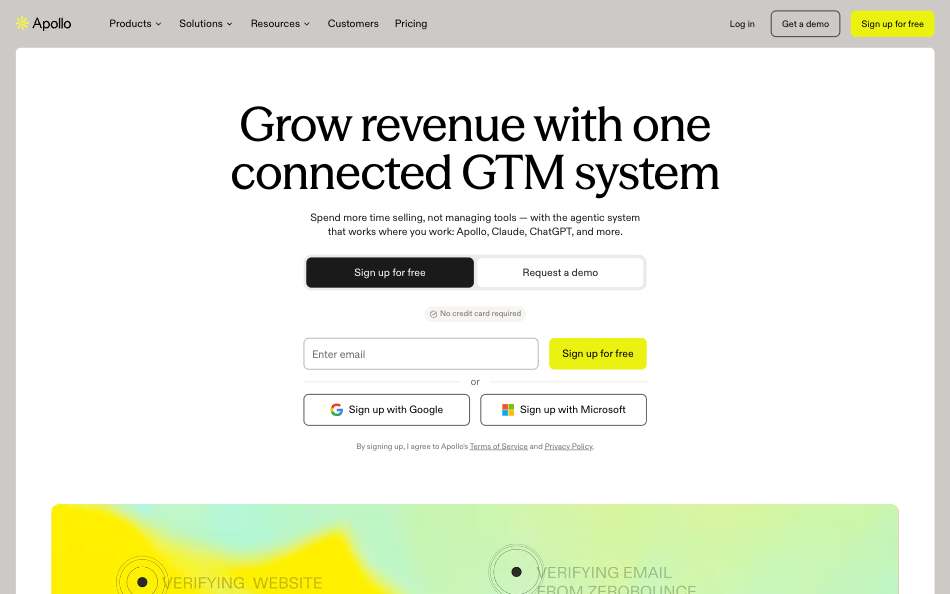
Apollo is a sales platform with a contact database attached. It lists 240 million plus contacts and 30 million plus companies, with sequences, a dialer and a Chrome extension (Apollo MCP page, September 2026). It is the closest swap for an Adapt user who lives in the extension. Check it first if your team sends from the tool it searches in.
It ranks second here because the API is open and the limits are workable. Apollo says every plan includes API access, and Adapt gates it behind a quote (Apollo developer FAQ, September 2026). Enrichment allows 1,000 requests a minute on paid plans, with no hourly or daily cap. Search allows 200 a minute and 50,000 a day (Apollo rate limits, September 2026). Bulk people enrichment takes 10 people per request.
The catch is the bill. Seats and credits both scale it. An email costs 1 credit and a phone number 8, and credits expire at the end of each billing cycle (Apollo credit docs, September 2026). The price of extra credits is not public, so you cannot price a bigger pool from the site. Apollo runs an official MCP server on any plan, including Free (Apollo MCP docs, September 2026).
Pros
- Database, sequences, dialer and Chrome extension in one app, like Adapt, with far more built around outreach.
- API and MCP on every plan, with OAuth sign-in for the server.
- Enrichment at 1,000 requests a minute on paid plans.
- A free plan, so you can test records before you pay.
Cons
- Seats and credits both drive cost, and credits do not roll over.
- Record selection caps of 25, 1,000, 2,500 and 10,000 per action, by plan.
- Phone numbers cost 8 credits, so phone-heavy pulls drain a seat fast.
Best for: sales reps who prospect and send from one workspace.
Pricing: Free. Basic $65, Professional $99 and Organization $149 per seat a month on monthly billing. Billed yearly they are $49, $79 and $119 (Apollo pricing, September 2026).
3. People Data Labs: best for per-match data and licences
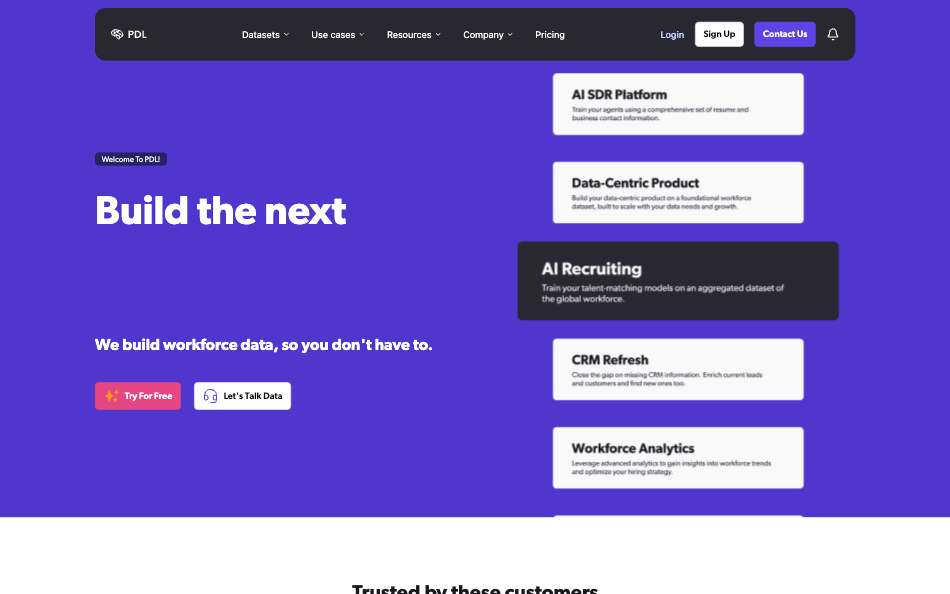
People Data Labs (PDL) is a long-running person and company data API with bulk licences. It states 2,466,510,427 person profiles, 592,376,573 of them with an email, and 76,606,079 company records (PDL datasets, September 2026). Those totals are larger than Adapt's stated database, though stated size is not match quality.
It charges per match. One credit is used per profile returned, and a request that returns nothing is not billed (PDL docs, September 2026). The entry price is high per record. Pro starts at $98 a month for 350 credits, which is $0.28 each, or $940 a year billed yearly. PDL says Pro profiles cost about $0.20 to $0.28 depending on volume (PDL pricing, September 2026).
Self-serve is meant for volumes below roughly 100,000 profiles a year. Above that PDL sends you to Enterprise and sales, so there is no public 1M price (PDL plans, September 2026). Person enrichment allows 1,000 requests a minute on paid plans. Person search defaults to 10 a minute (PDL usage limits, September 2026). We found no official PDL MCP server in its docs index (PDL docs, September 2026).
Pros
- Enrichment at 1,000 requests a minute on paid plans, with bulk calls of up to 100 persons.
- Large stated datasets and licences you can load into your own warehouse.
- No charge when a request finds nobody.
Cons
- $0.28 a record at the entry rate, and no public price at volume.
- Search defaults to 10 requests a minute, which is slow for list building.
- No official MCP server found, so agents need a wrapper you host.
- Contact data is hidden on the Free plan, which gives up to 100 credits a month.
Best for: teams that license data or enrich by match through code and accept per-record pricing.
Pricing: Free up to 100 credits a month. Pro from $98 a month for 350 credits, or $78 a month billed yearly. Enterprise is custom (PDL pricing, September 2026).
4. Crustdata: best for live people, company and job data by API
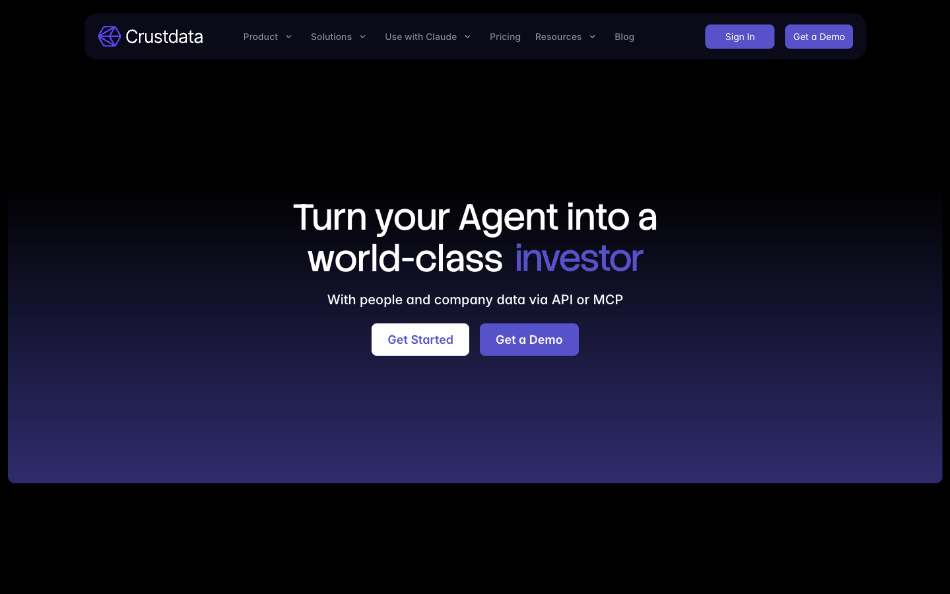
Crustdata sells people, company and job data as an API, with search, enrichment and change watchers. It is the closest match to Adapt's data-platform pitch and the furthest from its price page. Crustdata prints no plan names, no dollar prices and no price per credit (Crustdata pricing, September 2026). The docs give credits per call and say the dollar value depends on your plan (Crustdata docs, September 2026).
The credit table is the useful part. Search is 0.03 credits per result. A person enrich is 1 to 7 credits, so a work email through /person/enrich is 2 credits. The cheaper /person/contact/enrich is 1 credit but needs an enterprise plan, and a self-serve key gets a 403 (Crustdata contact docs, September 2026). One Crustdata blog post reports a lowest tier of $95 a month, which the pricing page does not list (Crustdata blog, September 2026).
The default rate limits are the main constraint. Person enrich and company enrich allow 15 requests a minute and search allows 30. Batch person enrich takes up to 10,000 identifiers a job (Crustdata rate limits, September 2026). The hosted MCP server uses OAuth for interactive clients and an API key as a bearer token for code (Crustdata MCP docs, September 2026).
Pros
- Search, person, company and job data behind one API.
- Hosted MCP server with OAuth and a bearer-token option for headless code.
- Change watchers that report when a person or company record moves.
- Free company identify and autocomplete calls.
Cons
- No public price, so you cannot budget from the site.
- 15 requests a minute on enrich by default, against 250 on Adapt.
- The cheapest email endpoint needs an enterprise plan.
Best for: teams that want fresh people and job data by API and will negotiate a contract.
Pricing: No public dollar price. Credits per call are in the docs. A lowest tier of $95 a month is reported by a Crustdata blog post (Crustdata pricing docs, September 2026).
5. ZoomInfo: best for company and contact records on pay-as-you-go credits
ZoomInfo sells an API, a CLI and an MCP server through GTM AI, its self-serve product. Signup gives 1,000 data credits and 1,000 AI credits with no card. MCP, API and CLI access are included, at 5 requests a second (ZoomInfo GTM AI pricing, September 2026). Adapt's free plan gives 25 credits and no API.
The meter is unusual for this list. Search, lookup and find-similar are free. One data credit enriches or exports one company, contact or intent record, and a record is charged once per 12 months (GTM AI credit docs, September 2026). Credits do not expire while the account is active. The price falls with pack size, from $0.45 a credit at the base tier to $0.25 at 100,000 credits for $25,000.
The slider stops at 100,000 credits, and larger volumes go to Enterprise. Rate limits rise by package: Builder 5 requests a second, Standard 25 and Scaling 35 (GTM AI rate limits, September 2026). Batch enrichment takes 25 records per call (GTM AI bulk docs, September 2026). This page prices only GTM AI credits, because we could not read ZoomInfo's platform plan prices.
Pros
- Free search and lookup, and a record is charged once a year.
- Official MCP server for Claude, ChatGPT and Cursor, and API access on the free plan.
- Credits do not expire while the account is active.
- ZoomInfo's brand and data size, with a claimed 500M+ contacts (ZoomInfo MCP docs, September 2026).
Cons
- The lowest rate is $0.25 a credit, so volume costs more than a flat fee.
- 25 records per batch call, against 50,000 rows per LeadOcean export request.
- No public price above 100,000 credits.
Best for: teams that want ZoomInfo data without a platform contract and buy by the pack.
Pricing: Free 1,000 data credits. Pay as you go from $20, at $0.45 to $0.25 a credit by pack size (GTM AI pricing, September 2026).
6. Lusha: best for reps who reveal contacts in an app
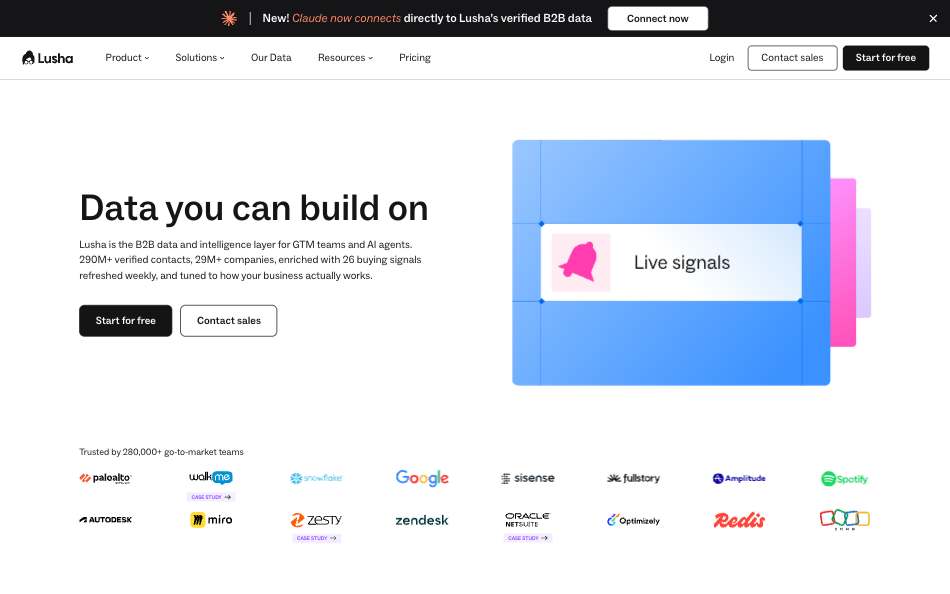
Lusha is a credit-based contact tool with an API. Every user gets an API key, including on Free (Lusha API guide, September 2026). That is a real step up from Adapt, where the API needs a quote. It ranks last for volume because the limits and credits both bind.
Credits are the meter. An email costs 1 credit and a phone number 5. A bulk request adds 1 credit per 25 results and stops at 100 contacts (Lusha credit docs, September 2026). Daily caps by plan are 100 calls on Free and Starter, 1,500 on Pro, 18,000 on Premium and 50,000 on Scale. The lowest published rate is about $0.0795 a credit, on Premium billed yearly at 120,000 credits.
The MCP server has 50 tools and shares the REST API credit pool (Lusha MCP docs, September 2026). A 1M work-email pull by bulk API is 1,040,000 credits, which is 104 times the largest listed monthly plan. Lusha publishes no price at that volume.
Pros
- API key on every plan, with an MCP server that returns data.
- Waterfall enrichment on all paid plans, at 2 credits per work email.
- Clear plan ladder from Free to Scale.
Cons
- Daily caps and credits both limit volume.
- Bulk calls stop at 100 contacts, and each request adds credits.
- No public price at 1M. Scale is a quote.
Best for: reps and small teams that reveal contacts in an app and call the API on the side.
Pricing: Free 40 credits a month. Starter $49.90, Pro $69.90 and Premium $399.90 a month on monthly billing. Billed yearly they are $37.45, $52.45 and $299.95 a month (Lusha pricing, September 2026).
Comparison table
| Tool | Best for | Starting price | Cost at 1M records a month | API | MCP | Rate limit |
|---|---|---|---|---|---|---|
| LeadOcean | API, agent and volume buyers | Free. Pro $499 a month | $499 flat. Fair use applies | REST on every plan | Yes. OAuth 2.1, 12 tools | 100 requests per second per key |
| Apollo | Reps with a sequencer | Basic $65 per seat a month | $24,750 a month monthly, $19,600 yearly | REST on every plan | Yes. Any plan | 1,000 a minute enrichment, 200 search |
| People Data Labs | Per-match data and licences | Pro from $98 a month | No public 1M price | REST, bulk of 100 | None listed in PDL's docs index | 1,000 a minute enrichment, 10 search |
| Crustdata | Live people and job data | No public price. $95 a month reported | No public price at 1M | REST. Contact endpoint enterprise only | Yes. OAuth or bearer key | 15 a minute enrich, 30 search |
| ZoomInfo | GTM AI credits | Free 1,000 credits. From $20 | No public price at 1M | REST on the free plan | Yes. Official server | 5 to 35 requests a second by package |
| Lusha | Reps with an app | Starter $49.90 a month | No public price at 1M | REST on every plan | Yes. 50 tools | 40 a minute on Free, up to 300 on Premium |
| Adapt (for reference) | Reps with an extension | Starter $49 a month | No public price at 1M | Custom plan only | None found in docs | 250 a minute per account |
Sources are linked in each tool section, all checked in September 2026. Vendors change plans often, so confirm on the pricing page before you buy. The 1M column is list-price arithmetic on email lookups where a public plan sells that volume. Apollo is 250 Professional seats at $99 on monthly billing, or 400 Basic seats at $49 on yearly billing. Crustdata has no public price at 1M, and 1M work emails is 2,000,000 credits on /person/enrich. PDL quotes Enterprise above about 100,000 profiles a year. ZoomInfo's public slider stops at 100,000 credits for $25,000, and Lusha's top public tier is Premium at 10,000 credits a month for $977.40.
How to choose
- You pull data in code or with an agent, at volume: LeadOcean. One flat price, REST and MCP on every plan, 100 requests per second.
- Your reps live in a browser extension and send from one tool: Apollo, or stay on Adapt Basic if 1,000 emails a month is enough.
- You license data or enrich by match: People Data Labs, and budget $0.20 to $0.28 a profile.
- You want fresh job and company change data: Crustdata, after you get a written quote.
- You want ZoomInfo data without a platform contract: ZoomInfo through GTM AI, by the pack.
- You reveal contacts by hand and call the API now and then: Lusha, and watch the daily caps.
- You use fewer than 1,000 emails a month in an app: stay on Adapt. Basic at $99 is cheaper than any plan here that sells that volume.
- You want both: keep a few Adapt or Apollo seats for reps and move bulk pulls and agent lookups to a flat-price API.
Verdict
LeadOcean wins for API, agent and volume buyers. It has a flat price, emails and phones in one plan, and an MCP server that returns records. Apollo wins for reps who want a database and a sequencer, and it is the easiest swap for an Adapt user who sends from the same app. PDL wins for licensed datasets and per-match enrichment. Crustdata fits teams that want job and change data and will negotiate. ZoomInfo and Lusha suit buyers who want a known brand and accept credits. Stay on Adapt if your team prospects a few hundred contacts a month from the extension. Otherwise start on the free plan and compare the same lookups.
FAQ
Why do teams leave Adapt?
Cost and shape. Adapt prices by credit, with three pools for email, enrichment and phone, and a daily cap of 25 to 100 contacts on self-serve plans (Adapt pricing, September 2026). The API is listed only on the Custom plan. Teams that use Adapt as a data source often move to an API-first tool.
Does Adapt have an API?
Yes, but only the Custom plan lists API access, and Custom has no public price. The docs give three endpoints for enrich, company search and contact search, and a limit of 250 requests a minute per account (Adapt API docs, September 2026). Contact search returns no email, so you buy each contact by ID afterward.
What does Adapt cost at 1M records a month?
Adapt does not publish a price at that volume. Its highest self-serve plan is Basic at $99 a month for 1,000 email credits and 100 phone credits (Adapt pricing, September 2026). Larger volume and the API go through a sales quote.
What is the cheapest Adapt alternative at volume?
At 1M records a month, LeadOcean at $499 flat is the only public price below five figures. Apollo costs about $19,600 a month on yearly billing and $24,750 on monthly. PDL, Crustdata, ZoomInfo and Lusha publish no price at that volume. Extrapolating a per-credit rate gives a number, not a plan, so get a quote.
Which Adapt alternative has an MCP server that returns data?
LeadOcean, Apollo, Crustdata, ZoomInfo and Lusha all do. We found no official PDL server, and none in Adapt's docs. Compare the tools each server exposes and the credits each call spends before you choose.
Do I need a credit card to try LeadOcean?
No. The free plan needs a work email and no card. It gives you 1,000 records, one-off, with the same API and MCP server as Pro. See pricing.
Related: Adapt pricing, Wappalyzer alternatives, Surfe alternatives, Harmonic alternatives, pricing.
Replace Adapt's credits and daily caps with one flat-price API. Start free.
Free to start. No credit card. 1,000 records to spend whenever you like.
Get your free API key →