Teams leave Amplemarket when they want its data without its seats. Startup is $600 a month on an annual term for 2 users, and Growth and Elite are quote only (Amplemarket pricing, September 2026). Email credits are sold per user per year: 13,500 on Startup and 40,000 on Elite. Phone credits are 600 and 9,600. No page shows a price at 1M records a month.
The API is open to every account, but the default limit is 500 requests a minute and bulk enrichment runs at 15,000 an hour (Amplemarket API docs, September 2026). MCP and AI Agents sit under Add-On on the pricing page with no price shown. You also pay for sequences, mailboxes and a dialer.
This list ranks six alternatives for readers who pull data in code, through an agent or at volume. For Amplemarket's own plans, see Amplemarket pricing.
TL;DR
| Tool | Best for | Starting price | Cost at 1M records a month |
|---|---|---|---|
| LeadOcean | Code, agents and volume pulls | Free (1,000 records, one-off). Pro $499 a month. | $499 flat. |
| People Data Labs | The widest record count and dataset licences | Pro $98 a month, $78 billed yearly (PDL) | No public 1M price. Above roughly 100,000 person profiles it is Enterprise quote only. |
| Crustdata | Live signals and agent workflows | No public price. A Crustdata blog post reports from $95 a month (Crustdata). | No public 1M price. 1M work-email lookups is 2,000,000 credits on /person/enrich. |
| FullEnrich | Waterfall email and phone on your own list | Pro $29 a month, $26 billed yearly (FullEnrich) | No public 1M price. Top listed tier is 100,000 credits for $3,500 a month. |
| Apollo | Reps who want a workspace and a public price | Basic $65 per seat a month, $49 billed yearly (Apollo) | $24,750 a month on monthly billing, $19,600 billed yearly. |
| Clay | GTM engineers building multi-provider workflows | Launch $185 a month, $167 billed yearly (Clay) | No public 1M price. Top public tier is 200,000 Actions and 50,000 Data Credits a month. |
For scale, Amplemarket has no public 1M price either. Elite lists 40,000 email credits per user a year, or 400,000 across the 10 users it includes (Amplemarket pricing, September 2026). The Apollo figures are list-price arithmetic at 1 credit per email, not a quote.
What we evaluated
- Access in code. A documented REST API on the plan you would buy, and whether an MCP server returns records.
- Rate limits. Requests per second or per minute on the default plan, because a 1M pull is a rate-limit problem first.
- Price model. Seats, credits or a flat fee, and what 1M records a month costs at list price.
- Coverage. Published counts of people, companies, emails and phone numbers, from each vendor's own pages.
- What you stop paying for. Amplemarket bundles sequences, mailboxes and a dialer. We note which tools keep them and which drop them.
1. LeadOcean: best for engineers, agents and volume pulls
LeadOcean is our product, and it is the data layer only. You search 693M people and 63M companies, enrich one record at a time and export up to 50,000 rows per request with POST /v1/exports. The app at app.leadocean.io runs the same exports with a filter builder, a column picker, the record price before you start and a CSV download.
The price is flat. Free gives you 1,000 records, one-off, with no card and the same API and MCP server as Pro. Pro is $499 a month with unlimited searches, enrichments and lookups, 100 requests per second per key and 5 API keys. There are no credits, no per-record price and no overage invoice. Past the fair-usage line a very large month is paced down to one request a minute until the reset, and one email to support raises the headroom.
The MCP server has 12 tools and signs in with OAuth 2.1. Counts are free, so you size a pull before you spend a record.
curl "https://api.leadocean.io/v1/people/search?jobLevel=VP&country=CA&limit=1&count=true" \
  -H "x-api-key: $LEADOCEAN_API_KEY"
Pros
- Flat $499 a month at any volume, with the same API and MCP server on the free plan.
- 100 requests per second per key, which is 6,000 a minute against Amplemarket's 500.
- 366M people with an email and 166M with a phone number, with an email status on every record.
- A miss on
POST /v1/people/enrichis a 404 and costs nothing. - 12 MCP tools, including free
count_leadsandlist_filters.
Cons
- No sequences, mailboxes, dialer or Chrome extension. Export to your own sequencer.
- No intent signals or job-change alerts of its own.
- A v2 contact call costs one record, including a call that finds nothing.
- Past the fair-usage line a very large month is paced down rather than cut off.
Best for: Engineers, RevOps and agent builders who want a fixed bill and an API that does not throttle a bulk job.
Pricing: Free, then Pro at $499 a month. See LeadOcean pricing, September 2026.
2. People Data Labs: best for the widest record count and dataset licences
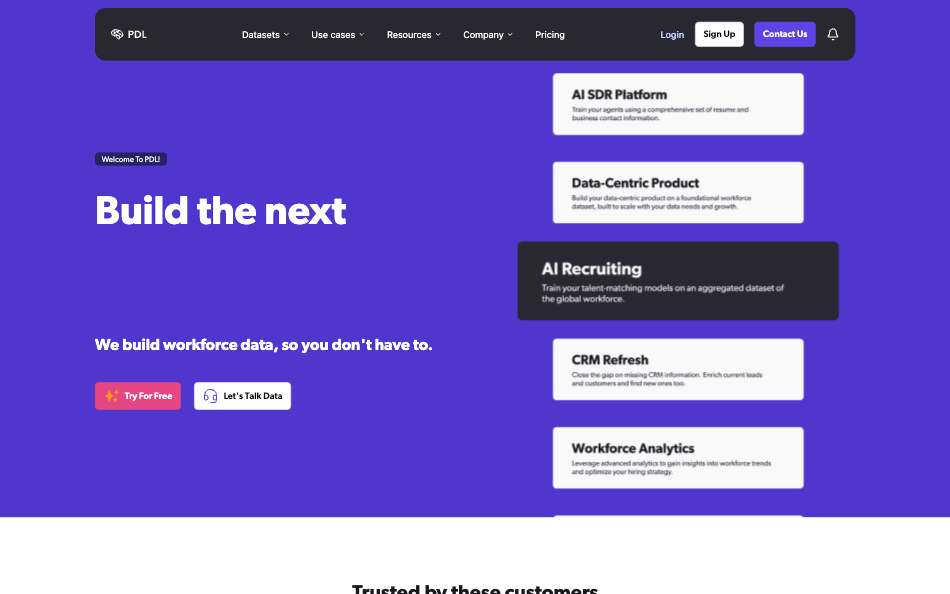
People Data Labs (PDL) is the largest database here by record count. Its full person dataset holds 2.47 billion profiles, 592M of them with an email and 470M with a mobile phone (PDL datasets, September 2026). PDL also sells data licences, so you can load files into your own warehouse.
The API is priced per record. Pro is $98 a month for 350 credits, which is $0.28 a credit, or $78 a month billed yearly ($940 a year) (PDL pricing, September 2026). PDL puts Pro profiles at about $0.20 to $0.28 each depending on volume (PDL blog, September 2026). One credit is used per successful match or per profile returned, and a request that finds nothing is not billed (PDL docs, September 2026).
Above roughly 100,000 person profiles PDL quotes Enterprise only, so there is no public price at 1M. Person Enrichment allows 1,000 requests a minute on paying plans. Person Search defaults to 10 a minute (PDL usage limits, September 2026). PDL's docs, llms.txt and GitHub list no official MCP server, only community ones (PDL docs, September 2026).
Pros
- 2.47 billion person profiles, more than any other tool on this list.
- Annual data licences delivered as files.
- A lookup that finds nothing costs nothing.
- Bulk enrichment takes up to 100 people per request.
Cons
- Per-record pricing climbs with volume, and 1M a month has no public price.
- Contact data is obscured on the free plan.
- Person Search defaults to 10 requests a minute.
- No official MCP server, so an agent needs your own wrapper.
Best for: Teams that license data in bulk, or need the biggest profile count and accept per-record prices.
Pricing: Free up to 100 credits a month, Pro from $98 a month for 350 credits ($78 billed yearly), Enterprise custom (PDL pricing, September 2026).
3. Crustdata: best for live signals and agent workflows
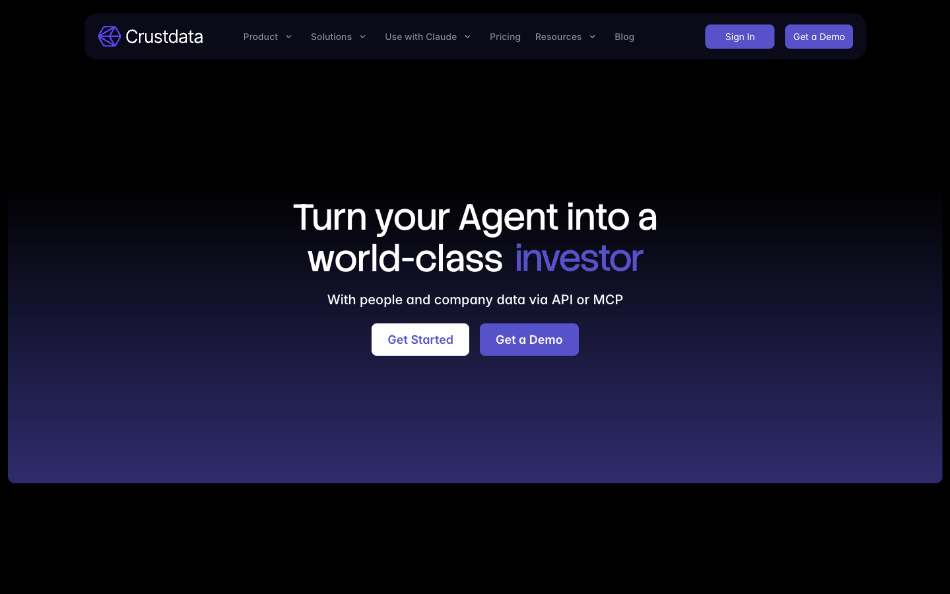
Crustdata is a data API with live signals on people, companies, jobs and posts. Its homepage claims 1B people (Crustdata, September 2026). It is the closest match here to Amplemarket's signals and job change alerts, sold as an API instead of a workspace.
Pricing is credits, and the dollar value of a credit is not public. The pricing page lists no plan names, dollar prices or credit allowances (Crustdata pricing, September 2026). Search costs 0.03 credits per result. Person enrich costs 1 to 7 credits, and a work-email lookup is 2 (1 base plus 1 business email). A person watcher costs 5 credits per changed profile at the 30-day setting (Crustdata pricing docs, September 2026). A Crustdata blog post reports the lowest tier at $95 a month (Crustdata blog, September 2026).
The hosted MCP server is at https://install.crustdata.com/mcp. It signs in with OAuth for interactive clients and takes an API key as a bearer token in code (Crustdata MCP docs, September 2026). Default limits are 15 requests a minute on person enrich and 30 on search (Crustdata rate limits, September 2026).
Pros
- Cheap discovery at 0.03 credits per search result, and company identify is free.
- Change watchers for people, companies, jobs and posts.
- A hosted MCP server for interactive clients, and an API key for code.
- Misses on the contact enrich endpoint are not billed.
Cons
- No public dollar price per credit, so you cannot forecast a month without asking.
- Low default limits: 15 requests a minute on person enrich.
- The contact endpoint, at 1 credit per work email, needs an enterprise plan.
- The docs say credits expire after 12 months and a July 2026 Crustdata blog post says 6. Confirm before you buy in bulk (Crustdata credits, September 2026).
Best for: AI SDR builders and teams that need change alerts on accounts and champions.
Pricing: Credit-based with no public dollar price per credit. A Crustdata blog post reports from $95 a month (Crustdata blog, September 2026).
4. FullEnrich: best for waterfall email and phone on a list you already have
FullEnrich is an enrichment layer, not a single database. It queries 25+ sources in turn and charges only for data it finds (FullEnrich pricing, September 2026). A work email is 1 credit, a personal email 3 and a mobile 10. A contact it cannot find, or a landline, costs 0 (FullEnrich credit docs, September 2026).
Pro starts at $29 a month for 500 credits, and the page opens on $55 for 1,000. Billed yearly, the entry tier is $26 a month for 6,000 credits a year. The top monthly tier is 100,000 credits for $3,500 a month, and above that the page says contact sales (FullEnrich pricing, September 2026). Unused credits roll over 3 months on monthly plans and 12 months on annual ones.
The API allows 60 calls a minute across Enrich, Reverse Email and Search. A bulk request takes up to 100 contacts, so 6,000 contacts a minute (FullEnrich volume docs, September 2026). API, MCP, search and bulk CSV are on every plan, including the free trial. Users are unlimited.
Pros
- You pay only for emails and phones it finds.
- A waterfall across 25+ sources, not one database.
- API and MCP on every plan, with unlimited users.
- Credits roll over: 3 months monthly, 12 months annual.
Cons
- Credits scale with records, and 1M a month is above the top listed tier.
- A mobile number is 10 credits, so phone-heavy pulls get expensive.
- 60 calls a minute, so a large job depends on bulk batches of 100.
Best for: Teams that already have a list and want the best match rate on emails and mobiles, paid per find.
Pricing: Free trial with 50 credits, Pro from $29 a month ($26 billed yearly), Enterprise custom (FullEnrich pricing, September 2026).
5. Apollo: best for reps who want a workspace and a public price
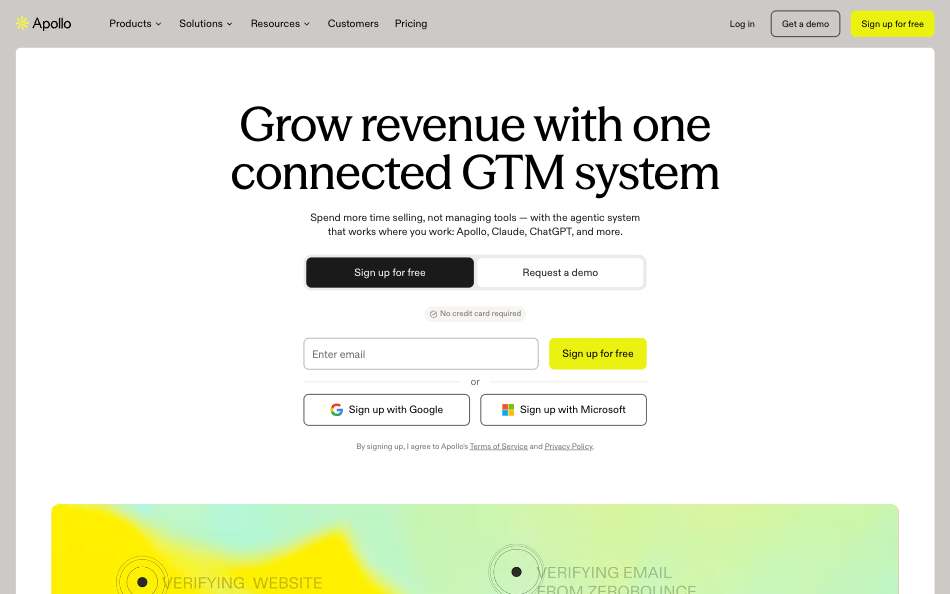
Apollo is the closest swap if your reps work in Amplemarket every day. It sells a database and a rep workspace per seat, with credits pooled across the team. It ranks fifth here because seats, not records, drive the bill.
Monthly list prices per seat are Free $0 with 75 credits, Basic $65 with 2,500 and Professional $99 with 4,000. Organization is $149 with 6,000 and a 3-seat minimum. Billed yearly they are $49, $79 and $119 (Apollo pricing, September 2026). An email costs 1 credit and a phone number 8. Credits expire at the end of each billing cycle, including purchased add-ons (Apollo API pricing, September 2026).
At 1M work emails a month that is 250 Professional seats at $99, or $24,750 on monthly billing. Billed yearly, 400 Basic seats at $49 is $19,600 a month. Both are arithmetic on list prices. The price of an extra credit is not public.
Every plan includes the API. Enrichment allows 1,000 requests a minute on paid plans. Search allows 200 a minute and 50,000 a day (Apollo rate limits, September 2026). The official MCP server at https://mcp.apollo.io/mcp works on any plan, including Free, and spends the same credits (Apollo MCP docs, September 2026).
Pros
- The only credit-based tool here whose list prices reach 1M records, so you can budget it.
- API and MCP on the Free plan.
- Published rate limits for search and enrichment.
- An email is never more than 1 credit.
Cons
- Seats scale the bill. 1M emails needs hundreds of seats on list prices.
- Credits expire every billing cycle and do not roll over.
- General endpoints cap at 2,000 requests a day on Basic and Professional.
- No public price for extra credits.
Best for: Sales teams that want one workspace for data and outreach and are fine paying per seat.
Pricing: Per seat a month: Basic $65, Professional $99, Organization $149. Billed yearly: $49, $79, $119 (Apollo pricing, September 2026).
6. Clay: best for GTM engineers building multi-provider workflows

Clay is a workflow platform that buys data from many providers on your behalf. That is a different job from a data API. You build tables and waterfalls, and Clay spends credits at each step. It ranks last because it is not built for bulk API pulls.
There are two meters. Data Credits buy the data and start at $0.05 each. Actions meter the platform work, at 1 Action per enrichment. Launch is $185 a month, or $167 billed yearly. Growth is $495, or $446 billed yearly. Enterprise is custom on an annual commitment (Clay pricing, September 2026).
The ceiling matters at volume. The largest self-serve tiers are 200,000 Actions and 50,000 Data Credits a month, and Actions cannot be topped up. The Public API and CLI are on every plan, including Free. The HTTP API column, which calls out of Clay, starts on Growth (Clay API docs, September 2026). Clay publishes no API rate limit and returns a 429 with a Retry-After header when you exceed it (Clay developer docs, September 2026). Clay MCP puts its providers and your workflows inside Claude and ChatGPT (Clay MCP guide, September 2026).
Pros
- Waterfalls and bring-your-own-key in one workspace.
- A free plan with 100 Data Credits and 500 Actions a month.
- The Public API and CLI on every plan.
- An enrichment that returns no result is not charged.
Cons
- Two meters, Data Credits and Actions, make cost hard to forecast.
- Actions cannot be topped up, so the self-serve ceiling is 200,000 a month.
- The HTTP API column needs Growth or Enterprise.
- No published API rate limit.
Best for: GTM engineers who want to orchestrate many providers and AI research in one place.
Pricing: Free, Launch from $185 a month ($167 billed yearly), Growth from $495 ($446 billed yearly), Enterprise custom (Clay pricing, September 2026).
Comparison table
| Tool | Best for | Starting price | Cost at 1M records a month | API | MCP | Rate limit |
|---|---|---|---|---|---|---|
| LeadOcean | Code, agents and volume pulls | Free. Pro $499 a month. | $499 flat. | REST on every plan, including Free | Yes. 12 tools, OAuth 2.1, returns records. | 100 requests per second per key |
| People Data Labs | Record count, dataset licences | Pro $98 a month, $78 billed yearly | No public 1M price. Quote only above roughly 100,000 person profiles. | REST on Free and Pro | No official server | Enrichment 1,000 a minute on paid plans, Person Search 10 a minute |
| Crustdata | Live signals | No public price. Reported from $95 a month. | No public 1M price. 2,000,000 credits for 1M work-email lookups. | REST, credits | Yes, hosted | 15 a minute person enrich, 30 search |
| FullEnrich | Waterfall enrichment | Pro $29 a month, $26 billed yearly | No public 1M price. Top listed tier is 100,000 credits for $3,500 a month. | REST on every plan | Yes, on every plan | 60 calls a minute, 100 contacts per bulk call |
| Apollo | Rep workspace | Basic $65 per seat, $49 billed yearly | $24,750 a month monthly, $19,600 billed yearly | REST on every plan | Yes, any plan | Enrichment 1,000 a minute, search 200 a minute |
| Clay | Workflows | Launch $185 a month, $167 billed yearly | No public 1M price. Top public tier is 200,000 Actions a month. | Public API and CLI on every plan | Yes | Not published |
Every non-LeadOcean cell comes from the vendor pages linked in its section, checked in September 2026. Prices change, so confirm before you buy.
How to choose
- You pull data in code or through an agent on a fixed bill: LeadOcean. It is the only flat price here with an MCP server that returns records.
- You need the biggest profile count or files in your warehouse: People Data Labs. Budget for per-record prices.
- You replace Amplemarket's signals: Crustdata, and ask for the dollar price per credit first.
- You have a list and want the best email and mobile match rate: FullEnrich.
- Your reps live in a workspace all day: Apollo. Keep it for sequences and move bulk pulls elsewhere.
- You build multi-provider workflows: Clay, with the Action ceiling in mind.
Verdict
LeadOcean wins for API, agent and volume buyers. It is the only option here with a flat price, 100 requests per second and an MCP server that returns records, all on the free plan. People Data Labs wins on record count and dataset files. Crustdata wins on live signals, FullEnrich on match rate per find and Clay on workflow building. Apollo is the pick if reps need a workspace and a public price. Only Apollo replaces Amplemarket's sequencer and dialer. Other teams with reps should swap the data source and keep a sending tool.
FAQ
What is the best Amplemarket alternative for API access?
For a flat price and high rate limits, LeadOcean. It allows 100 requests per second per key on every plan. Amplemarket allows 500 requests a minute by default, and 300 a minute on people search (Amplemarket API docs, September 2026).
Is there a free Amplemarket alternative with an API?
Yes, several. LeadOcean Free gives 1,000 records, one-off, with no card. PDL gives up to 100 credits a month, FullEnrich 50 credits, Apollo 75 credits a month and Clay 100 Data Credits and 500 Actions a month. Amplemarket offers a free trial on every plan, not a free plan.
Does Amplemarket have an API and an MCP server?
Yes to both. The API is available from all accounts (Amplemarket API quickstart, September 2026). The MCP server uses OAuth, is limited to 100 requests a minute per user, and charges 0.5 credits per enrichment (Amplemarket MCP docs, September 2026).
How does Amplemarket charge for data?
In credits per user per year. A found person is 0.5 email credit, an email reveal is 1 and a phone reveal is 1 phone credit (Amplemarket API docs, September 2026). Startup lists 13,500 email credits per user.
Can I keep Amplemarket and add another data source?
Yes, and it is the cheapest change. Pull bulk lists from an API source, then import the CSV into Amplemarket for sequencing and calling. Reps keep their workspace and the volume work leaves the credit pool.
Which Amplemarket alternatives have an MCP server?
LeadOcean, Crustdata, FullEnrich, Apollo and Clay all publish one. PDL's docs list none, so an agent there needs your own wrapper around the REST API.
Related: Amplemarket pricing, Wappalyzer alternatives, Surfe alternatives, Harmonic alternatives, LeadOcean pricing. Back to all alternatives.
Replace Amplemarket's credit pools with one flat data API. Start free.
Free to start. No credit card. 1,000 records to spend whenever you like.
Get your free API key →