Auto lead generation software finds, enriches and refills lead lists on its own, so nobody exports a CSV by hand each week. Teams that run outbound at volume, agencies and anyone feeding an AI agent need it.
Most roundups rank these tools by features. The cost at volume decides it. A tool that looks cheap for 500 leads can cost five figures a month at 1M, and several publish no price at all above a mid tier.
We compared published prices, limits and MCP docs from September 2026, and LeadOcean's October 2026 pricing. We did not run a find-rate benchmark, so there are no accuracy scores here. Every cost at 1M is list-price arithmetic with the method shown.
Three tools have a deeper LeadOcean comparison: Apollo, Clay and ZoomInfo. For the outbound side, see outbound lead generation and the lead generation funnel.
TL;DR
| Tool | Best for | Starting price | Cost at 1M records a month |
|---|---|---|---|
| LeadOcean | API, agents and volume | Free ($0, 1,000 records for life); Solo $97 a month | $497 a month (Agency) |
| Apollo | Reps who also send | Free; Basic $65 a seat a month ($49 billed yearly) | $24,750 a month ($19,600 billed yearly) |
| Clay | Workflow builders | Free; Launch $185 a month ($167 billed yearly) | No public 1M price |
| Seamless.AI | Sales teams buying by quote | Free license, 50 credits; no public paid price | No public 1M price |
| ZoomInfo (GTM AI) | Pay-as-you-go enterprise data | From $20 of credits | No public 1M price |
| Lusha | Small teams, browser workflow | Free; Starter $49.90 a month ($37.45 billed yearly) | No public 1M price |
| Prospeo | Verified emails at mid volume | Free; Starter $49 a month ($37 billed yearly) | $14,456 a month ($11,223 once, billed yearly) |
The 1M figure assumes 1,000,000 work-email lookups in a month.
What we evaluated
- Automation reach. Can code or an agent run the whole loop (search, enrich, refill) with no one clicking?
- API and MCP. A documented REST API, a hosted MCP server, and which plans include them.
- Rate limits. The published pace per second or minute, because it caps how fast a list refills.
- Price model. Seats, credits or flat plan, and whether unused credits expire.
- Cost at 1M records a month. From the vendor's own pricing page. If it is not public, we say so and do not multiply a rate.
1. LeadOcean: best for API, agent and volume work
LeadOcean is a data layer, not a rep workspace. It holds 693M people and 67M companies, and you reach them over REST, MCP or a CSV export from the app. Automation means your code or your agent calls it on a schedule.
The loop is short. Size a list for free with leadocean_count_leads or GET /v1/companies/count. Search with /v1/people/search, then enrich with POST /v1/people/enrich. One search pages to 10,000 rows, so you narrow filters instead of walking the index.
There is no sequencer, dialer or CRM. If your reps need to send email from the same tool, look at Apollo. If an agent or a script does the work, this is the cheapest path at volume.
Pros
- Flat plans, no credits. Agency is $497 a month for 1M enrichments a day, raisable, with 25M search records a month.
- 13 MCP tools with OAuth 2.1 sign-in, on every plan.
- Counts, filter lists and empty enrichments cost nothing.
- 200 requests a second on Agency, 10,000 on Platform.
- Career history on person enrich since October 2026.
Cons
- No sequences, dialer, CRM or Chrome extension. You bring your own sender.
- Bulk CSV export is not on Free.
- Paid plans have a fair-use pace. Reaching it slows the key rather than billing more.
Best for: engineers, GTM teams and agencies that pull data through code or an agent. Pricing: Free $0 (1,000 records for life), Solo $97, Agency $497, Platform $1,997 a month (LeadOcean pricing, October 2026).
2. Apollo: best for reps who also send
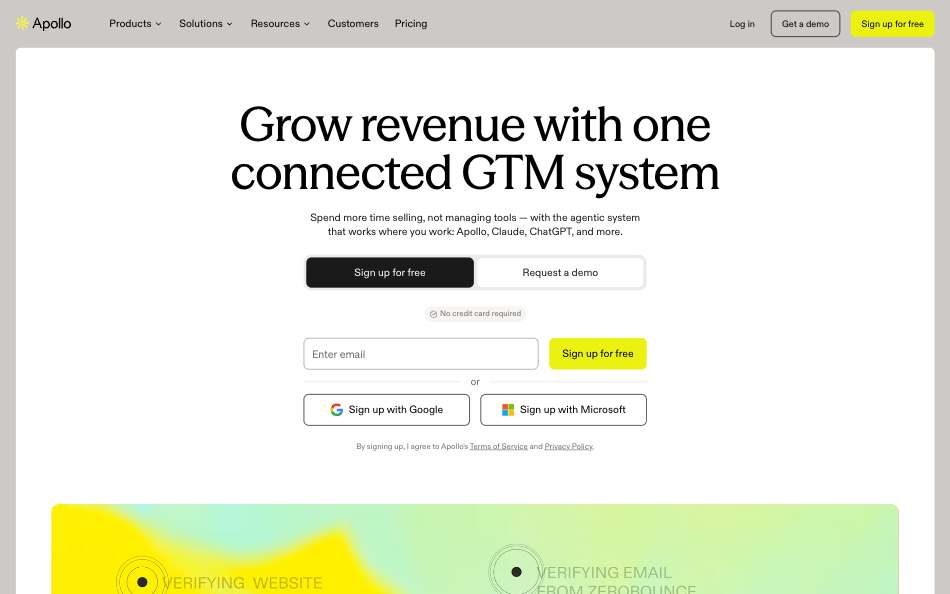
Apollo bundles a contact database, sequences, a dialer and a rep workspace. For a team that wants one login for finding and emailing, it is the obvious pick. The API is on every plan, Free included (Apollo developer FAQ, September 2026).
The price model is per seat with a credit allowance. An email costs 1 credit and a phone number 8. Credits are pooled across the team, expire at the end of the billing cycle and do not roll over (Apollo API pricing, September 2026).
At volume the seat math bites. Paid plans carry 2,500 to 6,000 credits per seat a month, so 1M lookups needs about 250 Professional seats. The price of extra credits is not public.
Pros
- Data, sequences and dialer in one product.
- Official MCP server, and the API reaches 1,000 enrichment requests a minute on paid plans.
- Free plan with API access.
- Credits are granted upfront each month.
Cons
- Seat pricing makes 1M a month expensive: $24,750 at list on monthly billing.
- Credits expire each cycle.
- Phone numbers cost 8 credits each.
Best for: sales teams that want find and send in one tool. Pricing: Free; Basic $65, Professional $99, Organization $149 a seat a month, billed monthly (Apollo pricing, September 2026). At 1M lookups: 250 Professional seats, $24,750 a month, or $19,600 a month equivalent billed yearly on 400 Basic seats.
3. Clay: best for workflow builders
Clay is a table that runs enrichment steps in sequence, with a waterfall across many data providers. It is the most flexible automation builder here. A row arrives, Clay finds the company, the person and the email, then pushes the result on.
It meters two things. Data Credits pay for the data and Actions pay for each step. Clay says a fully enriched record typically costs 6 to 20 Data Credits, plus one Action per enrichment (Clay docs, September 2026).
The Public API and CLI are on every plan. The HTTP API column, which calls an outside API from a table, starts on Growth at $495 a month. Tables cap at 50,000 rows on Launch and Growth.
Pros
- Waterfall enrichment and AI research columns in one table.
- No charge for an enrichment that returns no result.
- Free plan with waterfalls and unlimited seats.
- Public API on every plan.
Cons
- No self-serve tier reaches 1M lookups. The largest is 200,000 Actions and 50,000 Data Credits a month.
- Actions cannot be bought as top-ups.
- Two meters make the bill hard to predict.
- Clay publishes no number for its Public API rate limit.
Best for: operators who build enrichment workflows in a table. Pricing: Free; Launch from $185 a month ($167 billed yearly); Growth from $495 a month ($446 billed yearly) (Clay pricing, September 2026). No public price at 1M.
4. Seamless.AI: best for teams that buy by quote
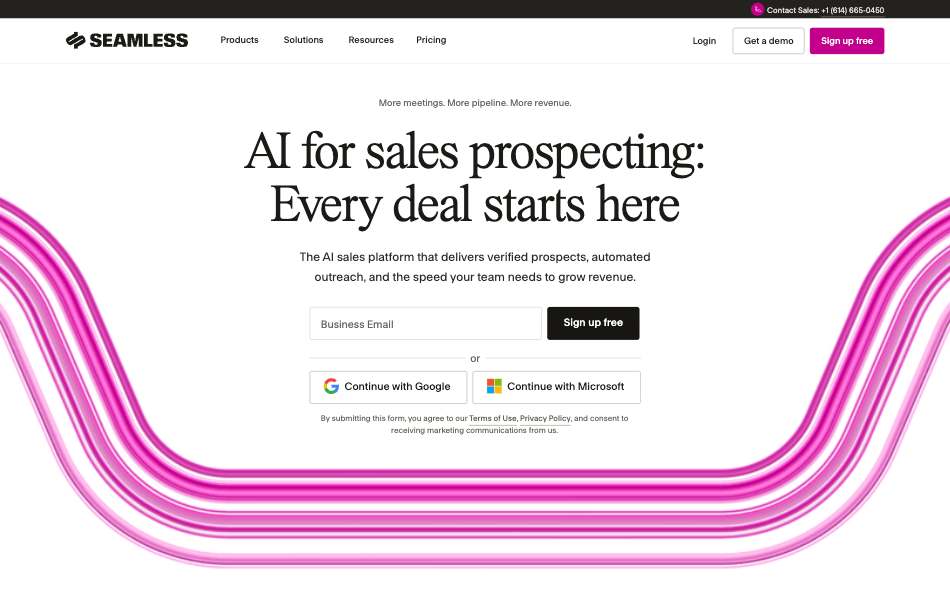
Seamless.AI sells a large contact database with search and research in the app and over an API. One credit researches one contact, and one credit covers the email and phone together. Search costs 1 credit per 10 results.
It does not publish a dollar price. The pricing page is an inquiry form, and API keys are bundled with plan tiers or sold as an add-on (Seamless.AI pricing, September 2026). A Pro license carries 10,000 credits a month.
The API is workable for automation. The default limit is 60 requests a minute per endpoint, shared by the whole organization, and one research call takes up to 500 records (Seamless.AI docs, September 2026).
Pros
- One credit returns email and phone together.
- Hosted MCP server with 57 tools. Search tools through MCP use no credits.
- Search pages return up to 500 contacts.
- A free license exists for a first look.
Cons
- No public dollar price for any plan, credit or bulk pool.
- Subscriptions are annual, and cancellation needs 60 days' notice before renewal.
- 60 requests a minute is shared across the whole organization.
- Research is asynchronous, so you poll for results.
Best for: sales teams that are fine with a quote and an annual contract. Pricing: No public paid price. Free license with 50 credits, Pro at 10,000 credits a month per license (Seamless.AI credit docs, September 2026). No public 1M price.
5. ZoomInfo (GTM AI): best for pay-as-you-go enterprise data
ZoomInfo sells its platform by contract, and zoominfo.com/pricing sits behind a human check, so we could not read platform plans. Its pay-as-you-go product, GTM AI, is public. Credits start at $20 with no contract and no seat fee.
Search, lookup and find-similar are free. One data credit enriches or exports one record, and a record is charged once per 12 months (GTM AI credit docs, September 2026). Free signup includes 1,000 data credits, MCP, API and CLI access at 5 requests a second.
The price per credit falls with the size of the purchase, from $0.45 at 100 credits to $0.25 at 100,000. The public slider stops at 100,000 credits for $25,000. Above that it is Enterprise sales.
Pros
- Search is free and a record is charged once a year.
- Official MCP server and an API on the free signup.
- No contract on pay-as-you-go.
- Rate limits are published: 5, 25 and 35 requests a second by package.
Cons
- Priced per credit, and 100,000 credits costs $25,000.
- No public 1M price.
- Batch enrichment takes at most 25 records a call.
- Platform plans are not readable without a sales path.
Best for: teams that need ZoomInfo data without an annual contract. Pricing: Pay as you go from $20 (GTM AI pricing, September 2026). No public 1M price.
6. Lusha: best for small teams in the browser
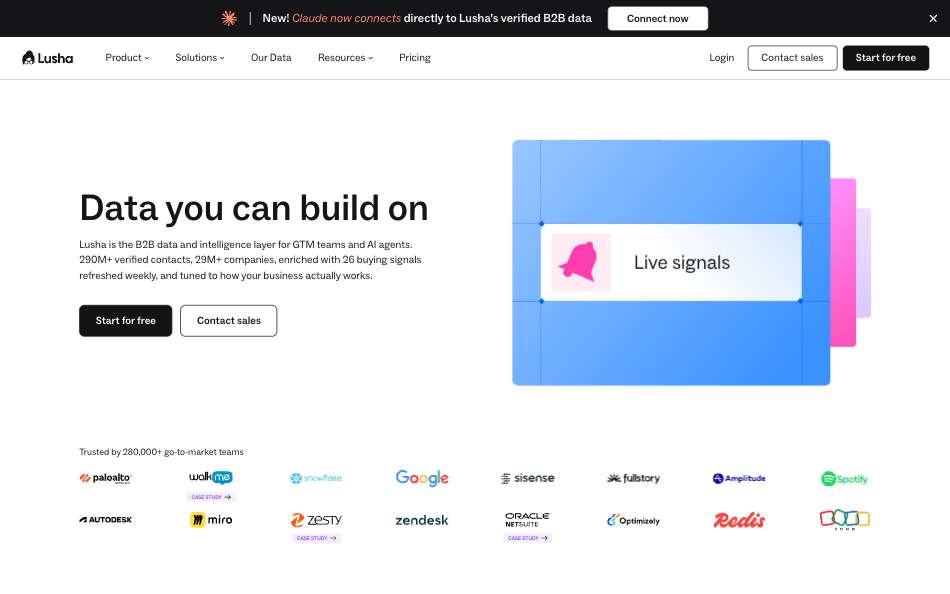
Lusha sells contact emails and phones through its web platform and a browser extension, priced in credits. It fits a rep who looks up contacts one at a time.
The API is real, and every plan gets a key. An email costs 1 credit and a phone number 5. A single API request for email plus phone is up to 7 credits (Lusha API guide, September 2026). A bulk request adds 1 credit per 25 results.
Volume is the limit. The top public tier holds 10,000 credits a month, and 1M lookups would be about 104 times that. Scale is custom through sales.
Pros
- Free plan and a low entry price.
- Credits roll over up to 2x on Pro and Premium billed monthly.
- Hosted MCP server with 50 tools.
- Data Waterfall charges only on a successful match.
Cons
- Small credit pools: Starter has 400 a month.
- Phone numbers cost 5 credits.
- Free and Starter API limits are 40 requests a minute and 100 a day.
- Docs disagree on whether a no-match request is charged.
Best for: individual reps and small teams who work from the browser. Pricing: Free; Starter $49.90, Pro $69.90, Premium $399.90 a month, billed monthly (Lusha pricing, September 2026). No public 1M price.
7. Prospeo: best for verified emails at mid volume
Prospeo focuses on verified emails and mobiles, and it publishes a clear price table. One credit buys a verified email, 10 credits a mobile with the email included, and a lookup that finds nothing is free.
Credits are pooled per seat. Add-on credits are a recurring subscription, need a paid plan and do not roll over (Prospeo help center, September 2026). That makes 1M a month a stack of seats plus the largest add-on.
The hosted MCP server has 8 tools. On Pro, the enrich API runs at 30 requests a second.
Pros
- Plain price table with per-credit rates.
- No charge for a no-result lookup or a repeat enrich inside 90 days.
- Hosted MCP server, OAuth or API key.
- The cheapest public 1M path of the per-seat tools here.
Cons
- Credits and add-ons expire each cycle.
- A mobile costs 10 credits.
- Add-on slider tops out at 350,000 credits a month.
- First-party pages disagree on API access for the Free plan.
Best for: teams that want verified emails and can live with seats. Pricing: Free; Starter $49, Growth $99, Pro $249 a user a month, billed monthly (Prospeo pricing, September 2026). At 1M: 44 Pro seats plus the 350,000-credit add-on, $14,456 a month, or $11,223 once billed yearly.
Comparison table
| Tool | Best for | Starting price | Cost at 1M records a month | API | MCP | Rate limit |
|---|---|---|---|---|---|---|
| LeadOcean | API, agents, volume | Free; Solo $97 a month | $497 a month | REST, every plan | Yes, 13 tools | 5, 50, 200, 10,000 a second by plan |
| Apollo | Find and send | Free; Basic $65 a seat | $24,750 a month | Every plan | Yes | 1,000 enrich calls a minute on paid plans |
| Clay | Workflow tables | Free; Launch $185 a month | No public 1M price | Every plan | Yes | No published number |
| Seamless.AI | Quote-based buying | Free license; no paid price | No public 1M price | Bundled with plans | Yes, 57 tools | 60 a minute per endpoint, per org |
| ZoomInfo (GTM AI) | Pay as you go | From $20 | No public 1M price | Yes | Yes | 5 to 35 a second by package |
| Lusha | Small teams | Free; Starter $49.90 a month | No public 1M price | Every plan | Yes, 50 tools | 300 a minute on Premium |
| Prospeo | Verified emails | Free; Starter $49 a month | $14,456 a month | Paid plans (Free is disputed) | Yes, 8 tools | 30 a second on Pro (enrich) |
How to choose
- You want find and send in one tool: Apollo. Reps get data, sequences and a dialer under one login.
- You build enrichment workflows without code: Clay. Plan for two meters and a hard ceiling below 1M.
- An agent or a script refills the list: LeadOcean. Count first for free, then pull on a flat plan.
- You need 1M records a month and want a price today: LeadOcean at $497 a month, or Prospeo at $14,456 and Apollo at $24,750. The rest have no public 1M price.
- You look up contacts one at a time in a browser: Lusha.
- You are already a ZoomInfo shop: use GTM AI to buy data credits without a contract.
- You buy through procurement: Seamless.AI, once you have a quote.
For the next step after the list is built, see predictive lead generation and our pricing.
Verdict
LeadOcean wins for anyone who pulls data through an API, an agent or at volume, because $497 a month covers what costs five figures per seat or per credit elsewhere. Apollo wins for reps who want to find and send from one screen, Clay for operators who build workflows in tables, and Prospeo for verified emails at mid volume. Lusha fits a single rep in a browser. Seamless.AI and ZoomInfo fit buyers who accept a quote or a credit meter. If the sequencer matters more than the data, pick Apollo and pair it with a flat data source.
FAQ
What is auto lead generation software?
It is software that finds, enriches and refreshes lead lists on a schedule or through an API, so nobody pulls a CSV by hand. Some tools also send the outreach. Others only supply the data and leave sending to another tool.
Which tool is cheapest at 1M records a month?
LeadOcean at $497 a month on Agency, from its pricing page. Prospeo is $14,456 a month on its cheapest public path, and Apollo is $24,750 at list on monthly billing. Clay, Seamless.AI, ZoomInfo and Lusha publish no 1M price.
Do I need a sequencer as well?
Only if the tool does not send. Apollo includes sequences. LeadOcean is data only, so you export to the sequencer you already use or let an agent call it over MCP.
Can an AI agent run these tools?
Yes. All seven run a hosted MCP server, so Claude or ChatGPT can search and enrich directly. LeadOcean's is at https://api.leadocean.io/mcp with 13 tools.
Is a free plan enough to test one?
For a small test, yes. LeadOcean's Free plan gives 1,000 records for life with no card. Apollo, Clay, Lusha and Prospeo also have free plans, with smaller monthly allowances.
How accurate is the data?
We did not run an accuracy test for this page, so we make no find-rate claim. Test two or three tools on the same 200 contacts before you commit.
Automate your lead list on one flat price
Free to start. No credit card. 1,000 records to spend whenever you like.
Get your free API key →