A lead generation web tool is software you open in a browser or call by API to find the people and companies you want to sell to, and to get their contact details. Sales teams use them to build prospect lists. Developers and RevOps teams use them to feed a CRM, a pipeline or an AI agent.
The tools split by how you pay. Most sell seats and credits. Hunter sells credit packs. ZoomInfo's GTM AI sells data credits. LeadOcean sells a flat monthly price with a fair-use pace. At 10,000 records the gap is small. At 1,000,000 a month, the published prices differ by a factor of 14 to 50.
This list ranks six tools and prices each at 1M records a month from first-party pages. If you are leaving one of them, we also wrote Apollo, Hunter, Clay, Lusha and ZoomInfo alternatives pages.
TL;DR
| Tool | Best for | Starting price | Cost at 1M records a month |
|---|---|---|---|
| LeadOcean | API, agent and volume pulls | Free, then $97 a month | $497 a month (Agency, fair use) |
| Apollo | Sales teams that want data plus sequences | Free, then $65 per seat a month ($49 billed yearly) | $24,750 a month monthly billing, $19,600 billed yearly |
| Hunter | Finding emails by domain | Free, then $49 a month ($34 billed yearly) | $6,900 one purchase (Data Platform) |
| Clay | Building enrichment workflows | Free, then $185 a month ($167 billed yearly) | No public 1M price |
| Lusha | Individual reps who need phones | Free, then $49.90 a month ($37.45 billed yearly) | No public 1M price |
| ZoomInfo | Enterprise teams with a contract | GTM AI data credits from $20 pay as you go | No public 1M price |
Prices are list prices, monthly billing first, checked September 2026. Sources are under each tool.
What we evaluated
- Data you can filter on. Title, seniority, industry, headcount and location, before you spend a credit.
- API and MCP. Can code and an AI agent pull leads without a person clicking.
- Rate limits. Requests per second or minute, and what happens when you hit them.
- Price model. Seats, credits or flat. Whether a miss costs anything.
- Cost at 1M records a month. From list prices only. If a vendor publishes no 1M price, we say so and do not multiply a rate out.
1. LeadOcean: best for API, agent and volume pulls
LeadOcean is a people and company data API with a hosted MCP server. The dataset holds 693M people and 67M companies, with 366M people carrying an email and 166M a phone (LeadOcean, measured October 2026). You search with 50 people filters and 34 company filters, then enrich by LinkedIn URL, email, phone or person ID.
We ran a count to show the sizing step. On 2026-10-21, leadocean_count_leads for VPs in Sales & Business Development in the US returned 129,494 people with a verified, catch_all_valid or catch_all email. Without the email condition the same filters match 350,517. Counts are free, so you size a list before you pay for it.
It is not a rep workspace. There are no sequences, dialer or CRM. The app has an Exports page with a filter builder, price preview and CSV download, and the rest is API and MCP.
Pros
- Flat price: Agency is $497 a month with 1M enrichments a day and 25M search records a month.
- 13 MCP tools. Counts, filter lists and account checks cost nothing.
- Free plan keeps 1,000 records for life with every feature, no card.
- Searches page to 10,000 rows and flag it with
meta.depthCapped.
Cons
- No sequencer, dialer, CRM or Chrome extension.
- Free does not include bulk CSV export.
- Fewer household-name integrations than Apollo or ZoomInfo.
Best for: developers, RevOps and agent builders who pull data by API or MCP at volume.
Pricing: Free $0, Solo $97, Agency $497, Platform $1,997 a month. Rate limit is 5, 50, 200 and 10,000 requests a second by plan. (LeadOcean pricing, October 2026)
2. Apollo: best for sales teams that want data and outreach in one seat
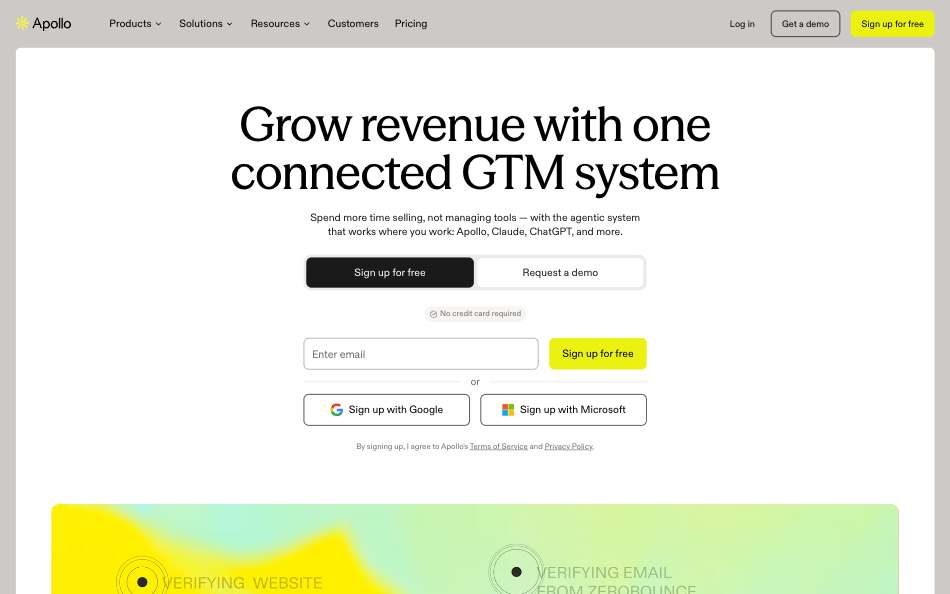
Apollo pairs a lead database with email sequencing and a dialer, sold per seat. A rep logs in, filters a list, and sends from the same place. For a team of five that closes deals from a UI, that is the shortest path.
The API is on every plan, Free included. Enrichment endpoints allow 1,000 requests a minute on paid plans (Apollo rate limits, September 2026). Apollo also runs an official MCP server at mcp.apollo.io on any plan (Apollo MCP, September 2026).
Credits are the catch. An email is 1 credit, a phone is 8, and credits expire at the end of each cycle (Apollo API pricing, September 2026). Professional gives 4,000 credits per seat a month, so 1M email lookups means 250 seats.
Pros
- Data, sequences and dialer in one tool.
- API and MCP on every plan, Free included.
- Free plan to test the data.
Cons
- Per-seat credits make volume expensive: $24,750 a month at 1M emails on monthly billing.
- Phones cost 8 credits each.
- Unused credits expire each cycle.
- The price of extra credits is not public.
Best for: sales teams that prospect and send from one UI.
Pricing: Free $0; Basic $65, Professional $99, Organization $149 per seat a month; yearly $49, $79, $119. (Apollo pricing, September 2026)
3. Hunter: best for finding emails by domain
Hunter is an email finder. You give it a domain, or a name and a domain, and it returns addresses with a confidence score. It also verifies emails, at half a credit each, and runs cold email campaigns.
Among the competitors here, it has the lowest published price per record at volume. Data Platform sells 1,000,000 Search credits for $6,900 as a one-off purchase valid 12 months (Hunter Data Platform, September 2026). That is API and bulk only.
The limit is the lookup shape. Core calls start from a domain, so building a list by title and seniority across a market takes many calls. Rate limits are per endpoint: 15 requests a second on Domain Search and Email Finder (Hunter API docs, September 2026).
Pros
- Clear 1M price: $6,900 one purchase.
- No credit charged when nothing is found.
- Official MCP server, included on all plans (Hunter MCP, September 2026).
- Bulk Email Finder takes up to 50,000 rows a file.
Cons
- Domain-first lookups, not market-wide list building.
- Email only. No phone numbers in the core product.
- A rate-limited call returns 403, and a spent quota returns 429.
- Monthly plans top out at 25,000 credits.
Best for: teams that already know the target domains and need emails.
Pricing: Free $0; Starter $49, Growth $149, Scale $299 a month; yearly $34, $104, $209. (Hunter pricing, September 2026)
4. Clay: best for building enrichment workflows
Clay is a spreadsheet-style workflow builder that calls many data providers in sequence, called waterfalls. You build a table, add columns that look up emails or company data, and let it run. It is the tool for people who want to design the process.
Its own docs say a fully enriched record typically costs 6 to 20 Data Credits, plus one Action per enrichment (Clay docs, September 2026). An enrichment that returns nothing costs nothing. The public API is on every plan, with search volume capped by plan (Clay API docs, September 2026). Clay also runs an MCP server that works in ChatGPT, Claude and Codex (Clay MCP guide, October 2026).
Clay is not built for a million records a month. The largest self-serve tier is 200,000 Actions and 50,000 Data Credits a month. Above that you talk to sales.
Pros
- Waterfalls across providers in one table.
- Free plan and a 14-day trial with 1,000 Data Credits.
- Public API on every plan.
- No charge when an enrichment finds nothing.
Cons
- Two meters, Actions and Data Credits, make cost hard to predict.
- Tables cap at 50,000 rows on Launch and Growth.
- No public price at 1M records.
- HTTP API columns need Growth or above.
Best for: GTM engineers who want to design multi-step enrichment.
Pricing: Free $0; Launch from $185 a month ($167 billed yearly); Growth from $495 ($446 billed yearly). (Clay pricing, September 2026)
5. Lusha: best for individual reps who need phone numbers
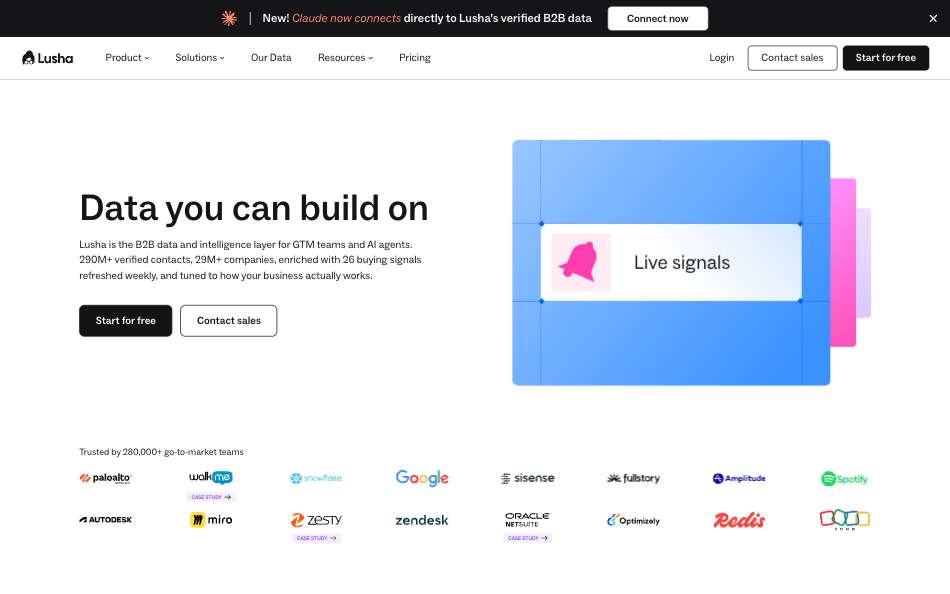
Lusha is a browser extension and web app for finding a contact's email and phone while you look at their profile. It is built for one rep working through a list by hand, with a small plan and a low barrier to start.
A phone costs 5 credits and an email 1. A single API request for both runs up to 7 credits (Lusha API guide, September 2026). The MCP server exposes 50 tools and shares the REST credit pool (Lusha MCP, September 2026).
Volume is the weak spot. The highest public tier is Premium at 10,000 credits a month, $977.40 billed monthly. Scale is custom.
Pros
- Phone numbers are a core strength.
- Free plan with 40 credits a month, no card.
- API key on every plan and an MCP server with 50 tools.
Cons
- Credit totals are small: 10,000 a month at the top public tier.
- Rate limits are tight on lower plans: 40 requests a minute on Free and Starter.
- No public price at 1M records.
- Docs disagree on whether a no-match request is charged.
Best for: a single rep or small team that needs direct dials.
Pricing: Free $0; Starter $49.90, Pro $69.90, Premium $399.90 a month; yearly $37.45, $52.45, $299.95. (Lusha pricing, September 2026)
6. ZoomInfo: best for enterprise teams with a contract
ZoomInfo is the incumbent enterprise database. Its platform plans are sold through sales, and zoominfo.com/pricing blocked our fetch in September 2026, so we cannot quote platform prices. The self-serve route is GTM AI, which sells data credits pay as you go.
GTM AI lists $0.45 a credit for 100 credits, falling to $0.29 at 30,000 to 50,000 credits (GTM AI pricing, September 2026). One credit enriches one company, contact or intent record, charged once per 12 months. Search is free. Credits above 100,000 are Enterprise.
The free tier gives 1,000 data credits, 5 requests a second and MCP access. ZoomInfo's MCP server needs a GTM AI account or an existing subscription (ZoomInfo MCP, September 2026).
Pros
- Large database and intent data.
- Free search on GTM AI.
- A record is charged once per 12 months.
- Free tier with 1,000 data credits and no card.
Cons
- No public price at 1M records.
- Batch enrichment is capped at 25 records a call.
- Platform pricing is not public.
- Rate limits depend on the package: 5, 25 or 35 requests a second.
Best for: enterprise teams that already have a ZoomInfo contract.
Pricing: GTM AI data credits from $20, no contract. (GTM AI pricing, September 2026)
Comparison table
| Tool | Best for | Starting price | Cost at 1M records a month | API | MCP | Rate limit |
|---|---|---|---|---|---|---|
| LeadOcean | API, agent and volume | Free, then $97 a month | $497 a month (Agency) | Yes, every plan | Yes, 13 tools | 5, 50, 200, 10,000 a second by plan |
| Apollo | Seats with outreach | $65 per seat a month | $24,750 a month monthly billing | Yes, every plan | Yes | 1,000 a minute on enrichment, paid |
| Hunter | Emails by domain | $49 a month | $6,900 one purchase | Yes | Yes | 15 a second per endpoint |
| Clay | Enrichment workflows | $185 a month | No public 1M price | Yes, every plan | Yes | Not published |
| Lusha | Reps who need phones | $49.90 a month | No public 1M price | Yes, every plan | Yes, 50 tools | 40 a minute Free and Starter; 300 a minute Premium |
| ZoomInfo | Enterprise contracts | GTM AI from $20 | No public 1M price | Yes | Yes | 5, 25 or 35 a second by package |
How to choose
- You pull data by API or through an agent. LeadOcean. Flat price, free counts, 13 MCP tools.
- Your reps need data and sequences in one login. Apollo.
- You have the domains and need emails. Hunter.
- You want to design a multi-provider workflow. Clay.
- One rep needs phone numbers by hand. Lusha.
- You buy enterprise software on contracts. ZoomInfo.
- You are testing. Start on a free plan. All six have one.
For the strategy around these tools, see our glossary on the lead generation funnel, outbound lead generation and predictive lead generation. Plans are on /pricing.
Verdict
LeadOcean wins for anyone who pulls data by API, through an agent or at volume, because $497 a month is the only public 1M figure that stays flat and under $1,000. Apollo wins for teams that want data and outreach in one seat. Hunter wins when you have domains and want the cheapest published 1M email price. Clay wins for workflow design, Lusha for single reps who need phones, and ZoomInfo for companies that already hold a contract.
FAQ
What is the best lead generation web tool?
It depends on how you work. For API, agent or volume use, LeadOcean. For a sales team that sends from one login, Apollo.
Which tool is cheapest at 1M records a month?
Of the six, LeadOcean at $497 a month on Agency (fair use) and Hunter at $6,900 one-off are the only two with a public 1M figure under $25,000. Clay, Lusha and ZoomInfo publish no 1M price.
Do these tools have an API?
Yes. All six have one. Apollo, Clay and Lusha put API access on every plan. LeadOcean does too, including Free.
Which have an MCP server?
All six do: LeadOcean (13 tools), Apollo, Hunter, Clay, Lusha (50 tools) and ZoomInfo.
Can I try them free?
Yes. LeadOcean Free gives 1,000 records for life with no card. Apollo, Hunter, Clay, Lusha and ZoomInfo's GTM AI each have a free tier at smaller or different limits.
How accurate are the prices here?
They are list prices from each vendor's pricing page in September 2026, and LeadOcean's from October 2026. Check the linked page before you buy, since vendors change plans often.
Size your lead list for free, then pull it by API
Free to start. No credit card. 1,000 records to spend whenever you like.
Get your free API key →