A phone number finder takes a name, a LinkedIn URL or an email and returns a direct dial or mobile number for a B2B contact. Developers need one when a product, a script or an agent has to fetch that number without a human opening a browser tab.
Developers leave phone tools for four reasons. The rate limit is too low, a mobile costs 5 to 10 credits, the API sits behind a sales call, or seat-based plans make no sense for a script. We read the published pricing, API and MCP docs of seven tools in September 2026. We did not run a hit-rate test, so no tool below has a find rate we measured.
For one-to-one comparisons, read the alternatives pages for FullEnrich, People Data Labs, Crustdata, Prospeo, Lusha and RocketReach. The general ranking is in best phone number finder tools.
TL;DR
| Tool | Best for | Starting price | Cost at 1M records a month |
|---|---|---|---|
| LeadOcean | Phone lookups from code or an agent at volume | Free, then Solo $97 a month | Agency $497 a month, phones included |
| FullEnrich | Waterfall lookups where a miss is free | $29 a month ($26 billed yearly) | No public 1M price |
| People Data Labs | Raw person data with a fast enrich API | $98 a month for 350 credits ($78 billed yearly) | No public 1M price |
| Crustdata | Enrichment with signals and a hosted MCP | No public dollar price | No public 1M price |
| Prospeo | Per-seat plans with a clean credit table | $49 a month ($37 billed yearly) | No single tier reaches 1M |
| Lusha | A team that wants an extension and an API | $49.90 a month ($37.45 billed yearly) | No public 1M price |
| RocketReach | A published credit table per action | $69 a month (reported) | No public 1M price |
What we evaluated
- API access. Whether a key exists on the cheap plans, which input it takes (LinkedIn URL, email, name or ID) and whether bulk calls exist.
- Rate limits. Requests per second or per minute. They set how fast a phone batch can run, and developers hit them first.
- MCP. Whether an agent can call the tool, how many tools the server exposes and how it signs in.
- Price model. What a mobile costs, whether a miss is charged, and whether credits expire or seats multiply the bill.
- Volume. What 1M records a month would cost, using only published prices. If a vendor publishes none, we say so.
1. LeadOcean: best for phone lookups from code or an agent
LeadOcean is a data API and a hosted MCP server. It holds 693M people, and 166M of them have a phone number. You call GET /v2/people/phone or the find_phone tool over MCP and get the number back (LeadOcean pricing, October 2026).
The price model is a flat monthly fee. Phones, bulk CSV export and every endpoint are on the paid plans, with no per-phone credit. Free is 1,000 records for life with no card at 5 requests a second. Solo is $97 a month at 50 requests a second. Agency is $497 a month at 200 requests a second with 5 keys. Platform is $1,997 a month at 10,000 requests a second.
The MCP server has 13 tools and signs in with OAuth 2.1, so no key is pasted into a client (LeadOcean MCP docs, October 2026). leadocean_count_leads is free, so an agent can size a list before it spends a record. LeadOcean is not a rep tool. The app at app.leadocean.io has an Exports page, API keys and usage, but no dialer, sequencer, CRM or Chrome extension.
Pros
- Phones are included on Solo and Agency, with no credit table to model.
- Rate limits run from 5 to 10,000 requests a second, set by plan.
- 13 MCP tools over OAuth, including
find_phone. - A free count shows how many people match before you spend a record.
Cons
- A v2 contact call that finds nothing still costs one record.
- No browser extension, dialer or CRM for reps.
- Bulk CSV export is not on Free.
Best for: developers, agent builders and RevOps teams that pull phones in code or at volume.
Pricing: Free $0, Solo $97, Agency $497, Platform $1,997 a month (LeadOcean pricing, October 2026).
2. FullEnrich: best for waterfall lookups with free misses
FullEnrich runs one lookup across 25+ data sources and returns the first match it can verify. API, MCP, search and bulk CSV are on every plan, including the free trial of 50 credits (FullEnrich pricing, September 2026).
A mobile costs 10 credits. A work email costs 1 and a personal email 3. A lookup that finds nothing, or returns a landline, costs 0 (FullEnrich credit docs, September 2026). For a script that fires at many contacts with unknown coverage, a free miss matters.
The ceiling is the rate limit. The API allows 60 calls a minute across Enrich, Reverse Email and Search, with up to 100 contacts per bulk request (FullEnrich volume docs, September 2026). Bulk requests are how you get past it.
Pros
- No charge when a lookup finds nothing.
- API and MCP on every plan, including the free trial.
- Up to 100 contacts per bulk request.
Cons
- At 10 credits a mobile, the $29 plan (500 credits) buys 50 mobiles a month.
- 60 API calls a minute is slow without bulk requests.
- Monthly tiers stop at 100,000 credits ($3,500), then it is sales. That is 10,000 mobiles.
Best for: teams that want one call to try many sources and pay only for a match.
Pricing: Pro starts at $29 a month for 500 credits, $26 a month billed yearly (FullEnrich pricing, September 2026).
3. People Data Labs: best for raw person data and a fast enrich API
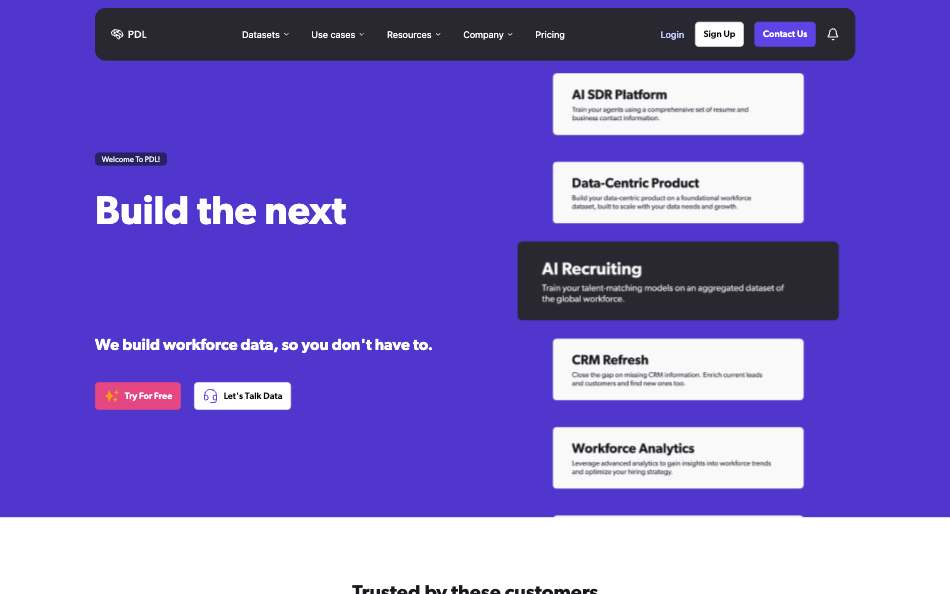
People Data Labs sells person data by API. Its own dataset pages count 470,338,967 profiles with a mobile phone and 763,983,403 with any phone (PDL datasets, September 2026). That is the largest phone dataset on this list by its own count.
One credit is used per successful match, and a 404 is not billed. Bulk enrichment takes up to 100 persons per request (PDL docs, September 2026). Person Enrichment allows 100 requests a minute on Free and 1,000 a minute on paying plans, while Person Search allows only 10 a minute (PDL usage limits, September 2026).
PDL has no official MCP server in its docs, llms.txt or GitHub organization. Only community servers exist (PDL llms.txt, September 2026). Free gives 100 credits a month with contact data obscured, so you cannot test the phone data before you pay (PDL pricing, September 2026).
Pros
- Fast enrich API: 1,000 requests a minute on paid plans.
- A 404 costs nothing.
- Large published phone datasets.
Cons
- No official MCP server.
- Free hides contact data, so you buy before you can test.
- Self-serve is meant for under roughly 100,000 person profiles. Above that PDL quotes Enterprise.
Best for: engineers who build a data product on top of raw person records and call the enrich API at low volume.
Pricing: Pro starts at $98 a month for 350 credits, $78 a month billed yearly. Enterprise is custom (PDL pricing, September 2026).
4. Crustdata: best for enrichment with signals and a hosted MCP
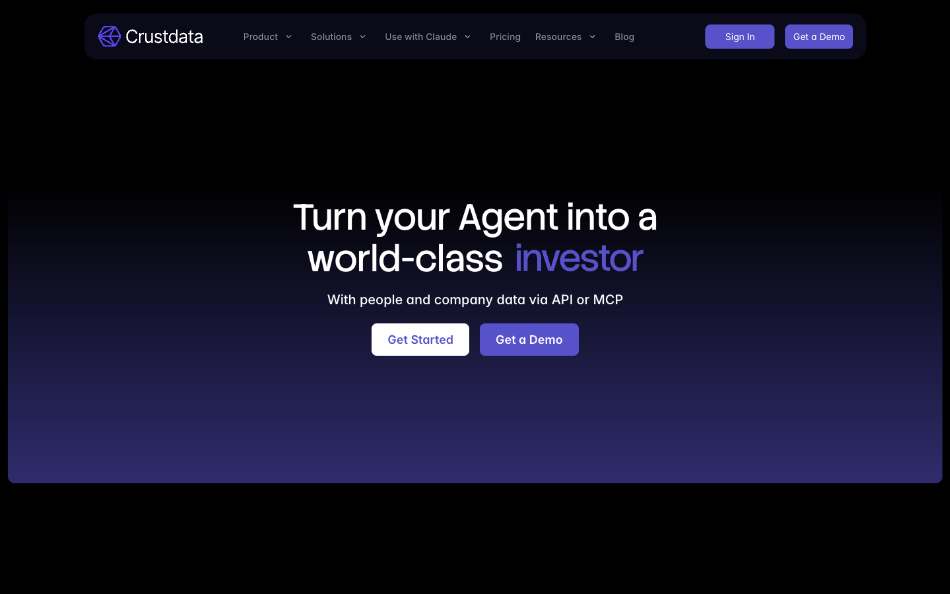
Crustdata sells credits, not plans you can read. Its pricing page lists no plan names and no dollar price per credit. The docs give credits per call and say the dollar value depends on your plan (Crustdata pricing, September 2026; Crustdata docs, September 2026).
Person enrich costs 1 credit for the base profile, plus 2 for a phone. A phone lookup through /person/enrich is therefore 3 credits. The dedicated contact endpoint is cheaper at 2 credits for a phone but needs an enterprise plan, and self-serve keys get a 403 (Crustdata contact docs, September 2026).
The hosted MCP server takes OAuth for interactive clients and an API key as a bearer token for code (Crustdata MCP docs, September 2026). Default rate limits are the tight part: 15 requests a minute on person enrich and 5 on batch contact enrich (Crustdata rate limits, September 2026). A batch person enrich takes up to 10,000 identifiers a job.
Pros
- A hosted MCP server with OAuth and bearer-token modes.
- Batch person enrich takes up to 10,000 identifiers a job.
- Misses on the contact endpoint are not billed.
Cons
- No public dollar price. A lowest tier of $95 a month appears only in a Crustdata blog post (Crustdata blog, September 2026).
- 15 requests a minute on person enrich.
- The cheaper phone endpoint is enterprise only.
Best for: teams that already buy Crustdata for company and people signals and want phones in the same API.
Pricing: No public dollar price. Phone is +2 credits on enrich (Crustdata docs, September 2026).
5. Prospeo: best for a clean credit table and an 8-tool MCP
Prospeo sells per-seat plans with one shared credit pool. A mobile costs 10 credits and includes the email. A lookup with no result costs 0, and re-enriching a record within 90 days costs 0 (Prospeo credits, September 2026).
Starter is $49 a month for 2,000 credits, which is 200 mobiles. Growth is $99 for 5,000 and Pro is $249 for 15,000. Enrich limits are 5 requests a second on Starter and Growth and 30 on Pro, with a daily cap of 2,000 on Starter (Prospeo rate limits, September 2026).
The hosted MCP server has 8 tools and takes OAuth or an API key (Prospeo MCP docs, September 2026). Credits expire at the end of each cycle. At 10 credits a mobile, 1M mobiles is 10,000,000 credits, far above the 350,000 monthly add-on the pricing page offers.
Pros
- Misses and repeat lookups within 90 days cost nothing.
- 30 enrich requests a second on Pro.
- An 8-tool hosted MCP server.
Cons
- 10 credits per mobile keeps the cheap plans to a few hundred phones.
- Credits expire at the end of the cycle.
- Seats multiply the bill, which suits a team more than a script.
Best for: small teams that want a readable credit table and per-seat billing.
Pricing: Starter $49 a month ($37 billed yearly), Growth $99 ($74), Pro $249 ($187) (Prospeo pricing, September 2026).
6. Lusha: best for a team that wants an extension and an API
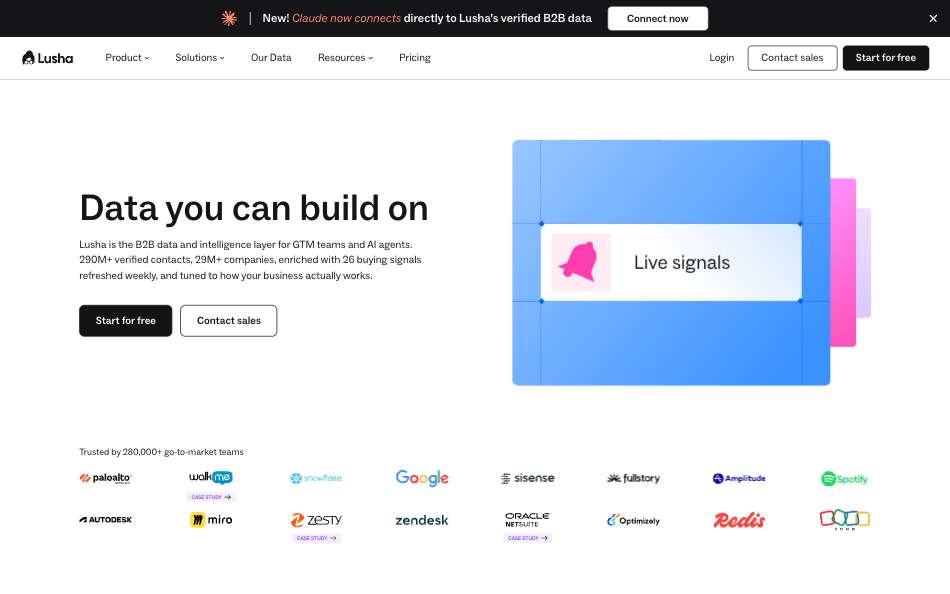
Lusha sells credits per user and puts a browser extension in front of most of them. A phone costs 5 credits and an email 1. Email plus phone is 7 credits through a single API request (Lusha API guide, September 2026).
Every plan has an API key, including Free with 40 credits a month. Starter is $49.90 a month for 400 credits, about 80 phones. Free and Starter cap the API at 100 requests a day, and Premium allows 300 a minute and 18,000 a day. The MCP server has 50 tools and draws on the same credit pool as the REST API (Lusha MCP tools, September 2026).
Lusha's own docs disagree on whether an API request with no match is charged. The API guide says a 1-credit minimum, and the billing FAQ says no charge (Lusha billing FAQ, September 2026). Test it on your key before you run a batch.
Pros
- An API key on every plan, including Free.
- A 50-tool MCP server on the same credit pool.
- A browser extension for the non-developers on your team.
Cons
- 5 credits per phone makes the cheap plans small for phone work.
- 100 API requests a day on Free and Starter.
- The docs disagree on whether a miss is charged.
Best for: a mixed team where reps use the extension and an engineer calls the API.
Pricing: Starter $49.90 a month ($37.45 billed yearly), Pro $69.90 ($52.45), Premium $399.90 ($299.95). Scale is custom (Lusha pricing, September 2026).
7. RocketReach: best for a published credit table per action
RocketReach publishes what each action costs in Universal Credits. A phone is 6 credits, a professional email 2 and a personal email 3. Nothing is charged when no data is found, and re-lookups of the same profile are free while the plan is active (RocketReach credit docs, September 2026).
The global API limit is 10 requests a second. Monthly person lookup caps run from 5,000 on Essentials to 20,000 on Pro and 50,000 on Ultimate (RocketReach rate limits, September 2026). The MCP server exposes 9 tools over OAuth 2.1 (RocketReach MCP docs, September 2026).
There is no public dollar price per credit or API plan price. Monthly plan prices of $69, $119 and $209 come from G2, because RocketReach's own pricing page showed a bot check on the day we looked (G2, September 2026).
Pros
- A clear credit table with a price per action.
- No charge for a miss and free re-lookups.
- A 9-tool MCP server over OAuth 2.1.
Cons
- No public dollar price per credit or for the API.
- Plan prices are reported by G2, not read first-party.
- Monthly lookup caps are low for volume work.
Best for: teams that want to estimate credit use from a published table.
Pricing: Essentials $69, Pro $119, Ultimate $209 a month on monthly billing, as reported by G2 (G2, September 2026).
Comparison table
| Tool | Best for | Starting price | Cost at 1M records a month | API | MCP | Rate limit |
|---|---|---|---|---|---|---|
| LeadOcean | Code and agent volume | Free, Solo $97 a month | Agency $497 a month | Yes, every plan | 13 tools | 5, 50, 200 or 10,000 a second by plan |
| FullEnrich | Free misses | $29 a month | No public 1M price | Yes, every plan | Yes, every plan | 60 calls a minute |
| People Data Labs | Raw person data | $98 a month | No public 1M price | Yes | Community only | 1,000 a minute enrich on paid plans |
| Crustdata | Signals plus phones | No public dollar price | No public 1M price | Yes | Hosted, OAuth or key | 15 a minute person enrich |
| Prospeo | Credit table | $49 a month | No single tier reaches 1M | Yes | 8 tools | 5 a second Starter, 30 Pro |
| Lusha | Extension plus API | $49.90 a month | No public 1M price | Yes, every plan | 50 tools | Varies by plan, Premium 300 a minute |
| RocketReach | Credit table | $69 a month (reported) | No public 1M price | Paid plans | 9 tools | 10 a second |
How to choose
- You call phones from code or an agent at volume: LeadOcean. Phones are included and the limit runs to 200 requests a second on Agency. Size the list first with the free count.
- Your batch has unknown coverage and you hate paying for misses: FullEnrich or Prospeo. Both charge 0 for a miss.
- You build a data product on raw person records: People Data Labs, at low volume.
- You already buy company signals: Crustdata, if you accept the 15 requests a minute and a quote.
- You have a mixed team of reps and engineers: Lusha.
- You want to try a phone lookup first: use the free phone number finder.
- You are a startup with a small budget: see the startup list.
Verdict
LeadOcean wins for the developer who pulls phones in code or with an agent. Phones are flat-priced and the API runs at 200 requests a second on Agency. FullEnrich wins when you want a waterfall and a free miss. People Data Labs wins for a data product built on raw records at low volume. Crustdata suits a team that already buys its signals, Prospeo a small team on per-seat plans, Lusha a mixed team, and RocketReach a buyer who wants a credit table. Check LeadOcean pricing against your monthly volume.
FAQ
What is a phone number finder API?
It is an endpoint that takes a name, LinkedIn URL or email and returns a direct dial or mobile number for a B2B contact. LeadOcean's is GET /v2/people/phone. Most vendors meter phones separately from emails.
Which phone number finder API has the highest rate limit?
LeadOcean allows 5, 50, 200 or 10,000 requests a second by plan. PDL allows 1,000 enrich requests a minute on paying plans. FullEnrich allows 60 a minute, and Crustdata 15 a minute on person enrich.
Which tools charge for a miss?
FullEnrich, Prospeo, RocketReach and PDL do not charge when nothing is found. LeadOcean's v2 contact endpoints cost one record even on a miss. Lusha's docs disagree, so test it.
Can an AI agent look up phones?
Yes. LeadOcean (13 tools), Lusha (50), RocketReach (9), Prospeo (8) and Crustdata publish MCP servers, and FullEnrich lists MCP on every plan. PDL has none from the vendor.
How accurate are the phone numbers?
We did not run a hit-rate test, so we publish no find rate for any tool. Run 100 of your own contacts through the free plans before you buy.
Is there a free way to test a phone lookup?
Yes. LeadOcean's free plan gives 1,000 records for life with no card and the same API as paid plans. There is also a free phone number finder tool.
Pull phone numbers from your own code, with phones included
Free to start. No credit card. 1,000 records to spend whenever you like.
Get your free API key →