Developers leave Ocean.io's API over three limits. Self-serve accounts get 60 requests a minute and 1,000 a day (Ocean.io docs, September 2026). One credit pool meters every call: search 0.2 credits a result, an email found 1, a phone found 10 (Ocean.io docs, September 2026). Emails and phones arrive by webhook, so you need a public endpoint.
The MCP server takes the token in the URL and spends credits at the REST rate (Ocean.io docs, September 2026). Ocean.io is still the tool for lookalike search. This page ranks seven alternatives for the data-pull step.
For a two-column view, read LeadOcean vs Ocean.io. For app-first tools, see Ocean.io alternatives.
TL;DR
| Tool | Best for | Starting price | Cost at 1M records a month |
|---|---|---|---|
| LeadOcean | API, agent and volume buyers | Free (1,000 records, one-off). Pro $499 a month | $499 a month flat. Fair use applies |
| BlitzAPI | Flat-price people and company search by API | Core $399 a month. Plus $499 adds verified emails | $499 on Plus, inside the 15M monthly line for accounts opened by September 30, 2026 |
| Crustdata | Live company and people data for agents | No public price list | No public price per credit (Crustdata pricing, September 2026) |
| Explorium | Company signals and prospect data behind an API | Lite $29.99 for 500 credits | About $30,000 at $0.015 a credit |
| FullEnrich | Waterfall emails and mobiles behind an API | Pro from $29 a month for 500 credits | No public 1M price. Top public tier is 100,000 credits for $3,500 a month ($0.035 a credit) |
| People Data Labs | Person and company data licences | Pro from $98 a month for 350 credits | No public 1M price. Pro is about $0.20 to $0.28 a profile, and above about 100,000 profiles a year it is quote only (PDL pricing, September 2026) |
| Apollo | Reps who want a database and a sequencer | Basic $49 per seat a month, billed annually | About $19,600 a month on yearly billing (400 Basic seats at $49). $24,750 a month on monthly billing (250 Professional seats at $99) |
"1M records" here means 1M work-email lookups that return a result, one credit each where the vendor uses credits. Figures are list prices where a plan sells that volume, and the cell says so where none does. Enterprise quotes are lower, so ask each vendor at your volume.
What we evaluated
- Rate limit: the default requests allowed, and whether a large job waits on a contract.
- Auth and MCP: how a key is sent, and whether an agent can search and enrich through the server.
- Search and schema: filters, paging depth and how results are shaped.
- Bulk export: how many rows one request returns.
- Price model: flat, credits or seats, and what 1M records a month costs at list price.
We read each vendor's pricing page and docs in September 2026. We ran no find-rate or accuracy test for this page, so we quote no quality numbers.
1. LeadOcean: best for API, agent and volume buyers
LeadOcean is one dataset behind one REST API and one MCP server. It holds 693M people, 366M with an email and 166M with a phone number, plus 63M companies. You search with 50 people filters and 34 company filters. Counts are free.
Auth is one x-api-key header. The rate limit is 100 requests per second per key on every plan, against Ocean.io's 60 a minute. Enrichment is POST /v1/people/enrich, phones are GET /v2/people/phone, and POST /v1/exports returns up to 50,000 rows per request. Email comes back in the same response, with no webhook. Search pages hold 100 rows and stop at 10,000 rows per search.
Below is Ocean.io's people search for VP-level sales contacts at US companies (Ocean.io docs, September 2026). Its reveal call is asynchronous and needs a webhook (Ocean.io docs, September 2026). Under it is the same search on LeadOcean, then one enrichment call that returns the email.
curl -X POST "https://api.ocean.io/v3/search/people" \
  -H "X-Api-Token: $OCEAN_API_TOKEN" \
  -H "Content-Type: application/json" \
  -d '{"size":10,
       "peopleFilters":{"seniorities":["VP"],"departments":["Sales"]},
       "companiesFilters":{"primaryLocations":{"includeCountries":["us"]}}}'

curl -X POST "https://api.ocean.io/v2/reveal/emails" \
  -H "X-Api-Token: $OCEAN_API_TOKEN" \
  -H "Content-Type: application/json" \
-d '{"personIds":["abc123"],"webhookUrl":"https://yourapp.com/webhooks/ocean-emails"}'curl -G "https://api.leadocean.io/v1/people/search" \
-H "x-api-key: $LEADOCEAN_API_KEY" \
--data-urlencode "jobLevel=VP" \
--data-urlencode "jobFunction=Sales & Business Development" \
--data-urlencode "country=US" \
--data-urlencode "emailStatus=verified" \
--data-urlencode "emailType=work" \
--data-urlencode "limit=10"
curl -X POST "https://api.leadocean.io/v1/people/enrich" \
-H "x-api-key: $LEADOCEAN_API_KEY" \
-H "content-type: application/json" \
-d '{"linkedin_url":"https://www.linkedin.com/in/jane-doe","reveal_email":true}'The MCP server at https://api.leadocean.io/mcp signs in with OAuth 2.1 and exposes 12 tools, from search_leads to find_phone and export_leads. No key goes into a URL. Every person or company returned counts as one record, and count_leads is free.
Pros
- Flat $499 a month at any volume, with no credit meter.
- 100 requests per second per key, on the Free plan too.
- Email in the same response as the enrichment call. No webhook receiver.
- Free counts, and a miss on
POST /v1/people/enrichis a free 404. - OAuth 2.1 MCP server with 12 tools, and exports of 50,000 rows per request.
Cons
- No lookalike search. You describe your market with filters.
- Search pages hold 100 rows, where Ocean.io returns up to 10,000 per request.
- No workflow builder, sequencer or CRM. The app has an Exports page, and the rest is API and MCP.
Best for: engineers, RevOps and agents that need volume and a fixed bill.
Pricing: Free is 1,000 records, one-off, no card. Pro is $499 a month, flat (LeadOcean pricing, September 2026).
2. BlitzAPI: best for flat-price search and enrichment by API
BlitzAPI sells B2B data as an API on flat monthly plans. Its homepage lists people and company search, email and phone enrichment, jobs data and domain to LinkedIn matching, over 1B+ records (BlitzAPI, September 2026). It is the closest rival to LeadOcean on price model.
The plan ladder is where it gets fiddly. Core is $399 a month and leaves out emails and phones. Plus is $499 and adds verified work emails. Full is $599 and adds US phone numbers (BlitzAPI pricing, September 2026). Enriching for contact data means Plus or Full.
Check two details before you commit. The 50 requests per second and 15,000,000 monthly results are tied to accounts opened by September 30, 2026, against a standard 5 per second. Limits for later accounts are not published, and limits also apply per endpoint (BlitzAPI docs, September 2026). And its MCP server gives an assistant the API documentation, not the data (BlitzAPI docs, September 2026).
Pros
- Flat monthly price. The 15,000,000 results a month fair-use line is the launch-offer limit for accounts opened by September 30, 2026 (BlitzAPI terms, September 2026). Limits for later accounts are not published.
- Jobs data and identity resolution sit next to people and company search.
- A free trial of 1,000 credits with no card.
Cons
- Three paid tiers, and phones need the top one.
- Phone numbers are US only on Full.
- The MCP server reads docs. An agent cannot search or enrich through it.
- The fast rate limit depends on when the account opened.
Best for: teams that want a flat-price search and enrichment API and run their own code.
Pricing: Core $399, Plus $499, Full $599 a month (BlitzAPI pricing, September 2026).
3. Crustdata: best for live company and people data in agents
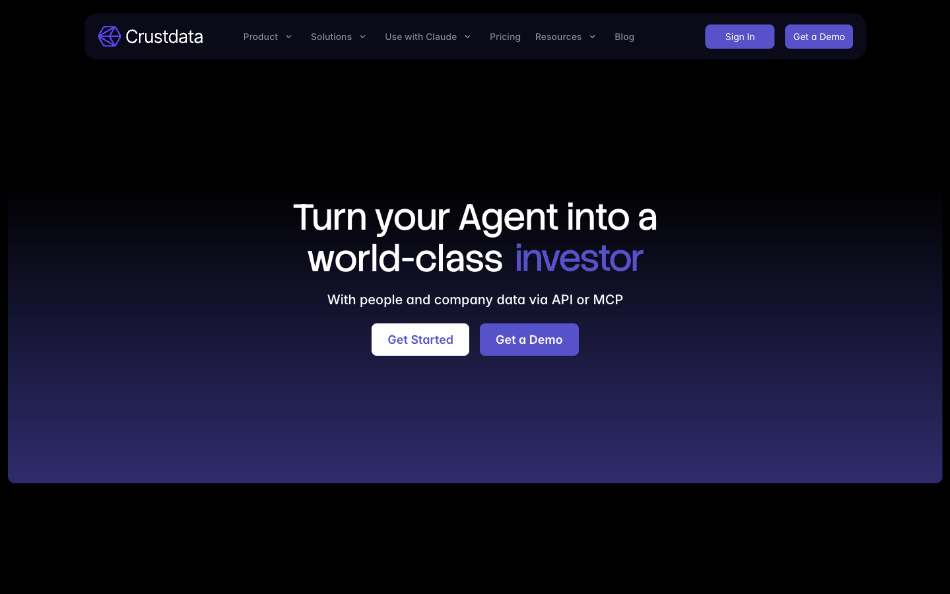
Crustdata sells real-time company and people data through APIs for search, enrichment, jobs, posts and watchers. It lists 1 billion+ people and describes its data as continuously re-verified (Crustdata, September 2026). It fits signal-driven work, such as hiring spikes and funding events, better than bulk list building.
Pricing is credit based and the public page shows no dollar price per credit (Crustdata pricing, September 2026). The docs list costs per call. Person search is 0.03 credits per result, person enrichment 1 to 7 credits, and contact enrichment 1 to 5.5 credits (Crustdata docs, September 2026). Purchased credits expire after 12 months.
Volume is the catch, and it is the same catch you have on Ocean.io. Standard search and enrich endpoints default to 15 to 30 requests a minute, and higher limits go through support (Crustdata docs, September 2026). At 30 a minute, one key makes about 1.3M single-record calls in 30 days. The MCP server at install.crustdata.com/mcp signs in with OAuth (Crustdata docs, September 2026).
Pros
- Live data and change watchers that a static database lacks.
- Cheap search at 0.03 credits per result, so you narrow before you enrich.
- OAuth MCP server that returns company, people and job data.
Cons
- No public price per credit, so you cannot price 1M records from the site.
- Default limits of 15 to 30 requests a minute on standard endpoints.
- Contact data costs more credits than a base profile.
Best for: AI SDR and signal workflows that need fresh data more than raw volume.
Pricing: Credit based, with no public price list. Per-call credit costs are in the docs (Crustdata docs, September 2026).
4. Explorium: best for company signals and prospect data behind an API
Explorium sells business and prospect data through AgentSource, an API and MCP server that run on prepaid credits. It claims 146M+ business entities and 767M+ professional profiles (Explorium, September 2026). Company breadth and event signals are its edge.
Credits are the meter. Lite is $29.99 for 500 credits, Growth $749.99 for 30K and Scale $7,499.99 for 500K, or $0.015 a credit. Credits are valid for 12 months and packages are non-refundable (Explorium pricing, September 2026). A contact lookup costs 2 credits for email only and 5 for phone (Explorium docs, September 2026).
The default limit is 200 queries per minute per key, and each row in a bulk request counts as a query (Explorium docs, September 2026). A 1M-row job takes about 3.5 days at that pace. The MCP server has 11 tools and uses an API key (Explorium docs, September 2026).
Pros
- Event and intent filters that a plain people database lacks.
- Hosted MCP server with 11 tools.
- 200 queries a minute is well above Ocean.io's self-serve 60 a minute.
Cons
- Credit packs expire after 12 months and do not refund.
- Email lookups cost 2 credits and phone lookups 5, so 1M emails is about $30,000 at the Scale rate.
- Bulk rows count one by one against the rate limit. More queries a minute is an Enterprise add-on.
Best for: teams that want company events and intent next to people data, and buy credits in packs.
Pricing: Lite $29.99, Starter $149.99, Growth $749.99, Scale $7,499.99, then Enterprise (Explorium pricing, September 2026).
5. FullEnrich: best for waterfall emails and mobiles behind an API
FullEnrich queries 25+ sources for each contact, and you pay only for data it finds (FullEnrich pricing, September 2026). Its pricing page lists API access, people and company search and an MCP server on Pro. It is a fit when Ocean.io's reveal step is your problem, since it covers emails and mobiles in one call.
Credits are the meter. A work email costs 1 credit, a personal email 3 and a mobile 10. Pro starts at $29 a month for 500 credits ($0.058 each), and the 1,000-credit tier is $55 ($0.055). The top public monthly tier is 100,000 credits for $3,500 ($0.035), and above that you contact sales. Search costs 0.25 credits per person returned (FullEnrich docs, September 2026). A mobile at the entry tier costs $0.58.
The API allows 60 calls a minute, with up to 100 contacts in a bulk request. Higher limits are an Enterprise feature (FullEnrich docs, September 2026). The MCP server can search, enrich and export, and it asks you before it spends credits (FullEnrich help, September 2026).
Pros
- Waterfall across 25+ sources, so one call can cover several vendors.
- Search, enrichment and export in the MCP server.
- Credits roll over for 3 months on monthly plans.
Cons
- Mobiles cost 10 credits each, the same as an Ocean.io phone.
- The default limit is 60 calls a minute, close to Ocean.io's.
- A credit meter at volume. There is no public price at 1M work emails, and the top public tier is $0.035 a credit.
Best for: teams that want waterfall contact data, mostly emails and mobiles, through an API or an agent.
Pricing: Pro $55 a month for 1,000 credits, Enterprise custom (FullEnrich pricing, September 2026).
6. People Data Labs: best for data licences and per-match enrichment
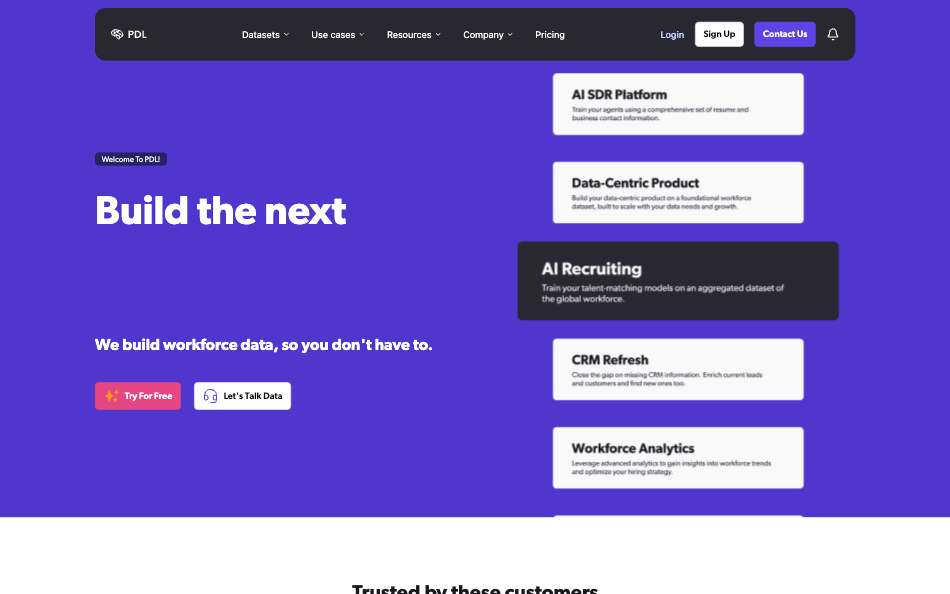
People Data Labs (PDL) is a long-running person and company data API with bulk licences. It is ISO and SOC 2 Type 2 compliant, which matters for procurement (PDL pricing, September 2026). It charges per match: a request that returns a person costs one credit, and a miss costs none.
The entry price is high per record. Pro starts at $98 a month for 350 credits, and PDL puts Pro at about $0.20 to $0.28 a profile (PDL blog, February 2026). The Free plan gives up to 100 records a month with contact data hidden. Above about 100,000 profiles a year it is quote only, so there is no public 1M price (PDL docs, September 2026).
Enrichment allows 1,000 calls a minute on paid plans, with up to 100 records per bulk request (PDL docs, September 2026). Person search defaults to 10 requests a minute (PDL docs, September 2026). We found no official MCP server in PDL's docs index (PDL docs, September 2026).
Pros
- A stated 1,000 enrichment calls a minute on paid plans.
- Bulk person enrichment and dataset licences for your own warehouse.
- ISO and SOC 2 Type 2 shown on the pricing page.
Cons
- About $0.20 to $0.28 a profile on Pro, and volume above about 100,000 profiles a year needs a sales call.
- Search is limited to 10 requests a minute by default.
- No official MCP server found, so agents need a wrapper you host.
Best for: teams that license data or need compliance paperwork and accept per-record pricing.
Pricing: Free up to 100 records a month. Pro from $98 a month for 350 credits. Enterprise custom (PDL pricing, September 2026).
7. Apollo: best for reps who want a database and a sequencer in one
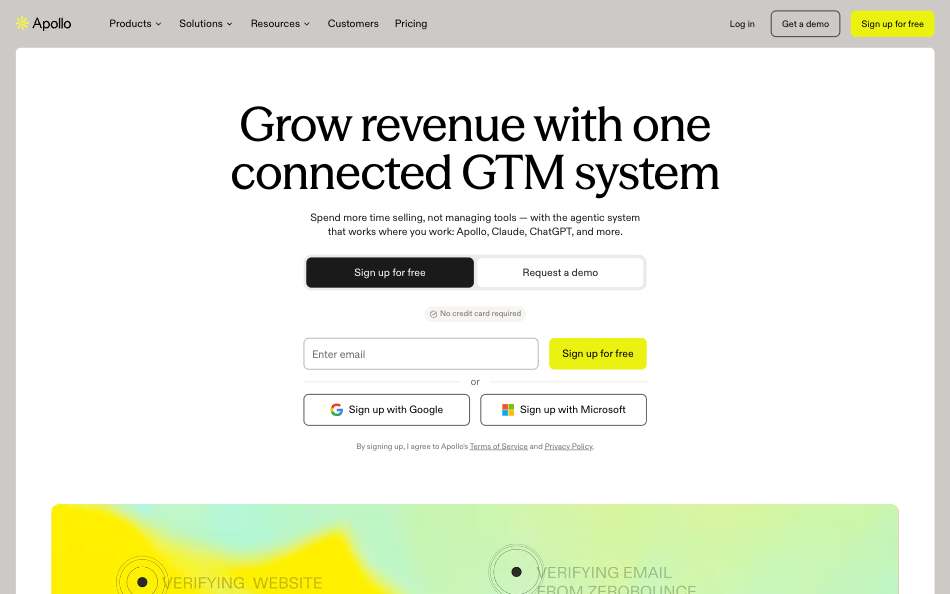
Apollo is a sales platform with a contact database attached. It lists 240M+ contacts and 30M+ companies, sequences, a dialer and a Chrome extension (Apollo MCP page, September 2026). It ranks last here because the pricing is built around seats, not volume.
Basic is $49 per seat a month with 30,000 credits a year. Professional is $79 with 48,000. Organization is $119 with 72,000 and a three-seat minimum, all billed annually (Apollo pricing, September 2026). An email costs 1 credit and a phone number 8. Unused credits expire each cycle.
The limits are workable. Enrichment endpoints allow 1,000 requests a minute on paid plans, and search allows 200 a minute and 50,000 a day, per team and not per key (Apollo docs, September 2026). The MCP server works on any plan and has its own limits. Apollo also says its plans are for internal business use only.
Pros
- Database, sequences, dialer and CRM sync in one tool.
- Enrichment at 1,000 requests a minute on paid plans.
- MCP server on every plan, with OAuth sign-in.
Cons
- Seats and credits both scale your bill, and credits expire each cycle.
- Rate limits are per team, so every key shares one counter.
- Internal use only, so you cannot build a product on it.
Best for: sales reps who prospect and send from one workspace.
Pricing: Free. Basic $49, Professional $79, Organization $119 per seat a month, billed annually (Apollo pricing, September 2026).
Comparison table
| Tool | Best for | Starting price | Cost at 1M records a month | API | MCP | Rate limit |
|---|---|---|---|---|---|---|
| LeadOcean | API, agent and volume buyers | Free. Pro $499 a month | $499 flat. Fair use applies | REST on every plan. x-api-key | Yes. OAuth 2.1, 12 tools | 100 requests per second per key |
| BlitzAPI | Flat-price search by API | Core $399 a month | $499 on Plus | REST. Emails from Plus | Docs only | 50 per second for accounts opened by September 30, 2026. Standard 5 |
| Crustdata | Live data for agents | No public price list | No public price per credit | REST | Yes. OAuth | 15 to 30 a minute by default |
| Explorium | Signals and prospect data | Lite $29.99 for 500 credits | About $30,000 | REST | Yes. API key, 11 tools | 200 queries a minute per key |
| FullEnrich | Waterfall emails and mobiles | Pro from $29 a month | No public 1M price | REST on every plan | Yes. Search, enrich, export | 60 calls a minute. Bulk of 100 |
| People Data Labs | Data licences | Pro from $98 a month | No public 1M price | REST, bulk endpoints | None found in PDL's docs index | 1,000 a minute enrichment, 10 search |
| Apollo | Reps with a sequencer | Basic $49 per seat a month | $19,600 a month yearly, $24,750 monthly | REST, enrichment from Basic | Yes. Any plan | 1,000 a minute enrichment, 200 search |
Sources are linked in each tool section, all checked in September 2026. Vendors change plans often, so confirm on the pricing page before you buy. The 1M column is list price on email lookups where a plan sells that volume. Apollo is 400 Basic seats at $49 on yearly billing, or 250 Professional seats at $99 on monthly billing. Explorium uses the Scale credit price at 2 credits an email. FullEnrich sells no public plan at 1M, so its cell says so, and its top public tier is 100,000 credits for $3,500 a month ($0.035 a credit). PDL has no public 1M price, so its cell gives the Pro per-profile range.
How to choose
- You pull data in code or with an agent, at volume: LeadOcean. One flat price, REST and MCP on every plan, 100 requests per second.
- You want a flat-price API from a second vendor: BlitzAPI Plus, if you can live with a docs-only MCP server.
- You need fresh signals and company events: Crustdata, with a rate-limit conversation first.
- You want events and intent next to people data: Explorium, and budget credits in packs.
- You need waterfall emails and mobiles: FullEnrich, and budget 10 credits per mobile.
- You need compliance paperwork or a licensed dataset: People Data Labs.
- Your reps live in the tool: Apollo.
- You need lookalike accounts: keep Ocean.io for that step and send the returned domains to a flat-price API.
Verdict
LeadOcean wins for developers who pull people and emails at volume. It has a flat price, 100 requests per second and an MCP server that returns records. BlitzAPI is the flat-price runner-up if you run your own code. Crustdata wins for live signals, Explorium for events and intent, and FullEnrich for waterfall mobiles. PDL wins for licensed datasets and Apollo for reps who want a sequencer. Stay on Ocean.io if lookalike search is the reason you bought it. Otherwise start on the free plan and compare the same lookups.
FAQ
Why do developers leave the Ocean.io API?
Rate limits and credit cost. Self-serve accounts get 60 requests a minute and 1,000 a day, and emails and phones arrive by webhook (Ocean.io docs, September 2026). Higher limits sit in an enterprise agreement.
What is the Ocean.io API rate limit?
60 requests a minute and 1,000 a day on self-serve (Ocean.io docs, September 2026). Reveal Emails takes up to 500 person IDs per request, so 1M emails is 2,000 requests, or two days at the daily limit (Ocean.io docs, September 2026). Enterprise limits come from your contract.
What does the Ocean.io API cost at 1M records a month?
Ocean.io does not publish a price at that volume, and its pricing page blocked our fetch. One email found is 1 credit, so 1M emails is 1,000,000 credits (Ocean.io docs, September 2026). Ocean.io does not publish plan prices or a price per credit, so ask its sales team for a quote at your volume.
Does Ocean.io have an API and an MCP server?
Both. The API has 25 endpoints, and the MCP server has 8 tools and connects with a token in the URL (Ocean.io docs, September 2026). MCP calls spend credits at the REST rate. The docs say API tokens inherit the permissions of the subscription plan, and they do not say which plan first includes API access (Ocean.io docs, September 2026). Ocean.io does not publish which plan includes API access, so confirm it with sales before you buy.
Can I use LeadOcean with Ocean.io?
Yes. Run a lookalike search on Ocean.io, keep the returned domain of each match, and call GET /v1/companies/{domain}/people on LeadOcean. Then enrich the people you want with reveal_email. You skip Ocean.io's reveal credits and the webhook.
Do I need a credit card to try LeadOcean?
No. The free plan needs a work email and no card. It gives you 1,000 records, one-off, with the same API and MCP server as Pro. See pricing.
Related: LeadOcean vs Ocean.io, Ocean.io alternatives, Wiza API alternatives, UpLead API alternatives, Snov.io API alternatives, pricing.
Replace Ocean.io's credit meter with one flat-price API. Start free.
Free to start. No credit card. 1,000 records to spend whenever you like.
Get your free API key →